Quantum biology is the study of whether living things use delicate quantum effects, such as coherence, tunnelling and electron spin, as a genuine functional tool rather than by accident. It is a real and active area of science, and it is also one of the most overhyped topics in popular writing, where plants and birds are casually described as quantum computers.
This guide takes the honest path. It separates what is genuinely established from what is still contested or frankly speculative, corrects the famous myth that photosynthesis proves room-temperature quantum coherence, and explains where quantum biology really connects to quantum computing. The short version is that the field is fascinating, but the strongest claims are the ones that have been quietly walked back.
All chemistry is quantum, that is not the claim. Quantum biology asks the harder question of whether life exploits fragile effects like coherence and spin as a selected advantage.
No case is fully proven. There is not yet a single example proven to use a delicate quantum effect functionally in a living organism, though several are promising.
The photosynthesis myth is broken. The famous 2007 result was at minus 196 degrees Celsius, and the long-lived signals are now read as vibrational, not functional electronic coherence.
Bird navigation is the best case. The radical-pair compass has strong laboratory support but has not been proven inside a living bird.
It does not build quantum computers. Living systems are not quantum computers, and quantum biology inspires rather than engineers the technology.
- What quantum biology actually means
- Why the field is both real and overhyped
- The photosynthesis coherence that turned out to be vibrations
- How birds may use quantum spin to navigate
- Quantum tunnelling inside enzymes
- The contested quantum theory of smell
- Proton tunnelling and DNA mutations
- What counts as established, contested or speculative
- Does quantum biology help build quantum computers
- Where the science goes next
- Frequently asked questions
What quantum biology actually means
Everything in biology is quantum mechanical at the deepest level, because chemical bonds and molecular structure obey quantum rules. That much is trivially true and is not what the field is about. Quantum biology asks the sharper question of whether life exploits the delicate side of quantum mechanics, the fragile coherence, entanglement and tunnelling that are hard to sustain in a warm, wet, noisy cell.
This distinction is the whole game, and confusing the two is the source of most hype and most dismissal alike. The interesting claim is not that a leaf contains electrons, but that a leaf or a bird might use a subtle quantum effect as a selected biological function. Keeping those two ideas apart is the first step to understanding quantum biology honestly.
Why the field is both real and overhyped
Quantum biology is a legitimate research area with reviews in journals such as Nature Physics, and serious groups work on it around the world. It is also young, contested and has a documented history of overclaiming, where a striking laboratory signal becomes, a few popularisations later, a settled fact about how nature works. Both things are true at once.
The honest summary is that quantum biology asks whether life uses quantum tricks, and for most proposed cases the answer is that quantum effects are present but a proven functional role is still open. That is a genuinely interesting place for a field to be, and it is very different from the confident headlines that plants and birds have solved quantum engineering.
The photosynthesis coherence that turned out to be vibrations
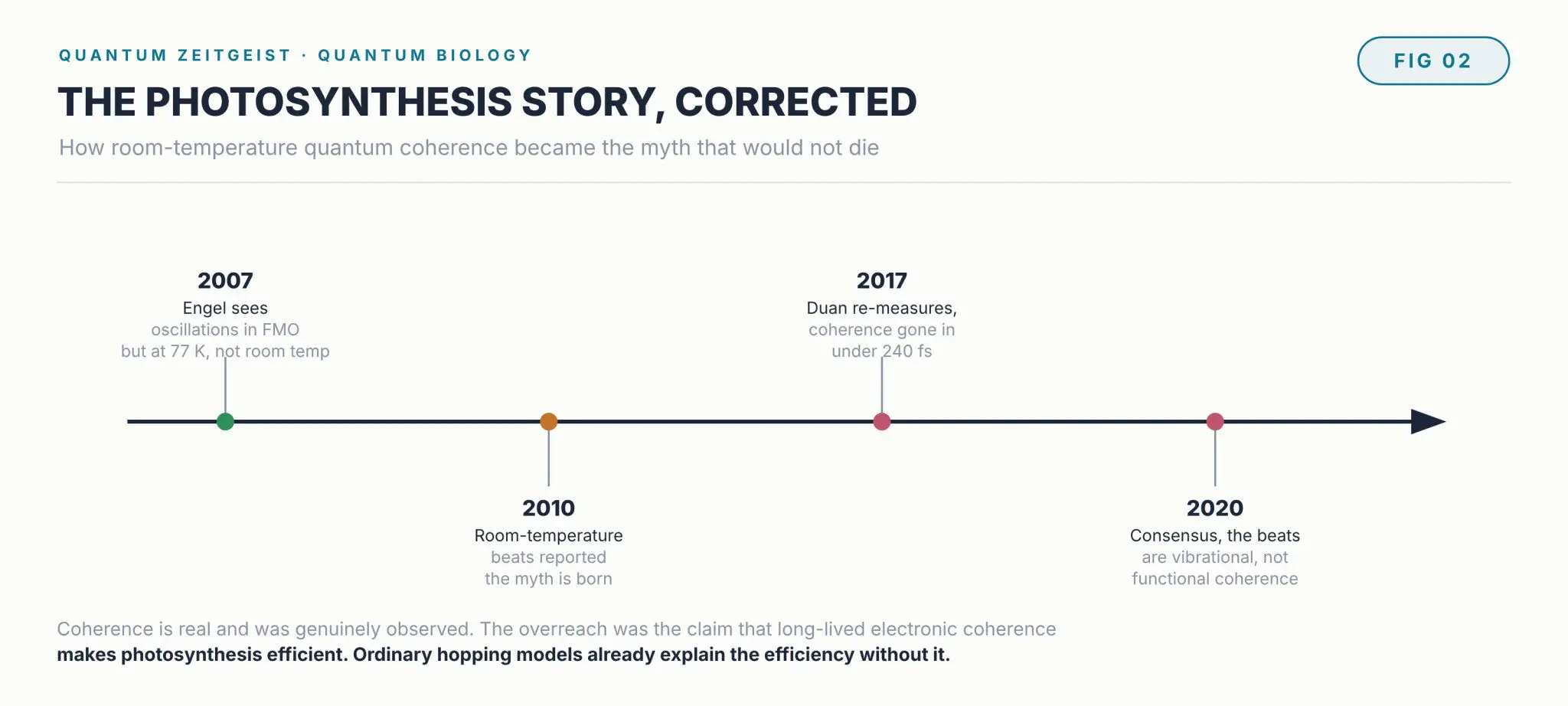
In 2007 Gregory Engel and colleagues used a laser technique on a light-harvesting protein and saw oscillating signals that they read as evidence of wavelike quantum energy transfer. The detail almost every popular account drops is that this experiment was run at about 77 kelvin, roughly minus 196 degrees Celsius, not at room temperature. Later work reported similar oscillations closer to physiological temperature, and the room-temperature quantum coherence story was born.
Since around 2017 the primary literature has substantially walked that story back. When Duan and colleagues re-measured the system under realistic conditions, the purely electronic coherence decayed within a fraction of a picosecond, and the long-lived beats that remained were attributed to vibrations in the molecule rather than to functional quantum coherence. The current mainstream view is that long-lived electronic coherence is not the reason photosynthesis is efficient, and ordinary hopping models already account for that efficiency. A small live debate continues, but the confident claim that plants compute with room-temperature coherence is not supported.
How birds may use quantum spin to navigate
The strongest and most physically credible case in quantum biology is the magnetic compass of migratory birds. The leading idea, the radical-pair mechanism, proposes that blue light creates a pair of molecules with correlated electron spins inside a protein called cryptochrome in the bird’s eye, and that the Earth’s weak magnetic field nudges the balance between two spin states. This is genuine quantum spin chemistry, well established as physics in its own right.
In 2021 a team showed that cryptochrome-4 taken from a migratory European robin is indeed magnetically sensitive in the test tube, and more so than the same protein from non-migratory birds. That is strong support, but it is not proof that the mechanism actually drives the compass inside a living bird, where the effects are small and hard to isolate. The radical-pair compass is best described as the leading hypothesis, backed by good laboratory evidence and still awaiting proof in the wild. It is closely tied to the physics of quantum entanglement and spin coherence.
Quantum tunnelling inside enzymes
The most solid quantum effect in biology is tunnelling in enzymes. Many enzymes move hydrogen from one place to another far faster than classical physics allows, and the tell-tale signature, an unusually large sensitivity to swapping hydrogen for its heavier isotope, is clear evidence that the particle tunnels through an energy barrier rather than climbing over it. This is the least controversial case because tunnelling is robust and does not need fragile coherence to survive.
What remains genuinely disputed is the stronger claim that enzymes have evolved special internal motions specifically to promote that tunnelling as a catalytic strategy. Some researchers argue the standard picture of enzyme catalysis, with a tunnelling correction added, explains the rates without any evolved quantum design. So the tunnelling itself is established, while the idea of tunnelling as a deliberately evolved trick is still an open argument.
The contested quantum theory of smell
One of the more colourful proposals in quantum biology is the vibration theory of smell, which suggests that olfactory receptors detect a molecule’s vibrational frequencies through electron tunnelling, rather than only recognising its shape. It is an ingenious idea and it made testable predictions, notably that swapping hydrogen for a heavier isotope should change how a molecule smells.
The prediction was tested directly, and it failed. In 2015 a study of a human musk receptor found that it did not distinguish a molecule from its heavier isotope version, which is the opposite of what the vibration theory requires. The mainstream olfaction field does not accept the vibration theory, and shape-based recognition remains the standard view. This one belongs firmly in the rejected column.
Proton tunnelling and DNA mutations
A long-standing speculative idea, going back to Per-Olov Löwdin in the 1960s, is that a proton could tunnel across one of the hydrogen bonds holding a DNA base pair together, shifting the base into a rare form that could be misread during copying and so cause a mutation. Recent computer models, including a 2022 open quantum systems study, find that this tunnelling can indeed create the rare forms much faster than classical hopping would.
The honest caveat is that these are theoretical and computational results showing the effect is possible, not evidence that it drives real mutation rates in living cells, where copying fidelity and repair machinery dominate the observed error rate. It is a respectable and intriguing mechanism, but for now it is a plausibility argument rather than a demonstrated biological cause.
What counts as established, contested or speculative

Laying the five headline cases side by side makes the real state of quantum biology clear. Enzyme tunnelling is established, bird navigation is a strong but unproven hypothesis, the photosynthesis coherence claim has been reinterpreted, DNA proton tunnelling is speculative, and the quantum theory of smell has been rejected. Not one of them is yet a proven, evolved use of a fragile quantum effect in a living organism.
That verdict is not a criticism of the field, it is the field being done properly. Quantum biology is most credible precisely when it resists the temptation to declare victory, and the honest tally above is more useful than any confident headline.
Does quantum biology help build quantum computers
This is where a quantum computing publication has to be especially disciplined, because it is the most hyped junction of all. The honest headline is that quantum biology does not help build quantum computers, and living systems are not quantum computers. Photosynthesis is not computation, and a microsecond of spin coherence in a bird’s eye is not a controllable, error-corrected qubit.
The real connection runs the other way and is more modest. The mathematics of open quantum systems and decoherence, developed for quantum optics and quantum computing, is exactly the toolkit that lets researchers frame and test claims about coherence in biology. The survival of spin coherence in a warm protein is also of genuine interest to people building room-temperature spin sensors, as inspiration and a benchmark rather than a blueprint. In the long run, quantum computers may even become a tool for simulating these biological quantum dynamics, the reverse of the usual hype.
Where the science goes next
The open questions in quantum biology are sharper than the headlines suggest. The field needs proof that the bird compass works through spin chemistry inside a living animal, a resolution to the argument over whether enzymes evolved to promote tunnelling, and better ways to tell functional quantum effects apart from incidental ones in the warm chaos of a cell.
Progress will come from more careful experiments and from using quantum simulators to model biomolecules directly. The likeliest future is not that life turns out to be a hidden quantum computer, but that a small number of quantum effects earn a proven, modest functional role while the grander claims are retired. That would be a real and satisfying result, and it is the outcome the evidence currently points towards.
Frequently asked questions
What is quantum biology in simple terms
It is the study of whether living things use delicate quantum effects, such as coherence, tunnelling and electron spin, as a real functional tool. It is different from the trivial fact that all chemistry is quantum. The open question is whether life exploits the fragile quantum effects that are hard to keep alive in a warm cell.
Is quantum biology real or pseudoscience
It is real, legitimate science, with peer-reviewed reviews and serious research groups. It is also young and has a history of overclaiming. The balanced view is that quantum effects are present in several biological systems, but a proven functional role has not yet been demonstrated for any of them.
Does photosynthesis use quantum coherence
Not in the way the popular story claims. The famous 2007 experiment was run at about minus 196 degrees Celsius, and the long-lived signals seen later are now attributed to molecular vibrations, not functional electronic coherence. Ordinary energy-hopping models already explain why photosynthesis is efficient.
Do birds really navigate using quantum mechanics
Possibly, and it is the strongest case in the field. The radical-pair mechanism, using electron spins in a protein called cryptochrome, is the leading hypothesis and has good laboratory support, including a 2021 study of the European robin. It has not yet been proven to operate inside a living bird.
What is the most solid example of quantum biology
Quantum tunnelling in enzymes. Many enzymes move hydrogen by tunnelling through an energy barrier, shown by their unusual sensitivity to heavier isotopes. The tunnelling itself is well established, though whether enzymes evolved to promote it is still debated.
Can we smell using quantum effects
Almost certainly not. The vibration theory of smell, which proposed that receptors sense molecular vibrations through electron tunnelling, failed a direct test in 2015 and is not accepted by the olfaction field. Shape-based recognition remains the standard explanation.
Does quantum biology mean living things are quantum computers
No. Living systems are not quantum computers, and no biological process performs computation using controlled qubits. Biological quantum effects are short-lived and uncontrolled, and there is no route from them to a gate-based quantum processor.
Who founded quantum biology
The ideas go back to physicists such as Pascual Jordan and Erwin Schrödinger in the early twentieth century, with Per-Olov Löwdin proposing DNA proton tunnelling in the 1960s. The modern field took shape in the 2000s around photosynthesis experiments and a widely cited 2013 review of quantum biology in Nature Physics.




See today’s quantum computing news on Quantum Zeitgeist for the latest breakthroughs in qubits, hardware, algorithms, and industry deals.