A quantum-secure framework for cash withdrawals replaces traditional bank cards with non-copyable quantum tokens, offering a new defense against financial crimes. Vineet Kumar of Charles University and the Center for Quantum Engineering and Science proposes integrating token generation, authentication and verification directly into existing banking systems using quantum control techniques.
This approach aims to mitigate card cloning, credential theft, and counterfeiting, vulnerabilities that currently threaten the approximately 2.9 million ATMs operating globally in 2024. In India alone, around 250,000 ATMs were in operation at the end of financial year 2025, with public sector banks controlling over half of that network.
Quantum Tokens Replace Cards for Secure Withdrawals
The proposed quantum system uses three classes of qubits, response, reference and support, to construct a quantum token, a foundational element for secure transactions. These qubits, designated as S, R, and A, are combined to create a token with a total of N qubits, where N equals the sum of the number of qubits in each class (p + q + r). This design allows for the preparation of a raw quantum token through a specific process detailed in the framework, using the principles of quantum mechanics to ensure security.
The system’s architecture moves away from storing coherent quantum states within cards for extended periods, a vulnerability in current card technology. These machines, with public sector banks controlling 53.19% of the network, are susceptible to financial crimes exploiting the copyable nature of traditional credentials.
The proposed solution aims to prevent duplication, detect credential theft through state disturbance, and render counterfeiting physically infeasible without access to the bank’s secret token preparation parameters. This approach moves beyond simply encrypting data. It fundamentally alters the nature of the credential itself, making it impossible to replicate perfectly. The core innovation lies in generating quantum tokens on demand at the ATM terminal, guided by instructions from the bank, rather than pre-storing them on a card. This on-demand generation is critical, as it circumvents the challenges associated with maintaining quantum coherence over extended periods.
The system incorporates basis randomization, a standard technique in quantum token design, and a hash-based approach that adds a cryptographic fingerprint derived from a token-specific serial number. “The proposed NV-center implementation suggests that such a framework is compatible with experimentally demonstrated room-temperature quantum control techniques,” the authors state, indicating a pathway towards practical realization using existing technology. The research team envisions a Quantum Teller Machine (QTM) ecosystem, comprised of a QTM card serving as the physical platform for quantum token preparation and a QTM terminal responsible for quantum operations and transaction verification.
This system replaces reproducible classical credentials with non-copyable quantum tokens for authentication, a key distinction from current security measures. While 2.9 million ATMs operated globally in 2024, despite the increasing popularity of digital payments, the continued reliance on physical cash access highlights the broad potential impact of a solution addressing ATM security.
The framework’s design is not merely theoretical. It is grounded in experimentally motivated quantum control techniques, suggesting a feasible path toward implementation. Future work will focus on experimental implementation, protocol optimization and the development of scalable quantum banking infrastructures. The authors believe this work may inspire the practical development of quantum-secure financial systems, moving beyond incremental improvements to a fundamentally more secure architecture. Continued advances in solid-state quantum hardware are expected to facilitate the realization of this vision, offering a long-term solution to the persistent threat of financial fraud.
ATM System Vulnerabilities and Classical Data Reliance
The standard ATM transaction relies on a predictable sequence of classical data exchange, beginning with a card read operation that deterministically copies stored information. This initial step, denoted as Read(·) in the presented framework, creates an inherent vulnerability as the card details, encompassing the card number Nu, cardholder name Na and validity period from Ti to Tf, are readily replicated. The protocol detailed in the research replaces this process with a quantum token system, fundamentally altering how authentication occurs at the point of sale.
The existing system then prompts for a personal identification number (PIN), P, which is encrypted before transmission to the bank alongside a subset of the card details, represented as ATM → Bank:C′,E(P). Verification hinges on matching the card number Nu against a bank database D, and subsequent processing of the encrypted PIN within a secure cryptographic device.
This reliance on centralized databases and classical encryption methods introduces systemic risks, as a compromise of either element could facilitate widespread fraud. The framework’s design incorporates encoding cryptographic data specified by the bank into a nearby ^(13)C qubit, binding the token state to transaction-specific parameters. This phase encoding, implemented through a virtual Z-gate, imprints bank data onto the qubit, creating a unique, non-reproducible quantum token.
The system’s security stems from the principles of quantum mechanics; any attempt to copy or intercept the quantum token would inevitably alter its state, rendering it invalid and preventing unauthorized access. The conceptual basis for this system uses an NV-center in diamond, using the electron-spin qubit q1 coupled to carbon and nitrogen nuclear-spin qubits q2 and q3.
QTM Ecosystem: Card and Terminal Components
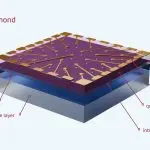
The physical realization of this quantum security framework relies on a diamond chip measuring 3.0 mm x 3.0 mm, fabricated from single-crystal diamond with a typical nitrogen-vacancy (NV) center density of 4.5 ppm. This material is the foundation for the QTM card, the platform for generating quantum tokens, and is specified to exhibit a spin dephasing time of 0.5 μs and a spin coherence time of 10 μs.
These characteristics are critical for maintaining the quantum state long enough for secure transaction verification. The QTM terminal, designed to interact with the card, can be implemented either as a dedicated experimental setup or integrated into existing ATM infrastructure as a rack-mounted control system. The terminal’s functionality extends beyond simple card reading; it incorporates laser sources, optical modulators and detectors to facilitate the preparation, manipulation, and measurement of quantum states.
This integration transforms a conventional ATM into a QTM, capable of generating and authenticating quantum tokens on demand. This layered approach enhances security by adding an extra layer of protection against potential attacks. The generated tokens are not stored within the card for extended periods, unlike current magnetic stripe or chip-based cards. Instead, they are created by the terminal itself, guided by instructions from the bank, immediately before the transaction.
This on-demand generation mitigates the risk of long-term quantum state decoherence and prevents potential interception or duplication of stored tokens. The bank’s demand, represented by the operation = H, is physically implemented by applying a microwave π/2 pulse to drive transitions between the electron-spin sublevels. The system uses the unique properties of the carbon-13 nucleus within the diamond lattice.
When the electron is prepared in the | = 0⟩ state, the carbon-13 nucleus experiences minimal hyperfine-induced frequency shifts, allowing it to evolve predictably under an external magnetic field. However, when the electron is in the | = -1⟩ state, the hyperfine interaction causes a shift in the precession frequency, creating a distinguishable quantum state. This subtle difference is key to the authentication process, enabling the terminal to verify the token’s integrity.
The design of the QTM terminal accounts for the practical challenges of integrating quantum technology into existing financial infrastructure. The system is not envisioned as a complete replacement of current ATMs, but rather as an upgrade to existing machines, adding the necessary quantum control components. This approach minimizes disruption and allows for a phased implementation, starting with high-security applications and gradually expanding to broader deployment. The ability to generate secure, non-copyable quantum tokens on demand represents an advancement in ATM security, addressing vulnerabilities inherent in classical credential systems.
NV-Center Spin Qubits Enable Token Realization
The physical realization of quantum tokens for secure banking relies on precise control of electron and nuclear spins within diamond, a material chosen for its unique quantum properties. The system uses a 3.0 mm single-crystal diamond containing nitrogen-vacancy (NV) centers at a density of 4.5 parts per million, enabling extended spin coherence times of up to 10 microseconds. A raw quantum token is then prepared by applying specific transformations to each qubit, using bases selected from the computational and diagonal | + states.
This preparation process establishes the unique quantum state that represents the token’s cryptographic fingerprint. The authors selected (p,q,r) = (1,1,1) for illustrative purposes, employing the Hadamard (H) and identity (I) transformations to define the qubit states. The system’s architecture uses the interplay between the electron spin of the NV center and the nuclear spins of surrounding carbon-13 and nitrogen-14 atoms.
While measured signatures may not be identical over extended use, they are expected to remain sufficiently distinguishable for reliable identification. A similarity function, S(F_t,F_0), and a predefined acceptance threshold, τ, determine whether a card is accepted based on the comparison between the current signature (F_t) and the enrolled signature (F_0). The implementation details reveal a sophisticated approach to quantum control.
Before token preparation, the electron spin is initialized to the | = 0⟩ state using optical pumping with a 532 nm laser. This initialization is a critical step, ensuring a consistent starting point for the subsequent qubit manipulations.
The QTM terminal itself can be realized as either a dedicated experimental platform or a rack-mounted control system, providing the necessary capabilities for token generation and authentication. The potential impact of this technology extends beyond the 250,000 ATMs currently operating in India, as of the end of the 2025 financial year.
QTM Protocol for Token Generation and Authentication
The system’s design incorporates a QTM card embedding a quantum chip, replacing conventional ATM card chips for token management, and a QTM terminal capable of generating, authenticating, and verifying these quantum tokens. This modularity allows for adaptation to existing ATM infrastructure, minimizing disruption during deployment and maximizing compatibility with current banking workflows. Two levels of token construction are considered within the framework, using different qubit classes to enable flexible cascaded encoding architectures and enhance token security.
The standard token is represented as Uk|φ⟩, with Uk being a secret encoding operator alongside parameters (p,q,r) and Ub, while an upgraded reference class is denoted as *|ω⟩*. The system’s security is further bolstered by the potential incorporation of entangling gates to generate entangled token states, adding an additional layer of authentication and strengthening the overall protocol.
Verification occurs through projective measurements performed by the bank, comparing observed outcomes with expected responses; agreement within a defined tolerance authenticates the token, while deviations trigger rejection. Alternative quantum measurement and verification strategies are also possible, tailored to the specific hardware platform and implementation requirements. The motivation behind this approach stems from vulnerabilities in existing systems, where the copyable nature of classical credentials enables adversaries to duplicate card information, steal credentials and counterfeit user credentials.
This framework directly addresses the risk of authentication-related financial crimes by replacing reproducible classical credentials with quantum tokens, using the principles of quantum money and the quantum no-cloning theorem. The researchers envision a system where the QTM card is the physical platform for realizing quantum tokens, while the QTM terminal performs the necessary quantum operations for secure transactions.
👉 More information
🗞 Quantum banking system for secure cash withdrawal
✍️ Vineet Kumar
🧠 ArXiv: https://arxiv.org/html/2611.03706v1




See today’s quantum computing news on Quantum Zeitgeist for the latest breakthroughs in qubits, hardware, algorithms, and industry deals.