Nu Quantum proposes a shift in quantum computing architecture, envisioning a network of processors operating as a single distributed computer. Pointing to parallels with how modern artificial intelligence systems overcome limitations of single processors. The company’s aims to connect physically separate quantum processing units through shared entanglement, allowing them to bypass the physical constraints of building ever-larger chips. This approach mirrors the “scale-out” strategy used in frontier AI models requiring resources exceeding a single GPU rack.
Nu Quantum’s Entanglement Fabric for Distributed Quantum Computing
Nu Quantum is developing an Entanglement Fabric, a networking infrastructure designed to establish entanglement between qubits residing in physically separate quantum processing units. This approach aims to allow those processors to function as components of a single, distributed computer.
Carmen Palacios-Berraquero. The core challenge, according to Palacios-Berraquero, is not merely adding more qubits but overcoming physical limitations as systems grow; “But as you start to scale, you start to reach physical limits.” Nu Quantum’s solution is a “scale-out” strategy, mirroring advancements in artificial intelligence where computational demands exceeding a single GPU rack are met by networking multiple units.
This parallels how frontier AI models overcome the limitations of single processors, but the scaling challenge is, according to Palacios-Berraquero, as fierce, if not more, than in AI. The company prioritizes entanglement rate and fidelity as critical link-level metrics, diverging from traditional bandwidth measurements used in classical networking. Nu Quantum calls its answer the Entanglement Fabric: networking infrastructure intended to create entanglement between qubits in physically separate quantum processing units so that those processors can operate as parts of one distributed computer.
Future iterations will transition to a chip-based interface compatible with commercial quantum charge-coupled devices, enabling ion shuttling between processing and networking zones, and wafer-scale cavity fabrication. Beyond the physical interfaces, a complete network stack is envisioned, encompassing fan-in/fan-out switching systems, tightly integrated quantum and classical control systems, precise time synchronization and a real-time orchestrator to manage entanglement distribution across the network.
The company is deliberately pursuing a modality-agnostic approach, demonstrated by a collaboration with Atom Computing to integrate Nu Quantum’s photonic networking hardware with Atom’s neutral-atom processors, the company says. This partnership focuses on photonic switches, qubit-photon entanglement interfaces and distributed fault-tolerant architectures for scaling neutral-atom systems. Nu Quantum intends to adapt its quantum photonic interfaces to various qubit types, modifying its networking units to accommodate differing wavelengths and rates.
This abstraction layer, where higher-level software doesn’t require detailed knowledge of individual processors, is a long-term architectural goal. Nu Quantum’s $60 million Series A funding round in December 2025 is supporting the Entanglement Fabric roadmap, international expansion and the growth of its multidisciplinary engineering team. The company’s vision extends beyond simply connecting quantum computers. It aims to build the foundational layer of a quantum data center, enabling a future where distributed quantum resources operate smoothly as a unified computational system.
The network allows you to scale not only in numbers of qubits, but also in circuit depth.
Dr. Carmen Palacios-Berraquero
Physical Limits of Qubit Scale-Up Drive Networking Approach
Nu Quantum is targeting photon-extraction efficiencies of 40% to 70% for its Qubit-Photon Interface, a figure significantly higher than the approximately 2% achievable with standard collection optics. This focus on efficient interfaces is critical, as photon loss at the processor level immediately halts entanglement transmission regardless of downstream network sophistication. The company’s work with trapped ions represents its most mature implementation of this networking hardware, with a dedicated laboratory opened in Cambridge earlier in the year to facilitate testing against ion-based quantum systems.
Nu Quantum calls its answer the Entanglement Fabric: networking infrastructure intended to create entanglement between qubits in physically separate quantum processing units so that those processors can operate as parts of one distributed computer. Simulations published in June demonstrated the potential for recovering quantum information even with the complete failure of an individual quantum processing unit, or QPU node. This capability moves beyond simply increasing qubit count. It suggests a path toward more reliable and continuously available quantum computing resources.
The potential for abstraction is another key driver of Nu Quantum’s approach. The company envisions a network layer that shields higher-level software from the intricacies of individual processors, presenting a unified, larger computational resource. This abstraction, she argues, is vital for simplifying quantum programming and enabling more complex algorithms. While scaling qubit numbers remains a primary focus for many developers, Nu Quantum’s work acknowledges the inherent physical limitations of this approach.
Miniaturization and manufacturing are central to realizing this vision. This adaptability supports interoperability and creates a truly heterogeneous quantum network. Nu Quantum calls its answer the Entanglement Fabric: networking infrastructure intended to create entanglement between qubits in physically separate quantum processing units so that those processors can operate as parts of one distributed computer.
The network allows you to scale not only in numbers of qubits, but also in circuit depth.
Dr. Carmen Palacios-Berraquero
Entanglement Rate and Fidelity Define Network Performance
Nu Quantum benchmarks network performance not by raw bandwidth, but by the rate and fidelity of entanglement, critical metrics for establishing functional links between quantum processing units. Entanglement rate dictates how often viable connections can be created, while fidelity quantifies how closely those links match the ideal quantum state. Both must surpass thresholds to avoid negating the benefits of distributed computing.
The company’s prior modeling suggests interconnect fidelity around 99. 5% may be adequate for certain fault-tolerant architectures, a target achieved through sparse photonic networks rather than direct qubit-to-qubit connections. These figures represent subsystem goals, not complete end-to-end performance, but highlight the importance of the interface itself. A lost photon at the processor level cannot be recovered downstream, regardless of networking sophistication.
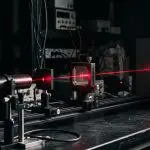
A recently unveiled 19-inch rack-mounted prototype connects four trapped-ion processor nodes, designed for adaptability to future qubit modalities. Nu Quantum reports that its optical path introduces less than 0. 3% Bell-state measurement error, contributing to a maximum remote-entanglement fidelity of up to 99. 7%. The controller operates with approximately 300-nanosecond latency and supports entanglement attempts at megahertz rates. While this 99. Beyond simply connecting two processors, a truly scalable distributed quantum computer requires a complete network stack, termed the.
This architecture is not solely about increasing qubit count. It also enhances system availability and allows for the execution of deeper circuits. The ability to correct for errors introduced during entanglement is also paramount.
Palacios-Berraquero explained that network-induced failures can be treated as errors correctable through established quantum error correction techniques. This approach allows the system to maintain coherence and reliability even as the network scales, according to Nu Quantum. The company’s long-term goal is to build a system where the network itself contributes to the overall robustness and computational power, enabling quantum computers to tackle problems currently intractable for even the most powerful classical machines.
It’s all about miniaturizing, and it’s about manufacturing.
Dr. Carmen Palacios-Berraquero
Qubit-Photon Interface Enables Networked Qubit Communication
The company’s approach uses optical microcavities surrounding the qubit emitter, directing a significantly larger proportion of photons into an usable optical mode for transmission. The architecture accommodates diverse qubit modalities, initially focusing on trapped ions while designing for future compatibility with other technologies. This progression towards wafer-scale cavity fabrication highlights a commitment to manufacturability and scalability, essential for building a functional Entanglement Fabric. The 19-inch rack-mounted prototype system connects four trapped-ion processor nodes, incorporating a real-time network orchestrator alongside the photonic dynamic-entanglement system.
This meticulous approach is necessary to minimize error accumulation as entanglement is distributed across the network. This capability is key for realizing a truly scalable distributed quantum computer, where the network itself contributes to overall robustness. The company’s long-term goal is to create “a distributed compute system that computes as one,” a vision of interconnected processors operating smoothly as a single, powerful unit.
She notes that simply adding more qubits to a single processor, or “scale-up,” eventually hits physical limits.
This creates a distributed compute system that computes as one.
Trapped Ions as First Implementation of Networking Hardware
Nu Quantum’s Cambridge laboratory houses the first dedicated industrial research and development facility for distributed trapped-ion quantum computing in the UK and Europe, a demonstration of the company’s commitment to scaling quantum processing beyond single processors. The facility, expanded in February 2026, focuses on testing networking hardware specifically with ion-based quantum systems, moving beyond architectural simulations toward tangible hardware solutions. This focus on trapped ions represents a deliberate first step in realizing the Entanglement Fabric, Nu Quantum’s proposed infrastructure for linking physically separate quantum processing units, the firm reports.
This Qubit-Photon Interface, or QPI is critical because qubits within a processor cannot directly travel through conventional networking infrastructure. The interface creates entanglement between the stationary qubit and the emitted photon, enabling remote quantum operations. This transition to wafer-scale cavity fabrication is a necessary step toward mass production and widespread deployment.
Manufacturing reproducibility is paramount, as a scalable network demands numerous interfaces fabricated consistently across many processor nodes, a point emphasized by Founder and CEO Carmen Palacios-Berraquero. While trapped ions currently is the most mature implementation of the Entanglement Fabric, Nu Quantum is intentionally designing a modality-agnostic network, capable of integrating with diverse qubit technologies. The partnership with Atom Computing aims to extend the reach of the Entanglement Fabric beyond trapped ions, positioning it as a universal networking layer rather than a technology tied to a single quantum computing approach.
Nu Quantum’s expansion extends beyond the UK, with growing teams in Spain and the United States, and a workforce now approaching 100 people. The company has also taken a leadership role in establishing the Quantum Datacenter Alliance, bringing together stakeholders from hardware and software to systems integration and data-center infrastructure. This industry-building effort reflects the core premise driving Nu Quantum’s technological development: that scaling quantum computing requires a fundamental shift in architecture, mirroring the “scale-out” strategies employed in modern artificial intelligence systems.
The scaling challenge is as fierce, if not more, than in AI.

See today’s quantum computing news on Quantum Zeitgeist for the latest breakthroughs in qubits, hardware, algorithms, and industry deals.