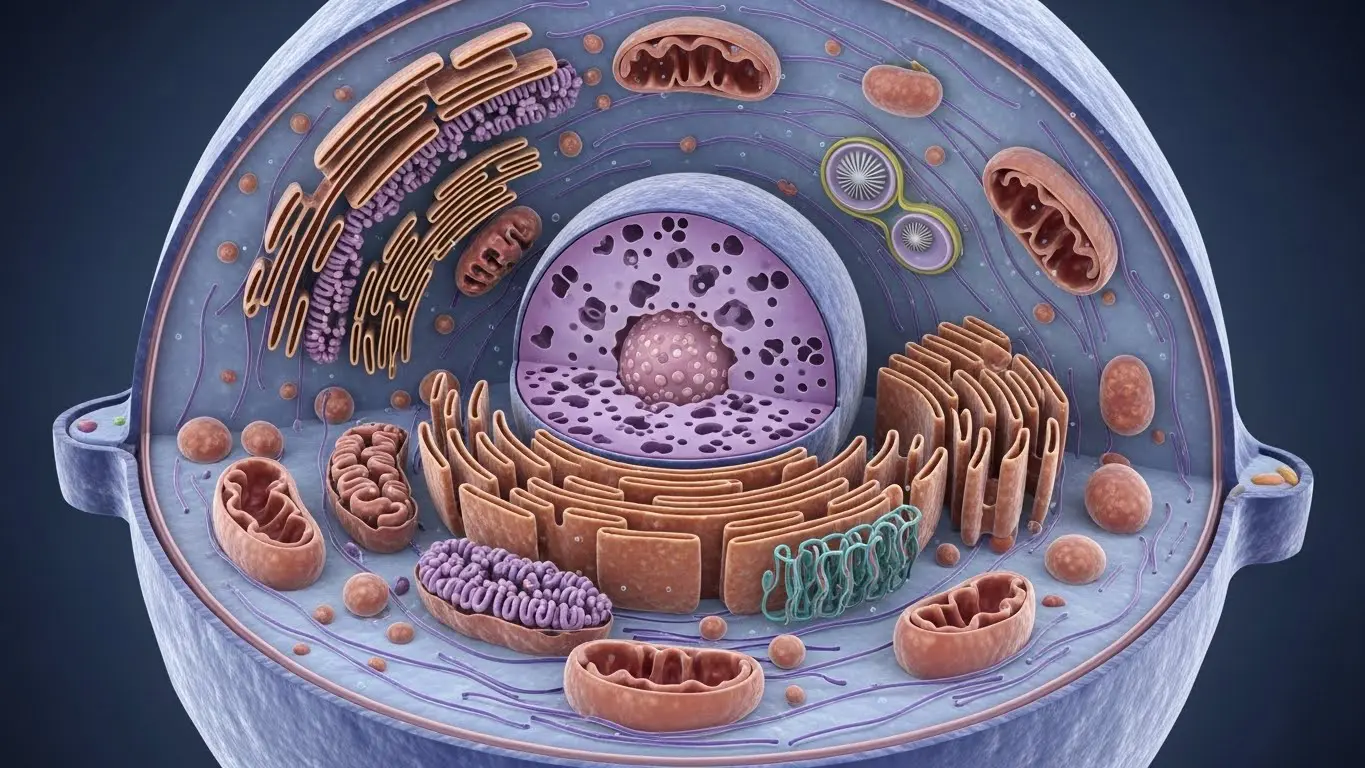
Non-equilibrium thermodynamics is the modern physical framework for understanding living systems, climate, and any other process that maintains order while exchanging energy and matter with its surroundings. This 2026 guide walks the discipline from Onsager’s 1931 reciprocal relations through Prigogine’s dissipative structures into the modern stochastic-thermodynamics era and the active-matter physics of biology.
Life, at its core, is a defiance of entropy. While the second law of thermodynamics dictates a relentless march towards disorder, living organisms maintain remarkable order, complexity, and functionality. This isn’t a violation of physics, but a masterful exploitation of non-equilibrium statistical mechanics, a field that explores systems driven far from equilibrium, where traditional thermodynamic descriptions break down. For decades, physicists considered equilibrium the natural state of matter, but the realization that life requires disequilibrium has spurred a revolution in our understanding of both biology and physics. This field, initially developed by physicists like Lars Onsager, who received the Nobel Prize in 1968 for his work on irreversible thermodynamics, provides the framework for understanding how living systems harness energy to create and maintain order. It’s a world where fluctuations aren’t just noise, but the very engine of innovation and adaptation. The foundations of non-equilibrium statistical mechanics were laid by Ilya Prigogine, a Nobel laureate and professor at the Free University of Brussels. Prigogine challenged the classical view of systems tending towards a uniform, stable equilibrium. He proposed that systems driven far from equilibrium can self-organize into what he termed “dissipative structures.” These structures, like Bénard cells, convection patterns formed in a heated fluid, maintain their order by continuously dissipating energy. Crucially, Prigogine demonstrated that these structures aren’t simply temporary deviations from equilibrium, but fundamentally new states of matter, exhibiting emergent properties not present in the individual components. This concept is profoundly relevant to biology, where complex structures like cells, tissues, and even organisms are maintained through constant energy flow and dissipation. The very existence of life, Prigogine argued, is a testament to the power of dissipative structures.From Thermodynamics to Information: The Role of Fluctuations
Traditional thermodynamics focuses on macroscopic properties, averaging out the chaotic dance of individual molecules. However, in non-equilibrium systems, fluctuations, random deviations from the average, become amplified and play a crucial role. These aren’t merely disturbances to be ignored; they are the seeds of change, the drivers of innovation. As Rolf Landauer, a physicist at IBM Research, established in 1961, erasing information requires energy dissipation. This connection between information and thermodynamics is central to understanding how living systems process information and respond to their environment. Fluctuations allow systems to explore different states, and if a fluctuation leads to a more stable, energy-efficient configuration, it can be amplified and sustained, leading to the emergence of new structures and behaviors. This is akin to natural selection at the molecular level, where beneficial fluctuations are favored and propagated.The Minimal Dissipation Principle and Biological Efficiency
Living systems aren’t just complex; they are remarkably efficient. They operate far from the theoretical limits of energy expenditure predicted by classical thermodynamics. This efficiency is explained by the minimal dissipation principle, a cornerstone of non-equilibrium statistical mechanics. This principle states that systems driven far from equilibrium will self-organize to minimize the rate of energy dissipation. In essence, organisms aren’t simply fighting against entropy; they are cleverly navigating the landscape of energy flow to minimize waste and maximize functionality. This principle is evident in everything from the streamlined shape of a fish to the intricate network of capillaries in our bodies, all designed to minimize resistance and maximize efficiency. Understanding this principle is crucial for bioengineering and the development of sustainable technologies.The Cytoplasm as a Condensate: A New View of Cellular Organization
For decades, the cytoplasm of a cell was viewed as a homogenous soup of molecules. However, recent research, heavily influenced by non-equilibrium principles, reveals a far more complex picture. The cytoplasm is now understood to be a highly organized, dynamic environment filled with membraneless organelles formed through a process called liquid-liquid phase separation. These condensates, akin to oil droplets in water, concentrate specific molecules, creating microenvironments that enhance reaction rates and regulate cellular processes. These condensates aren’t static structures; they are constantly forming, dissolving, and rearranging in response to cellular signals, driven by fluctuations and energy dissipation. This dynamic organization allows cells to rapidly adapt to changing conditions and perform complex tasks with remarkable efficiency.Active Matter and the Self-Propelled World of Microorganisms
Non-equilibrium statistical mechanics isn’t limited to passive systems; it also provides a framework for understanding “active matter”, systems that consume energy to drive their own motion. Microorganisms, like bacteria and algae, are prime examples of active matter. They don’t simply respond to external forces; they actively generate forces, creating collective behaviors that defy traditional physics. These organisms can self-organize into swirling patterns, form biofilms, and even exhibit collective decision-making. This behavior is driven by the interplay between individual motility, hydrodynamic interactions, and energy dissipation. Understanding the principles governing active matter is crucial for developing new materials with self-propelling capabilities and for controlling microbial communities.The Physics of Development: Shaping Form from Chaos
The development of an organism from a single cell is a breathtaking example of self-organization. How does a seemingly homogenous zygote give rise to the intricate complexity of a fully formed organism? Non-equilibrium statistical mechanics provides a powerful framework for understanding this process. Development isn’t a pre-programmed sequence of events, but a dynamic process driven by fluctuations, energy gradients, and feedback loops. Pattern formation, such as the development of limbs or the segmentation of the body, can be explained by reaction-diffusion systems, mathematical models that describe how interacting chemicals create spatial patterns. These patterns aren’t imposed from the outside; they emerge spontaneously from the interplay of local interactions and energy dissipation.The Role of Noise in Gene Expression: Beyond Deterministic Models
Traditionally, gene expression was viewed as a deterministic process, where genes are transcribed and translated into proteins with predictable accuracy. However, recent research reveals that gene expression is inherently noisy. Fluctuations in the number of mRNA molecules, ribosomes, and other cellular components lead to significant variations in protein levels, even among genetically identical cells. This noise isn’t simply a nuisance; it can be beneficial. It allows cells to explore different phenotypes, increasing their adaptability and resilience. Furthermore, noise can act as a switch, triggering different developmental pathways or enabling cells to respond to subtle environmental cues. David Deutsch, the Oxford physicist who pioneered quantum computing theory, has even suggested that quantum fluctuations may play a role in the initial stages of gene expression.Metabolic Networks as Dissipative Engines
Metabolism, the sum of all chemical reactions that occur within an organism, is a prime example of a non-equilibrium process. Living cells constantly consume energy to maintain their metabolic pathways, driving reactions that would otherwise be thermodynamically unfavorable. Metabolic networks aren’t simply linear pathways; they are complex, interconnected webs of reactions that exhibit emergent properties. These networks are optimized to minimize energy dissipation and maximize the production of essential biomolecules. Understanding the principles governing metabolic networks is crucial for developing new therapies for metabolic diseases and for engineering synthetic metabolic pathways. While non-equilibrium statistical mechanics provides a powerful framework for understanding biological systems, it also highlights the inherent limits of predictability. Many biological systems exhibit chaotic behavior, meaning that small changes in initial conditions can lead to dramatically different outcomes. This sensitivity to initial conditions makes it impossible to predict the long-term behavior of these systems with perfect accuracy. However, even in chaotic systems, there are underlying patterns and constraints. Non-equilibrium statistical mechanics allows us to identify these patterns and understand the system’s statistical properties, even if we cannot predict its exact trajectory. Gil Kalai, the Hebrew University mathematician known for quantum computing skepticism, often points out the inherent unpredictability of complex systems, emphasizing the need for probabilistic models rather than deterministic predictions. The principles of non-equilibrium statistical mechanics aren’t limited to biology. They are relevant to a wide range of physical phenomena, from the formation of galaxies to the dynamics of climate change. The universe itself is a far-from-equilibrium system, constantly evolving and dissipating energy. Understanding the principles governing non-equilibrium systems is crucial for unraveling the mysteries of the cosmos and for addressing some of the most pressing challenges facing humanity. The study of non-equilibrium statistical mechanics is not just a quest to understand life; it’s a quest to understand the fundamental laws that govern the universe itself.this approach 2026 Outlook
this framework entered 2026 as a vibrant field at the intersection of physics, chemistry, and biology. Stochastic thermodynamics has matured into a precise quantitative discipline, with the Jarzynski equality and Crooks fluctuation theorem now textbook results. The application to biological molecular machines has produced quantitative models of motor proteins, ATP synthase, and ribosomal translation that match single-molecule experiments. The Nature Physics review of modern the discipline documents the modern formulation.this approach And Living Systems
Living systems are the canonical the field application. A cell maintains low internal entropy by exporting heat and chemical waste to its environment, with continuous metabolic energy flow. Modern Non-equilibrium thermodynamics can quantitatively describe how this works at the molecular level: the efficiency of motor proteins, the precision of biochemical signalling, and the energy cost of biological computation are all calculable from first principles within the framework. Non-equilibrium thermodynamics is biology’s deepest physical foundation.Non-equilibrium thermodynamics Of Computation
The Non-equilibrium thermodynamics of computation, building on Landauer’s principle, has become a major subfield. Erasing a bit of information requires dissipating at least kT log 2 of heat, and modern stochastic thermodynamics extends this to compute the minimum energy cost of arbitrary computational protocols. Practical implications include the energy efficiency of biological vs silicon computation, with current biological brains operating closer to the Non-equilibrium thermodynamics bound than current digital computers.What Comes Next
By 2030 the field expects mature Non-equilibrium thermodynamics treatments of active matter, complete energy budgets for major biological processes, and rigorous Non-equilibrium thermodynamics foundations for machine learning and AI training. The Non-equilibrium thermodynamics of climate, applied to coupled atmosphere-ocean dynamics, is also a fast-moving subfield. Non-equilibrium thermodynamics has moved from a specialist’s discipline to a foundational framework that touches biology, computation, and Earth science.Non-equilibrium thermodynamics FAQ
What is Non-equilibrium thermodynamics?
Non-equilibrium thermodynamics is the branch of thermodynamics that describes systems exchanging energy or matter with their surroundings rather than sitting at equilibrium. Most real systems, including all living organisms, weather systems, and engineered devices like engines and refrigerators, fall under Non-equilibrium thermodynamics. The discipline provides quantitative tools to describe how such systems maintain order, dissipate energy, and produce entropy. Non-equilibrium thermodynamics extends and complements the equilibrium thermodynamics taught in introductory physics.
How does Non-equilibrium thermodynamics apply to living systems?
Living systems are the canonical Non-equilibrium thermodynamics examples. A cell maintains its low internal entropy by continuously exporting heat and chemical waste to its environment, powered by metabolic energy flows. This violates no physics: the second law of thermodynamics requires the entropy of the universe to increase, but allows a local system to maintain or decrease its entropy as long as the environment’s increases more. Non-equilibrium thermodynamics provides the quantitative tools to describe how cells, organs, and organisms achieve this balance, and is the deepest physical foundation for biology.
What is the Jarzynski equality in Non-equilibrium thermodynamics?
The Jarzynski equality, derived in 1997, is a precise relation in Non-equilibrium thermodynamics that connects equilibrium free-energy differences to non-equilibrium work measurements. It states that the average of exp(-beta W), taken over many non-equilibrium trajectories, equals exp(-beta Delta F), where W is the work done and Delta F is the equilibrium free-energy difference. This is remarkable because it allows extraction of equilibrium thermodynamic information from non-equilibrium experiments. The Jarzynski equality and the related Crooks theorem are central results of modern Non-equilibrium thermodynamics.
Why is Non-equilibrium thermodynamics important for computation?
Non-equilibrium thermodynamics sets the fundamental energy cost of computation via Landauer’s principle: erasing a single bit of information requires dissipating at least kT log 2 of heat to the environment. This is a Non-equilibrium thermodynamics statement: the act of computation produces entropy, which must be exported. Modern stochastic thermodynamics extends Landauer’s bound to arbitrary computational protocols. The Non-equilibrium thermodynamics of computation explains why biological brains are vastly more energy-efficient than current silicon computers, and bounds how much further silicon computing can improve in efficiency.




See today’s quantum computing news on Quantum Zeitgeist for the latest breakthroughs in qubits, hardware, algorithms, and industry deals.