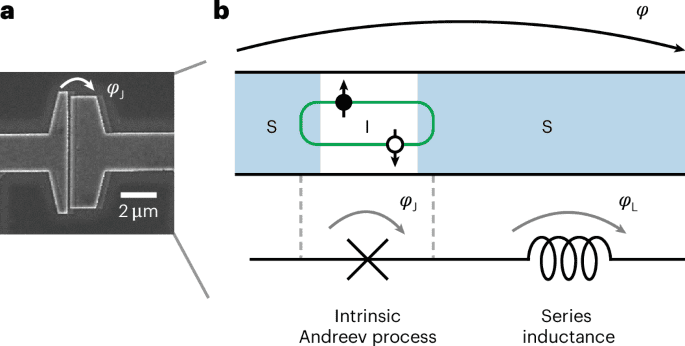
Researchers led by Junghyun Kim, with William D. Oliver as the last author, have demonstrated that a second-harmonic contribution to the standard model of Josephson tunnel junctions accurately reproduces observed deviations in device behavior, revealing a previously underestimated source of error in superconducting circuit design. The team distinguished between intrinsic harmonics and those caused by external factors using nearly symmetric superconducting quantum interference devices, or SQUIDs, a key methodological advancement. Spectroscopic measurements revealed features inexplicable by a standard cosine potential, but accounted for when including the second-harmonic contribution. The findings pinpoint metallic trace inductance as the source of the observed second harmonic scaling with Josephson junction size, a critical insight for improving superconducting circuits and investigations of the supercurrent diode effect.
Higher-Order Harmonics in Josephson Tunnel Junctions
A subtle distortion in the behavior of superconducting circuits, previously dismissed as noise, is now understood to stem from unexpectedly significant higher-order harmonics within Josephson junctions. These harmonics, deviations from the standard sinusoidal current-phase relationship, are not merely a curiosity but a fundamental factor impacting the performance of quantum computing components. Researchers led by Junghyun Kim and William D. Oliver introduced a novel method to pinpoint the origin of these harmonics, distinguishing between those intrinsic to the Josephson junction itself and those induced by external factors. This approach proved crucial, allowing for precise spectroscopic measurements of level transitions, revealing features that cannot be explained by a standard cosine potential, but are accurately reproduced when accounting for a second-harmonic contribution to the model. The observed scaling indicates that metallic trace inductance is responsible for the harmonic distortion, and these results can inform the design of superconducting circuits for quantum information processing and investigations of the supercurrent diode effect.
SQUID Measurements Distinguish Harmonic Origins
Superconducting quantum interference devices, or SQUIDs, have long served as exquisitely sensitive detectors of magnetic fields, but recent work demonstrates their utility in a more nuanced capacity: discerning the origins of harmonic distortions within Josephson junctions. These distortions, subtle deviations from the ideal sinusoidal current-phase relationship expected in these fundamental circuit elements, have presented a persistent challenge to building increasingly complex and reliable quantum systems. While previously understood to stem from either the intrinsic properties of the junction itself or external factors like trace inductance, pinpointing the dominant source proved difficult; now, researchers led by Junghyun Kim and William D. Oliver have developed a method leveraging nearly symmetric SQUIDs to differentiate between these harmonic contributions. The team’s approach centers on meticulously characterizing the higher-order harmonics present in the Josephson potential.
Spectroscopic measurements of level transitions in multiple devices reveal features that cannot be explained by a standard cosine potential, but are accurately reproduced when accounting for a second-harmonic contribution to the model. The observed scaling of the second harmonic with Josephson junction size indicates that it is due almost entirely to the metallic trace inductance. These results can inform the design of superconducting circuits for quantum information processing and investigations of the supercurrent diode effect.
Second Harmonic Scaling Reveals Inductance Source
Researchers led by Junghyun Kim and William D. Oliver are refining the design of superconducting circuits by pinpointing a source of signal distortion. Spectroscopic measurements of level transitions in multiple devices reveal features that cannot be explained by a standard cosine potential, but are accurately reproduced when accounting for a second-harmonic contribution to the model. The observed scaling of the second harmonic with Josephson junction size indicates that it is due almost entirely to the metallic trace inductance. These results can inform the design of superconducting circuits for quantum information processing and investigations of the supercurrent diode effect.
The pursuit of stable and scalable quantum computation received a significant refinement with the identification of metallic trace inductance as a dominant source of harmonic distortion in Josephson tunnel junctions. This is a critical adjustment, as the standard model has formed the foundation for analysis in the field, and these results can inform the design of superconducting circuits for quantum information processing and investigations of the supercurrent diode effect.

See today’s quantum computing news on Quantum Zeitgeist for the latest breakthroughs in qubits, hardware, algorithms, and industry deals.