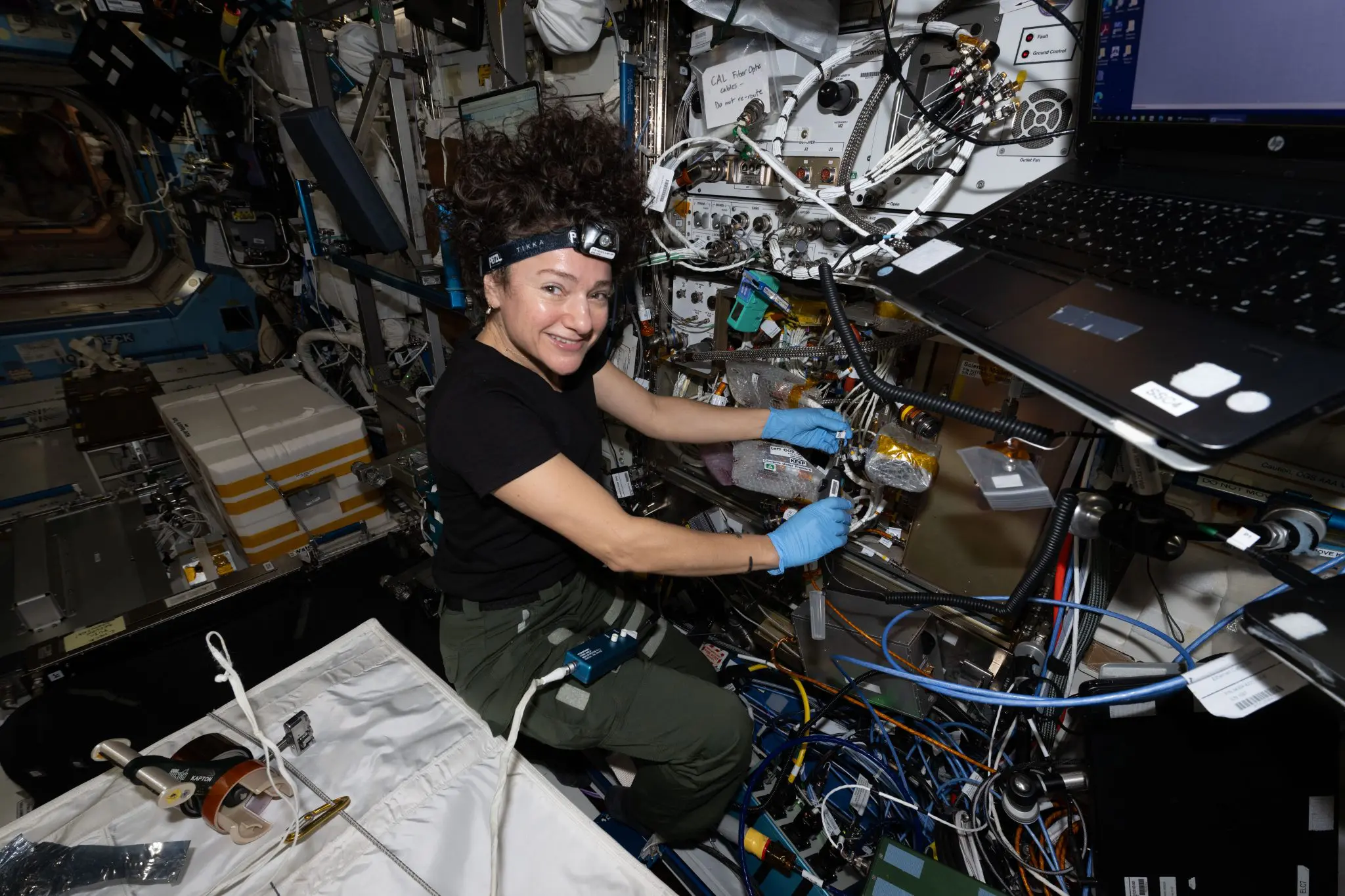
NASA’s Cold Atom Lab aboard the International Space Station has been upgraded to achieve temperatures below minus 459 degrees Fahrenheit, enabling researchers to create a Bose-Einstein condensate, a fifth state of matter where atoms behave as a single collection of matter waves. This facility, about the size of a minifridge and operated from Earth, leverages the microgravity environment of low Earth orbit to expand the scale of these quantum objects beyond individual subatomic particles. “At the coldest temperatures, matter behaves drastically different from anything we have experienced,” said Jason Williams, project scientist for Cold Atom Lab at NASA’s Jet Propulsion Laboratory, which built the facility. The upgraded lab, with new hardware installed by astronaut Jessica Meir while inspecting optical fibers on May 8th, will allow scientists to probe the fundamental workings of matter and test quantum technologies for future missions.
Cold Atom Lab Enables Fifth State of Matter: Bose-Einstein Condensates
The facility achieves this by chilling atoms to temperatures below minus 459 degrees Fahrenheit, a critical threshold where matter exhibits dramatically altered behavior. This extreme cold, just above absolute zero, facilitates the formation of a Bose-Einstein condensate, or BEC, described as a collection of matter waves and representing a departure from the more familiar solid, liquid, gas, and plasma states. The upgraded Cold Atom Lab, featuring a redesigned magnetic trap, enables manipulation of the shape of these quantum gas clouds, facilitating tests of atomic properties. Astronaut Jessica Meir’s recent inspection of optical fibers and installation of hardware updates on May 8th underscores the ongoing role of crew members in maintaining this research platform.
It’s the closest thing we have to controlling the boundary of the quantum world.
Kamal Oudrhiri, project manager of Cold Atom Lab at JPL
Laser Cooling and Magnetic Trapping of Rubidium/Potassium Atoms
The Cold Atom Lab doesn’t simply cool atoms; it employs a sophisticated process of laser cooling and magnetic trapping to achieve temperatures far below those routinely experienced on Earth. For each experiment, a strip of rubidium or potassium metal is heated to as high as 750 degrees Fahrenheit (400 degrees Celsius), hot enough to form a gas within the facility’s vacuum chamber. Then, precisely tuned lasers are directed at this gas, effectively draining energy from the atoms and slowing their movement, which dramatically reduces their temperature. This laser-cooling stage is critical, preparing the atoms for the next phase of confinement. Following laser cooling, a redesigned magnetic trap captures and holds the cooled gas in place, preventing collisions and allowing for extended observation. Through a series of complex techniques, the laboratory further reduces the atom cloud’s energy, bringing it close to a standstill and maximizing its time in microgravity.
While similar facilities exist terrestrially, the space-based Cold Atom Lab benefits from prolonged observation periods and even lower attainable temperatures. “It’s the closest thing we have to controlling the boundary of the quantum world,” said Kamal Oudrhiri, project manager of Cold Atom Lab at JPL, referencing these exceptionally low temperatures.
Microgravity Extends Quantum Gas Study Duration & Lowers Temperatures
While terrestrial facilities can create Bose-Einstein condensates (BECs), the microgravity environment dramatically extends the duration and lowers the temperatures attainable within the Cold Atom Lab, allowing for unprecedented study of these unique states of matter. The ability to sustain larger BECs for longer periods is not merely a technical achievement; it fundamentally alters the scale at which quantum phenomena can be observed. Researchers are no longer limited to studying quantum behavior in individual subatomic particles, but can now investigate larger collections of matter waves and their interactions with gravity. The latest upgrade, featuring redesigned metal strips that serve as gas sources and a new magnetic trap, is designed to further optimize these conditions. This work supports leadership in space-based quantum technologies. The extended study times and lower temperatures promise to unlock new insights into fundamental physics and enable advanced quantum technologies applicable to Earth science and space exploration.
As the first project to create Bose-Einstein condensates in orbit, we’re demonstrating that we can make quantum technology work reliably in space.
Ethan Elliott, deputy project scientist for Cold Atom Lab at JPL
Upgrade Advances Space-Based Quantum Technology & Precision Measurement
Beyond fundamental physics research, this facility is actively developing technologies with potential applications ranging from advanced Earth science missions to deep-space navigation. This extreme cold is not merely a scientific curiosity; it allows researchers to observe quantum behavior in a larger, more measurable form than previously possible. “The wavelike nature of matter dominates, and ultracold matter can behave in ways that are not only unexpected, but that also enable extremely precise measurements of time, gravity, and motion.” A redesigned magnetic trap is central to the upgrade, allowing scientists to alter the shape of the quantum gas clouds and investigate different atomic properties. New metal strips serve as gas sources, further refining experimental control.
At the coldest temperatures, matter behaves drastically different from anything we have experienced.
Jason Williams, project scientist for Cold Atom Lab at NASA’s Jet Propulsion Laboratory


See today’s quantum computing news on Quantum Zeitgeist for the latest breakthroughs in qubits, hardware, algorithms, and industry deals.