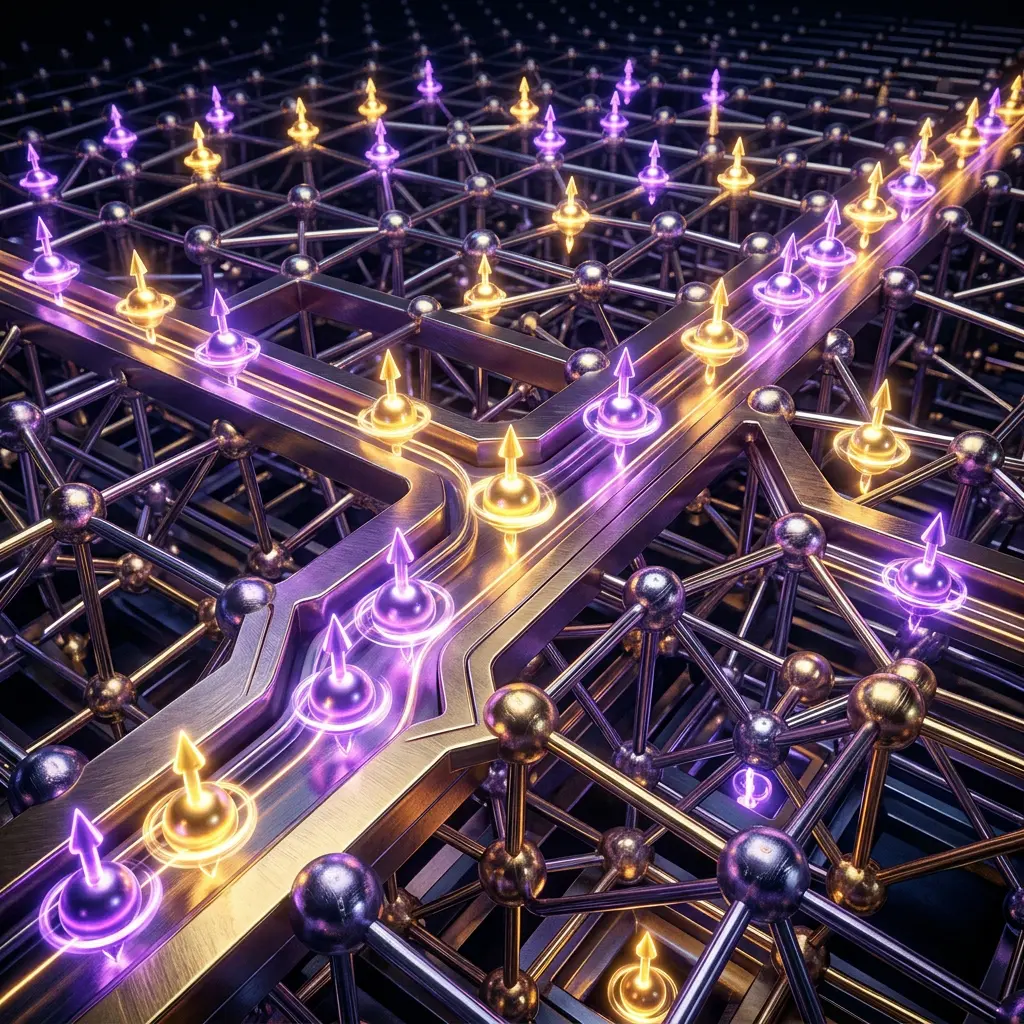
A U.S. Department of Energy framework named DQAOA-GPT evaluates against conventional DQAOA on dense HUBO optimization problems with up to 100 decision variables, a significant step toward tackling exponentially large search spaces. This new approach integrates DQAOA with GPT-based quantum circuit generation. Rather than iterative optimization, DQAOA-GPT utilizes a trained generative model to directly create high-quality quantum circuits for decomposed sub-problems, demonstrably reducing computational cost while maintaining competitive solution quality, with larger acceleration observed for larger sub-problem sizes.
DQAOA-GPT Framework for Scalable Quantum Optimization
This new approach, dubbed DQAOA-GPT, integrates the Distributed Quantum Approximate Optimization Algorithm with GPT-based quantum circuit generation, demonstrating a novel synergy between quantum computing and artificial intelligence. Central to the DQAOA-GPT framework is the elimination of a key bottleneck in traditional variational quantum algorithms: the iterative parameter optimization loop. This bypasses the computationally expensive variational process, a bottleneck particularly as problem sizes increase. Larger acceleration was observed for larger sub-problem sizes, indicating the framework’s potential for scalability. The framework consists of two key components: a DQAOA-based decomposition and aggregation strategy that enables scalable execution across HPC, QC environments, and a GPT-based circuit generation model that replaces iterative parameter optimization with direct circuit synthesis.
The framework’s design allows for exploration of complex optimization landscapes with reduced computational demands. While the current validation focuses on benchmark-scale problems, the researchers emphasize the potential for scaling the framework further. Increased GPU resources and parallel computing capabilities are anticipated to unlock even larger-scale combinatorial optimization possibilities in hybrid HPC-QC environments. The work’s contributions include the proposal of DQAOA-GPT as a unified framework and the demonstration of a GPT-based approach that removes the need for variational parameter optimization.
Distributed QAOA (DQAOA) for HPC-QC Integration
Current approaches to tackling complex optimization problems increasingly leverage hybrid high-performance computing (HPC) and quantum computing (QC) architectures, yet significant bottlenecks remain in scaling these systems effectively. Standard Quantum Approximate Optimization Algorithm (QAOA) implementations, while promising, demand increasing numbers of qubits and circuit depth as problem size grows, alongside computationally expensive classical parameter optimization. Researchers are now focusing on distributed strategies to address these limitations; Distributed QAOA (DQAOA) decomposes large problems into smaller, manageable sub-problems executed across parallel HPC resources. However, even with distribution, the iterative variational optimization inherent in DQAOA continued to pose a challenge until the emergence of DQAOA-GPT.
Instead of repeatedly evaluating and refining quantum circuits through iterative parameter updates, the system employs a generative model, specifically, a GPT-based quantum circuit generation model, to directly synthesize high-quality circuits tailored to the decomposed sub-problems. This bypasses a key limitation of earlier distributed approaches, enabling exploration of complex optimization landscapes. The team evaluated DQAOA-GPT against conventional DQAOA on dense HUBO optimization problems with up to 100 decision variables, a benchmark demonstrating a step forward in handling exponentially large search spaces. Central to this advancement is the integration of two distinct technologies. DQAOA provides the scalable HPC-QC framework, while the GPT model learns to generate optimized quantum circuits, effectively removing the need for the traditionally expensive variational loop.
GPT-Based Quantum Circuit Generation Eliminates Variational Loops
Seongmin Kim and colleagues are developing a new approach to quantum optimization, integrating artificial intelligence to bypass a longstanding computational hurdle. Their work centers on DQAOA-GPT, a hybrid framework designed to tackle complex combinatorial problems previously intractable for many quantum systems. Unlike traditional variational quantum algorithms that rely on repeated circuit evaluations and parameter adjustments, DQAOA-GPT leverages a generative pre-trained transformer (GPT) to directly synthesize quantum circuits. This innovation significantly alters the landscape of quantum computation, potentially unlocking solutions to problems with exponentially large search spaces. The framework consists of two key components: (i) DQAOA-based decomposition and aggregation strategy that enables scalable execution across HPC, QC environments, and (ii) GPT-based circuit generation model that replaces iterative parameter optimization with direct circuit synthesis. This integration is noteworthy because it combines the scalability of distributed computing with the efficiency of AI-driven circuit design.
The team anticipates that further increases in GPU resources and parallel computing capabilities will enable the framework to address even larger and more complex optimization challenges.
HUBO Problem Formulation and Ising Hamiltonian Mapping
The pursuit of efficient solutions to complex optimization problems has led researchers to explore hybrid computational approaches, and a recent development demonstrates progress on problems with up to 100 interacting variables. This scale is significant because many real-world challenges, from financial modeling to materials design, are fundamentally combinatorial, meaning the number of possible solutions explodes exponentially with the problem’s size. The team’s work, detailed in a new paper, focuses on a specific problem formulation, higher-order unconstrained binary optimization, or HUBO, and its translation into a form suitable for quantum computation. Understanding how a problem is expressed is crucial for leveraging quantum algorithms. The researchers specifically address HUBO problems, defined as real-valued polynomials over binary variables. A third-order HUBO problem, as they describe it, is represented mathematically with linear, quadratic, and cubic interaction coefficients. This formulation allows for complex relationships between variables, mirroring the intricacies of many practical optimization scenarios.
Solving HUBO problems is, in general, NP-hard, meaning there is no known algorithm that can find the optimal solution in polynomial time. To prepare these problems for quantum processing, the binary variables are mapped to spin variables, transforming the objective function into an Ising Hamiltonian using Pauli operators. This conversion allows the problem to be encoded directly onto qubits without the need for complex pre-processing steps like quadratization. The team benchmarked their approach using HUBO instances motivated by materials optimization applications, specifically problems with 100 decision variables. To gauge the quality of their solutions, they compared their results against the best-known results reported in a prior study. This rigorous comparison is essential for demonstrating the practical viability of the new framework.
The researchers also detail the use of FEATHER graph embeddings, which generate node representations from characteristic functions of random walk distributions on a graph, encoding structural information for use in their generative model. The work builds upon existing techniques like ADAPT-QAOA, which constructs problem-adaptive quantum circuits, and leverages the power of generative pre-trained transformers (GPT). “QAOA-GPT replaces the iterative optimization loop of variational quantum algorithms with generative circuit synthesis, producing a high-quality circuit through a single forward pass,” the authors explain. This direct circuit generation is a key innovation, bypassing the computationally expensive variational process that is a bottleneck to the scalability of quantum optimization algorithms. The framework’s ability to explore large and complex optimization landscapes with reduced computational overhead represents a step toward realizing the potential of hybrid HPC-QC environments.
Benchmark Validation on Dense 100-Variable Optimization
Researchers have now evaluated a novel hybrid framework, DQAOA-GPT, on dense HUBO optimization problems with up to 100 decision variables, a step toward harnessing quantum capabilities for challenging problems. This work demonstrates a reduction in computational demands while maintaining solution quality. These problems, characterized by exponentially large search spaces, serve as a rigorous testbed for optimization algorithms. The team specifically focused on instances with up to 100 decision variables, a scale where conventional methods face computational demands. This efficiency stems from the framework’s innovative approach to circuit generation, bypassing the variational process that is a bottleneck in quantum optimization algorithms. This work builds upon the Distributed Quantum Approximate Optimization Algorithm (DQAOA), which tackles large problems by breaking them into smaller, manageable components. However, even DQAOA relies on iterative optimization, creating a computational bottleneck. DQAOA-GPT addresses this by integrating DQAOA with GPT-based quantum circuit generation.
Department of Energy under Contract No. DE-AC05-00OR22725, highlighting the investment in this area of quantum research. This suggests that DQAOA-GPT is not merely a proof-of-concept, but a stepping stone toward practical quantum utility, offering a pathway to tackle increasingly complex optimization challenges in fields ranging from materials science to logistics.
Source: https://arxiv.org/abs/2607.20225

See today’s quantum computing news on Quantum Zeitgeist for the latest breakthroughs in qubits, hardware, algorithms, and industry deals.