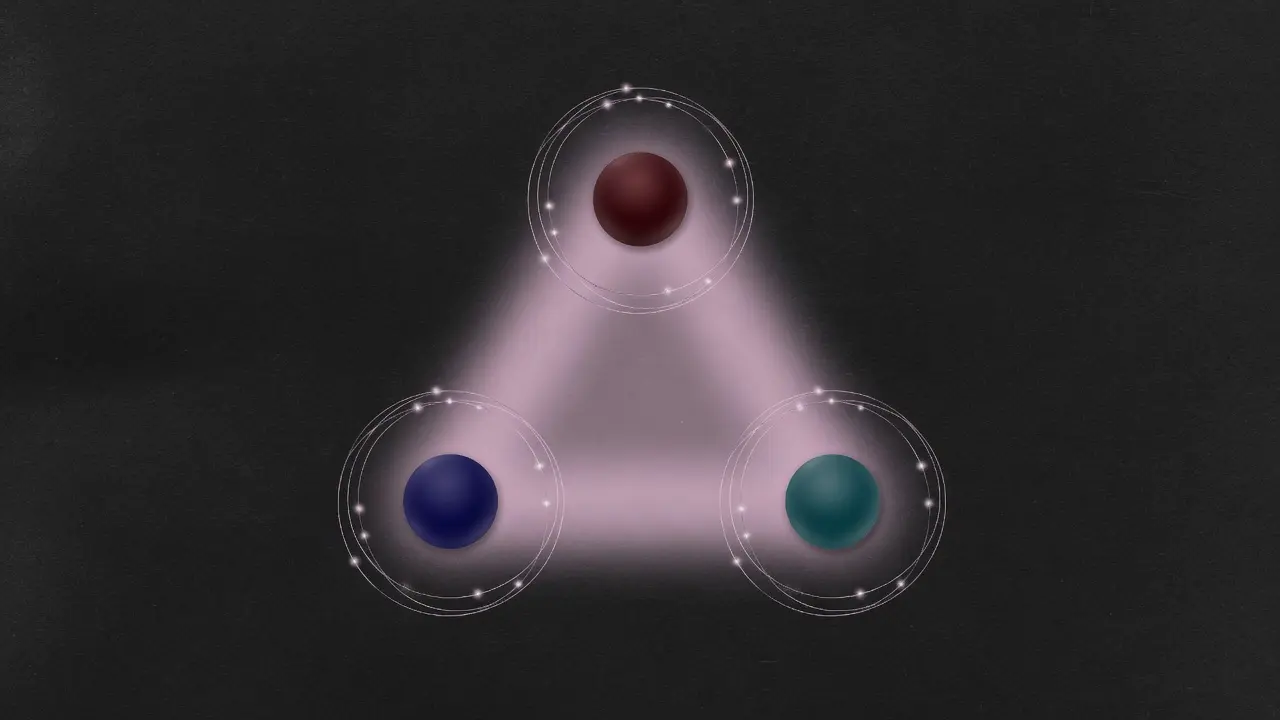
Researchers at Nanjing University of Posts and Telecommunications and Hangzhou Normal University have proposed a quantum secure direct communication (QSDC) protocol using Gottesman-Kitaev-Preskill (GKP) qubits. The GKP code possesses a lattice periodic structure that enables the effective correction of small displacement errors induced by noise in phase space, which is indispensable for quantum computation. The GKP code was also used to construct a long-distance entanglement channel in quantum repeaters and distribute random keys in quantum key distribution (QKD). The exponential attenuation loss of photons can be overcome by the third-generation quantum repeater.
Numerical simulations demonstrate that secure transmission distance exceeding 1000 km is achievable with a 23 dB squeezing level, and the team established a cost-based optimization framework to characterize the trade-off among secure communication distance, secrecy capacity and repeater resources, enabling optimized repeater deployment and providing a systematic design strategy for scalable quantum repeater architectures. The results demonstrate the potential of combining GKP error correction for long-distance QSDC and quantum networks.
Gottesman-Kitaev-Preskill Qubits Enable Long-Distance QSDC
This extended reach stems from the unique lattice periodic structure of the Gottesman-Kitaev-Preskill (GKP) code, which effectively corrects small displacement errors induced by noise in phase space, a critical feature for reliable quantum computation and communication. The protocol integrates GKP qubits with third-generation quantum repeaters, allowing for direct transmission of secure information and overcoming exponential signal loss over long channels. The proposed quantum secure direct communication (QSDC) protocol uses optical amplification and continuous-variable SUM gates at each repeater node to perform error correction, actively suppressing noise accumulated from both channel loss and imperfect state preparation.
The researchers show GKP qubits can correct errors arising from channel loss and gate operations at each repeater node, while simultaneously resetting variance, enabling QSDC through multiple error-correcting nodes. “Our work highlights the potential of GKP qubits as a practical building block for future long-distance QSDC and quantum networks,” the authors state, “particularly in scenarios requiring both security and robustness against channel loss.” Future research will focus on integrating this protocol with advanced quantum repeater architectures and optimizing for finite-size effects.
GKP Code Corrects Displacement Errors in Phase Space
GKP qubits use a unique lattice structure within phase space to counteract small displacement errors, a characteristic critical not only for quantum computation but now also for extending the reach of secure communication networks. This error resilience stems from the code’s ability to encode quantum information redundantly within a single oscillator mode, offering a distinct advantage over traditional approaches. The GKP code defines logical states in phase space with specific quadrature positions, establishing a foundation for correcting errors induced by noise during transmission and processing.
This dual functionality expands the utility of GKP qubits, moving them beyond solely computational roles into the realm of practical quantum communication protocols. The protocol proposed by the team not only transmits secret messages directly but also helps protect the safety of communication personnel.
GKP Qubit Generation Advances in Multiple Quantum Systems
Recent advances demonstrate GKP qubit generation is now occurring in multiple quantum systems, including superconducting circuits, trapped ions and integrated photonics, broadening the avenues for realizing fault-tolerant quantum information processing. While generating and manipulating these qubits presents challenges, particularly in optical systems requiring strong nonlinear interactions, novel schemes are emerging to prepare the necessary non-Gaussian states.
Quantum Secure Direct Communication Beyond Key Distribution
This protocol addresses a critical limitation of existing QSDC methods, which often rely on pre-shared keys or are restricted to point-to-point communication. The proposed QSDC protocol diverges from conventional methods by enabling direct transmission of secure information, a feature particularly valuable in scenarios where key exchange is impractical or undesirable.
“The third-generation quantum repeater is extremely suitable for direct transmission of secure information,” the researchers state, highlighting the close relationship between the GKP encoding and advanced repeater technology. This approach allows for the mitigation of message loss, a common challenge in quantum communication, and offers a pathway toward scalable quantum networks capable of supporting secure communication over vast distances. The protocol’s design also directly transmits the secret message, offering an additional layer of security for communication personnel.
23 dB Squeezing Achieves 1000km Secure Transmission
Simulations reveal a quantum secure direct communication protocol using Gottesman-Kitaev-Preskill (GKP) encoding can extend secure transmission distances to over 1000 kilometers, a figure significantly exceeding the reach of protocols without quantum repeaters. This extended range is achieved with a 23 decibel squeezing level, a key parameter in minimizing signal degradation over long distances.
The resulting optimization criterion offers a pathway for deploying repeaters at varying communication distances and provides a foundation for adapting the architecture to other quantum repeater designs. “We aim to identify the optimal number of repeater nodes NQRopt that minimize the cost function under different transmission distances,” the researchers state in their work.
Cost-Optimization Framework Balances QSDC Performance & Resources
Simulations reveal secure communication exceeding 1000 kilometers is achievable with 2750 repeater nodes using this level of squeezing, a significant extension beyond current limitations imposed by photon attenuation. This approach allows for a quantitative assessment of trade-offs, revealing that increasing the number of repeater nodes enhances the ability to mitigate channel loss and enable higher communication rates up to a certain point. The protocol relies on third-generation quantum repeaters, which use the intrinsic error-correcting capabilities of encoded qubits rather than entanglement purification, streamlining the process and reducing overhead.
Real-Time Eavesdropping Detection Protects Communication Personnel
This proactive security measure allows both parties to immediately cease communication and relocate, protecting individuals whose positions might otherwise be exposed. The protocol uses the unique properties of Gottesman-Kitaev-Preskill (GKP) qubits to not only facilitate long-distance communication but also to enhance the safety of those involved in the process. The system’s ability to detect intrusions during communication relies on a specific process where Alice randomly samples states to identify potential eavesdropping attempts, a step essential for maintaining security.
Following the detection of an intrusion, a feedback displacement is applied to the data mode based on homodyne detection of the ancilla, correcting errors and amplifying the signal to compensate for channel loss. This error correction, facilitated by the GKP code’s lattice periodic structure, is integral to the protocol’s effectiveness and its capacity to maintain signal integrity over extended distances. Future analyses will need to incorporate realistic imperfections and architectural requirements to refine the system further.
👉 More information
🗞 Long-distance quantum secure direct communication with Gottesman-Kitaev-Preskill qubits
✍️ Meng-Dong Zhu, Jia-Wei Ying and Shi-Pu Gu (College of Electronic and Optical Engineering, & College of Flexible Electronics (Future Technology), Nanjing University of Posts and Telecommunications, Nanjing, 210023, China); Qi Zhang and Xing-Fu Wang (College of Science, Nanjing University of Posts and Telecommunications, Nanjing 210023, China); Lan Zhou and Yu-Bo Sheng (School of Physics, Hangzhou Normal University, Hangzhou, 311121, China)
🧠 ArXiv: https://arxiv.org/abs/2611.11822v1



See today’s quantum computing news on Quantum Zeitgeist for the latest breakthroughs in qubits, hardware, algorithms, and industry deals.