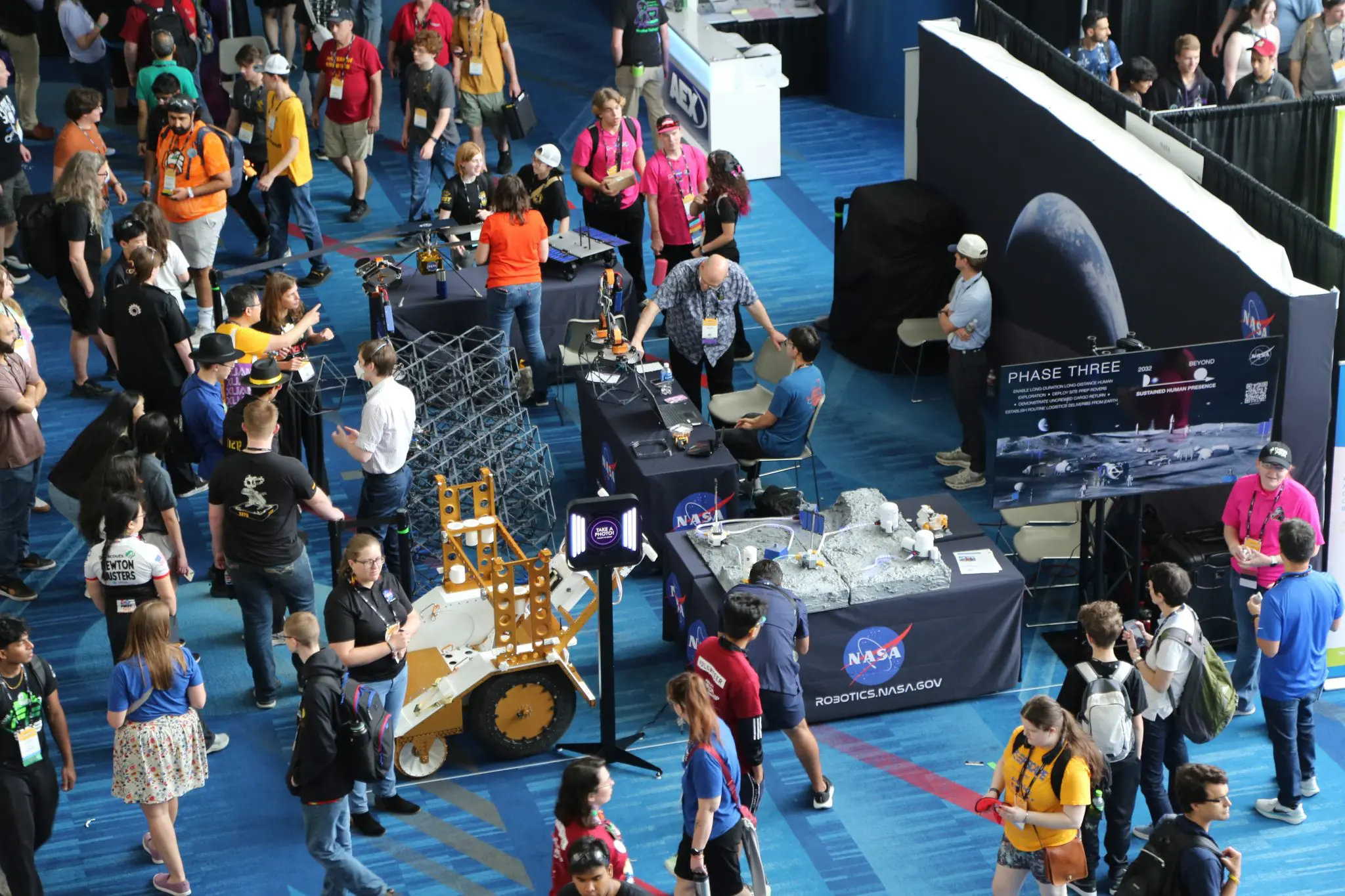
NASA directly engaged over 51,000 students, parents, and mentors at the FIRST Robotics World Championship in Houston, signaling a focused effort to cultivate the workforce that will build its vision for a permanent lunar outpost. The agency showcased its Moon Base plan, prioritizing a series of robotic and uncrewed missions to prepare the lunar surface before crewed Artemis landings, and targeting up to 30 robotic lunar landings through the CLPS program to rapidly deliver essential payloads. This accelerated cadence reflects a shift toward automated construction and scouting, utilizing innovations like modular robotic assembly systems and cooperative rover networks. “NASA Robotics will play a critical role in establishing a long-term presence on the Moon,” the agency stated, emphasizing opportunities for the next generation to contribute to both lunar and future Martian exploration.
Moon Base: NASA’s Plan for Lunar Outpost Construction
NASA is prioritizing robotic construction as the foundation for its planned Moon Base, a permanent lunar outpost intended to serve as a springboard for missions extending to Mars and beyond. These payloads include not just scientific instruments, but also crucial infrastructure components like rovers, hoppers, and drones, all designed to prepare the lunar surface for more complex operations. This technology is intended to reduce the need to launch fully assembled hardware from Earth, a critical consideration for sustainable deep space exploration. Complementing this is the Cooperative Autonomous Distributed Robotic Exploration system, consisting of a trio of lunar rovers designed to collaboratively gather data that a single robot could not achieve, potentially revolutionizing how scientists explore and understand the lunar environment. NASA demonstrated its commitment to fostering this talent by sponsoring over 160 FIRST Robotics Teams and providing a Mobile Machine Shop at the championship, completing over 600 repairs for teams during the event.
Robotic Systems Showcase: CLPS Flights & Autonomous Exploration
NASA is increasingly relying on robotic precursors to establish a sustained lunar presence, a strategy showcased at the recent FIRST Robotics World Championship in Houston. The agency detailed a plan where robotic missions will precede and prepare for human landings as part of the Moon Base initiative, with this initial phase prioritizing automated deployment and experimentation. This represents a significant increase in planned robotic activity, suggesting a faster timeline for building lunar infrastructure. The agency’s exhibit highlighted several key robotic technologies designed for this automated build-up. Among these is the Automated Reconfigurable Mission Adaptive Digital Assembly Systems, a modular construction system utilizing small robots and algorithms capable of autonomously assembling large-scale infrastructure in space, such as solar power arrays and habitats.
Further extending this robotic capability, NASA is also developing the Skyfall Mars Helicopters, building on the success of the Ingenuity helicopter at Mars. These aerial scouts are envisioned to provide crucial reconnaissance for both scientists and future human explorers on the Red Planet. Multiple NASA centers, including Johnson Space Center and Kennedy Space Center, contributed to the exhibit, demonstrating a broad agency commitment to robotic exploration and the development of technologies that will underpin both lunar and Martian missions.
This system could reduce reliance on launching fully assembled hardware from Earth, supporting sustainable deep space exploration.
NASA




See today’s quantum computing news on Quantum Zeitgeist for the latest breakthroughs in qubits, hardware, algorithms, and industry deals.