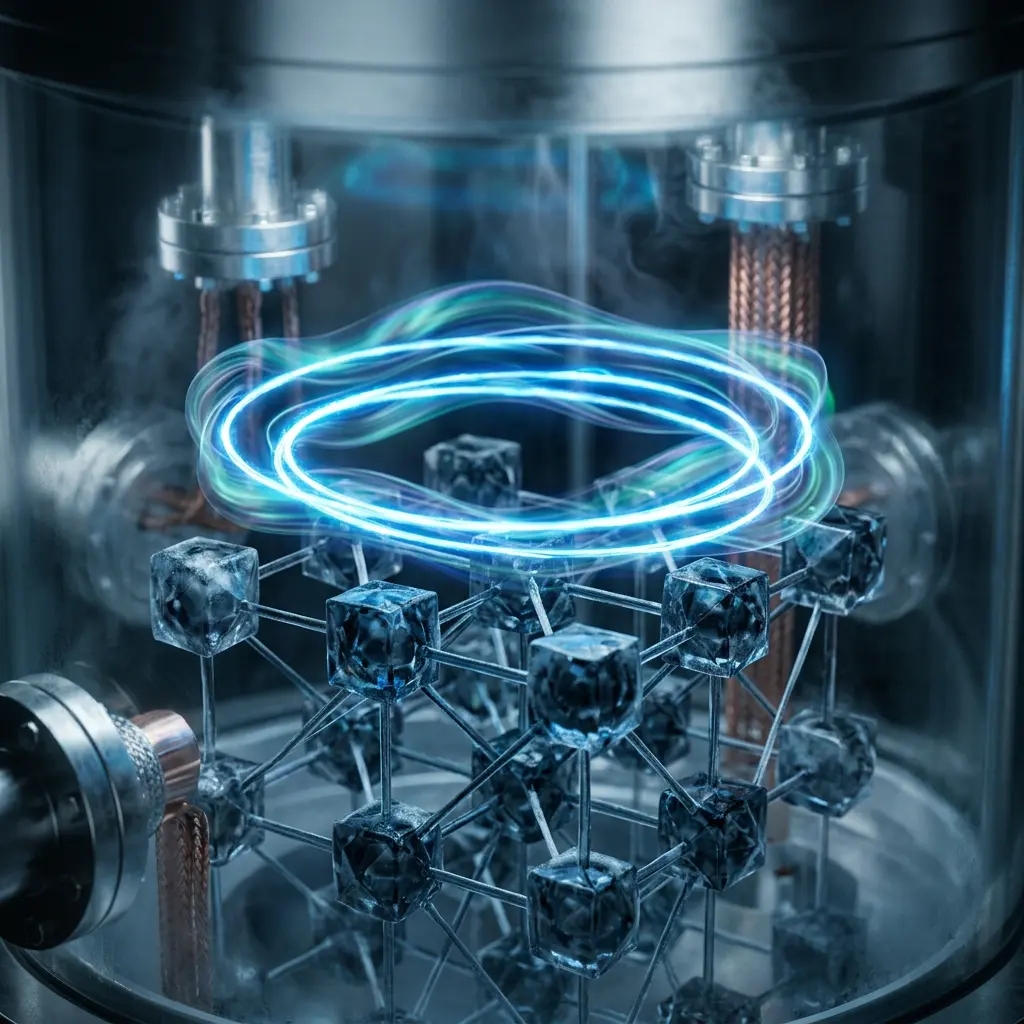
School of Physics, University College Dublin, Aalto University, ISC-CNR, and Sapienza University have co-authored a tutorial detailing critical quantum sensing protocols, focusing on a new approach to overcome limitations in precision measurement. The work addresses challenges facing quantum technologies, including scalability and environmental noise, by exploring how enhanced susceptibility and nonclassical correlations occur near quantum phase transitions. This emerging paradigm utilizes the unique properties of these transitions as resources for quantum-enhanced precision. Through examples of increasing complexity, the tutorial guides readers through various protocols applied to different critical systems and outlines opportunities for future quantum technologies.
Critical Quantum Metrology & Parameter Estimation Introduction
While quantum technologies promise measurement capabilities exceeding classical limits, practical hurdles related to scalability and noise continue to impede progress. This emerging paradigm offers a potential solution by exploiting the heightened sensitivity and nonclassical correlations that arise as a system approaches a critical point, the threshold where its fundamental properties dramatically shift. The tutorial provides a detailed overview of prominent quantum sensing strategies, guiding readers through examples of increasing complexity and applying these protocols to diverse critical systems. “Current progress is constrained by scalability, environmental noise, and challenges in practical integration,” the authors note, highlighting the motivation for exploring this novel approach. Unlike traditional quantum sensing, critical quantum metrology doesn’t simply use quantum effects; it actively seeks out and harnesses the intensified quantum behavior inherent in systems undergoing phase transitions. This focus on resource optimization is crucial for translating laboratory demonstrations into real-world applications.
The tutorial extends beyond idealized models, addressing the complexities of open-system, dissipative regimes and strongly correlated fermionic systems. The work explores how these principles can be applied to a range of sensing tasks, from thermometry to the detection of weak magnetic fields, and outlines both the challenges and opportunities for future quantum technologies, offering a unique perspective on a cutting-edge topic designed to inspire researchers across disciplines.
Quantum Phase Transitions as Metrology Resources
Researchers are increasingly focused on harnessing the subtle shifts occurring during quantum phase transitions to build more sensitive measurement devices. This approach represents a departure from traditional quantum sensing strategies and addresses limitations imposed by scalability and environmental noise. The tutorial aims to provide a comprehensive guide to leveraging the unique properties of these transitions for enhanced precision in parameter estimation. These characteristics amplify signals, allowing for measurements that surpass classical limits. The tutorial doesn’t simply demonstrate the possibility of improved sensing; it details the efficiency of these methods, which is crucial for moving beyond theoretical demonstrations and realizing deployable quantum sensors. The tutorial extends beyond simple, idealized models, acknowledging the complexities of real-world systems and considering scenarios where systems are not in perfect equilibrium, examining how sensing performance is affected by dynamic processes. This scope suggests a move toward a more holistic understanding of quantum sensing, integrating concepts from quantum metrology, many-body physics, and critical phenomena to inspire innovation across disciplines and equip researchers with the tools to explore new frontiers in quantum sensing.
Optimal Scaling of Estimation Precision
The work, published as an open-access resource, doesn’t merely demonstrate quantum sensing capabilities; it analyzes how effectively those capabilities are achieved, a crucial step toward practical applications. This focus on resource optimization is particularly relevant as the field moves beyond proof-of-concept experiments. The tutorial introduces critical quantum metrology as an emerging paradigm, leveraging the unique properties of systems experiencing quantum phase transitions. These transitions exhibit “enhanced susceptibility and nonclassical correlations” that can be harnessed for improved measurement precision, offering a potential solution to limitations currently hindering wider adoption of quantum sensors. The tutorial guides readers through increasingly complex protocols, applying them to diverse critical systems to illustrate the underlying principles. “Special emphasis is placed on the optimal scaling of estimation precision with respect to fundamental resources,” the researchers write, highlighting a core tenet of their approach.
This isn’t simply about achieving higher precision; it’s about achieving the most precision for a given investment of resources, be that time, energy, or the complexity of the quantum system itself. The tutorial extends its analysis beyond idealized models, delving into the complexities of operating in realistic environments where dissipation and strong correlations between particles can significantly impact performance. The work ultimately aims to bridge the gap between theoretical possibilities and tangible technological advancements in quantum sensing, providing a valuable resource for experts and newcomers alike.
Researchers are increasingly focused on extracting the maximum possible information from quantum systems, even those battling the inherent disorder of real-world environments. This emerging paradigm moves beyond traditional approaches by leveraging the unique properties found near quantum phase transitions, points where a material’s properties dramatically change, to enhance measurement precision.
Applications to Strongly Correlated Fermionic Systems
Beyond the promise of enhanced precision in macroscopic measurements, critical quantum metrology is revealing potential within the complex realm of strongly correlated fermionic systems. These materials, where electron interactions dictate behavior in ways defying simple models, present a significant challenge for traditional characterization techniques. Researchers from the School of Physics, University College Dublin, are now exploring how the heightened sensitivity near quantum phase transitions can be leveraged to probe these systems with unprecedented detail, moving beyond idealized models to address realistic complexities. The tutorial authored by George Mihailescu, Uesli Alushi of Aalto University, Roberto Di Candia and Simone Felicetti of ISC-CNR, and Karol Gietka, details how critical quantum sensing protocols can be adapted for these specific systems. A key focus lies in understanding how to extract meaningful information from dissipative regimes, where energy loss complicates measurements.
Specifically, the research explores the use of impurity probes, localized quantum systems interacting with the fermionic sea, to perform thermometry. Goold, In situ thermometry of a cold fermi gas via dephasing impurities, Phys., and Mitchison, Correlated decoherence and thermometry with mobile impurities in a one-dimensional Fermi gas, Phys. A 113, demonstrate how these probes can be used to measure the temperature of strongly correlated fermionic quantum systems, and this work builds on that foundation. This is particularly crucial when dealing with complex systems where isolating and controlling variables is difficult. The tutorial extends the analysis to consider the impact of strong correlations on the sensing process itself. The ultimate goal is to develop quantum sensors capable of resolving subtle features in the behavior of these materials, potentially unlocking new insights into superconductivity, magnetism, and other emergent phenomena, and paving the way for novel materials with tailored properties.
Advancements in Quantum Sensing Technologies
This collaborative effort outlines strategies for an emerging paradigm that moves beyond traditional limitations by harnessing “enhanced susceptibility and nonclassical correlations” occurring as systems undergo phase changes. The tutorial doesn’t simply present techniques; it delves into the fundamental principles governing how effectively these measurements can be made. The work extends beyond simply demonstrating improved precision; it also addresses the practical considerations for building functional quantum sensors. See Goold, In situ thermometry of a cold fermi gas via dephasing impurities, Phys. and Mitchison, Correlated decoherence and thermometry with mobile impurities in a one-dimensional Fermi gas, Phys. A 113, for related work. The tutorial’s scope encompasses a broad range of applications, from fundamental physics research to potential advancements in areas like materials science and biological sensing.


See today’s quantum computing news on Quantum Zeitgeist for the latest breakthroughs in qubits, hardware, algorithms, and industry deals.