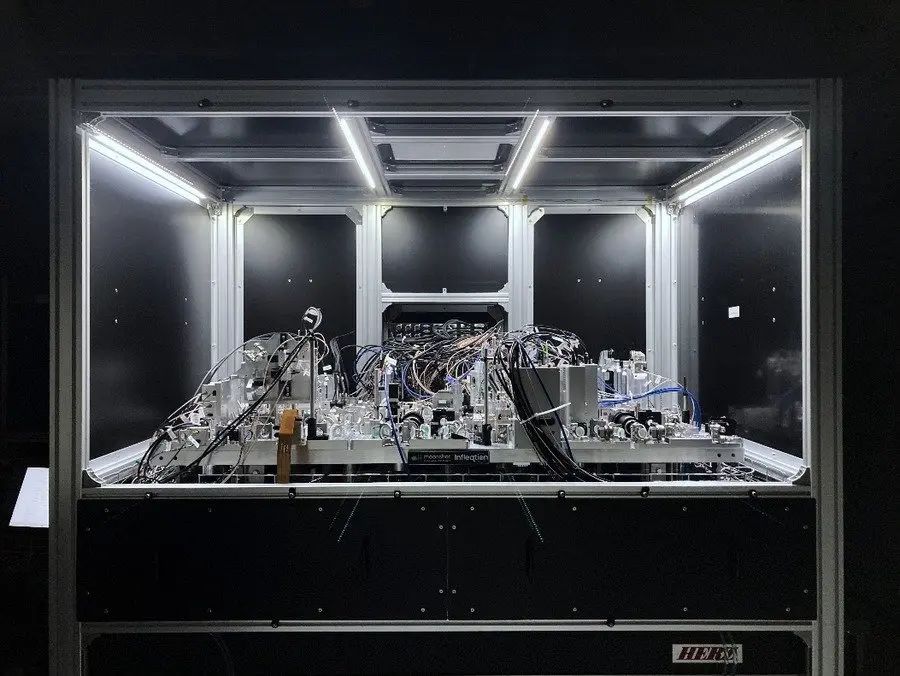
On August 24th, the Institute for Molecular Science (IMS) announced the operational status of Shunkai, Japan’s first full-stack neutral-atom quantum computer developed under the leadership of Professor Kenji Ohmori. Unlike many quantum computers requiring supercooled temperatures, Shunkai operates at room temperature, a feature anticipated to address challenges in scalability and error correction. The system achieves quantum entanglement between any two qubits by physically moving atoms during computation, allowing for flexible optimization for each algorithm. “Shunkai” is named after Harumi Shibukawa, an Edo-period astronomer, reflecting the precise control of quantum states central to its function.
Shunkai: Japan’s First Full-Stack Neutral-Atom Quantum Computer
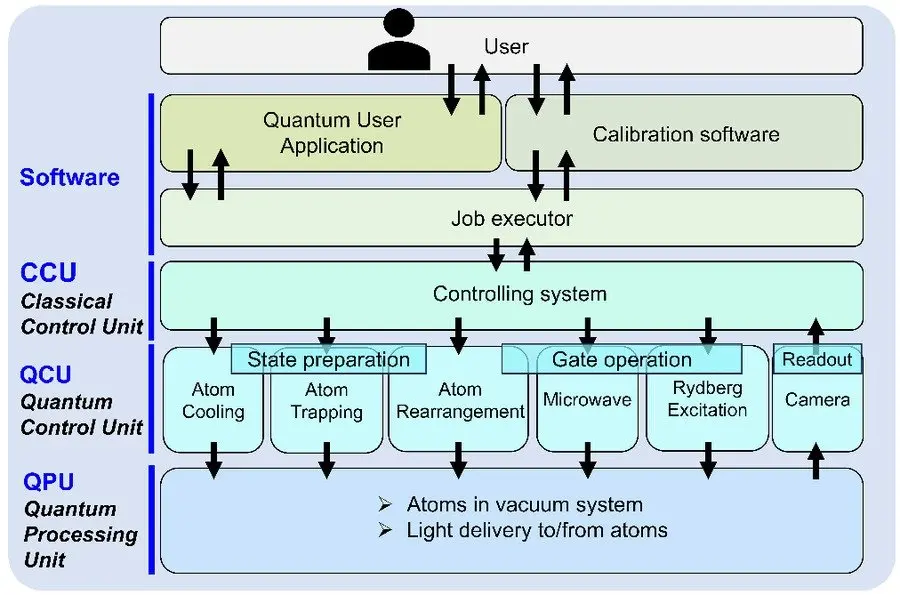
Shunkai uses a layered architecture, defining it as a “full-stack” system that translates user input into computational results. The Institute for Molecular Science (IMS) plans to initially operate Shunkai with approximately 50 qubits, scaling to around 500 qubits as development progresses.
Takafumi Tomita, Assistant Professor at the IMS, explained the rationale, noting that calculations of celestial motion “evoke the precise control of quantum states on the ‘Bloch sphere,’ which represents the state of a qubit in the physics expert community.” Shibukawa established Japan’s first original calendar system through meticulous calculation; the team hopes Shunkai will similarly deliver precise quantum computations. Professor Kenji Ohmori, the project manager, believes the system’s operation is extremely significant given the global interest in neutral-atom quantum computers.
External access to Shunkai is planned to encourage innovation in both theoretical and applied quantum computing, with a focus on error-correction technologies and practical applications. Professor Ohmori said that the external use of their full-stack machine Shunkai, for example, by theory and software researchers for the development of error-correction technologies, and by corporate researchers toward practical applications would lead to ripple effects on various fields in industry, academia and government around the world. Collaboration with Yaqumo Inc., a company founded and advised by Professor Ohmori, will also focus on the social implementation and further development of the quantum computer.
Neutral atom-based quantum computers have recently been rapidly attracting attention around the world as a new modality that could exceed the limits of the superconducting modality, which started its development earlier. I think it is extremely significant that now we have developed Japan’s first full-stack quantum computer in this cutting-edge modality and started its operation.
Neutral-Atom Qubit Control via Optical Tweezers and Laser Irradiation
Atomic qubits within the system are captured and arranged using created by focusing laser light through objective lenses, allowing for physical rearrangement during calculations. Quantum calculations proceed through irradiation with microwaves or laser light, with the resulting states observed by a camera detecting fluorescence from each atom. This full-stack development is a collaborative effort with partnerships with Ltd. for the software components and Inc. for the Quantum Processing Unit (QPU) stack.
The Institute for Molecular Science anticipates integrating Shunkai with its existing supercomputer facility, envisioning a hybrid quantum-GPU computing center. The system’s ability to manipulate individual atoms, the qubits, is central to its function, using a technique where tightly focused laser light captures particles near the focal point of the lens.


See today’s quantum computing news on Quantum Zeitgeist for the latest breakthroughs in qubits, hardware, algorithms, and industry deals.