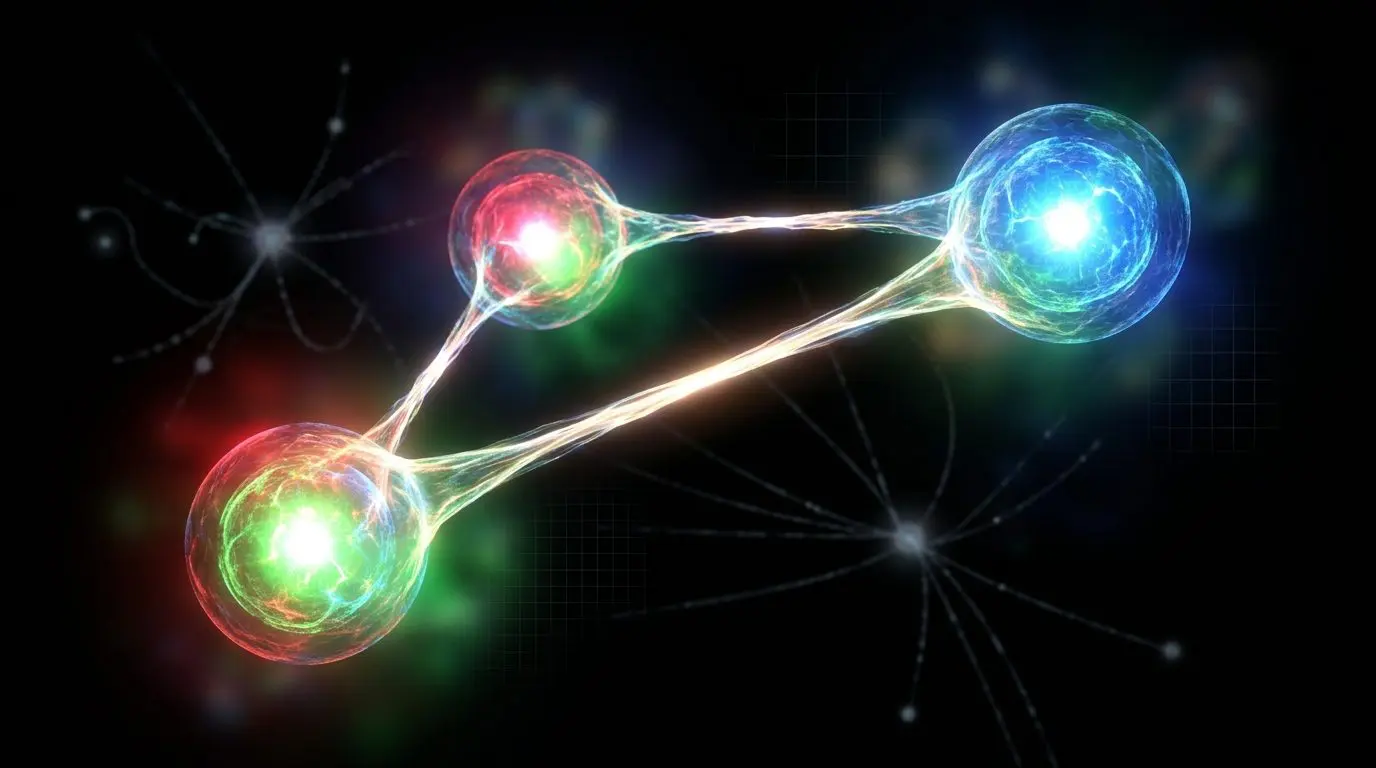
Researchers at the CMS experiment are probing the strong nuclear force in a completely new way, measuring four-way energy correlations between particles for the first time. Unlike other fundamental forces, the strong force increases with distance, behaving like a “rubber band” connecting particles; understanding its dynamics is important for understanding how matter forms.
Using data from 2018 proton-proton collisions at the LHC, the team analyzed dense sprays of particles, known as jets, to map these complex interactions. This measurement offers a novel approach to study the strong force, revealing how the motions of particles within jets are governed by intertwined forces, much like measuring tension in twisted rubber bands.
Four-Particle Correlations Probe Strong Force Dynamics
Measurements of four-particle interactions within jets of particles are providing insight into the strong nuclear force, a fundamental force still poorly understood despite its role in binding matter. This approach allows researchers to map the complex interplay of forces acting at extremely short distances. The unusual behavior of the strong force, increasing with distance like a stretched rubber band, complicates modeling its effects, particularly when multiple particles are involved, MIT says.
Researchers visualized this interaction by comparing it to twisted rubber bands connecting fingers; altering the position of one finger changes the force on all others, making prediction difficult with only a single band’s experience. Within jets, the strong force governs the motion of numerous particles, creating a similarly intricate web of interactions. CMS focused on events involving a Z boson decaying into muons, providing a clear signal alongside the jets produced by the strong force.
By examining three distinct four-particle configurations, including pairs with a common midpoint, the team revealed correlations beyond those predicted by existing models. Heatmaps of these correlations show enhanced particle production when pairs are close together, and reduced production when distant, mirroring the tension in the analogy. Comparisons with predictions from Pythia and Herwig, models limited to two-body interactions, demonstrate their inadequacy in capturing these complex multi-particle dynamics, according to the company.
“The strong nuclear force is far and away the least well-understood of the fundamental forces,” said Simon Rothman, PhD student at MIT and the lead author of the analysis. “Our results provide new insight into the multi-particle dynamics that make the strong force so difficult to understand and model.” The analysis, detailed in the CMS Physics Analysis Summary (SMP-25-009), offers a new pathway to unraveling the mysteries of the strong force and the structure of matter itself.
The strong nuclear force is far and away the least well-understood of the fundamental forces.
As Simon Rothman, PhD student at MIT and the lead author of the analysis




See today’s quantum computing news on Quantum Zeitgeist for the latest breakthroughs in qubits, hardware, algorithms, and industry deals.