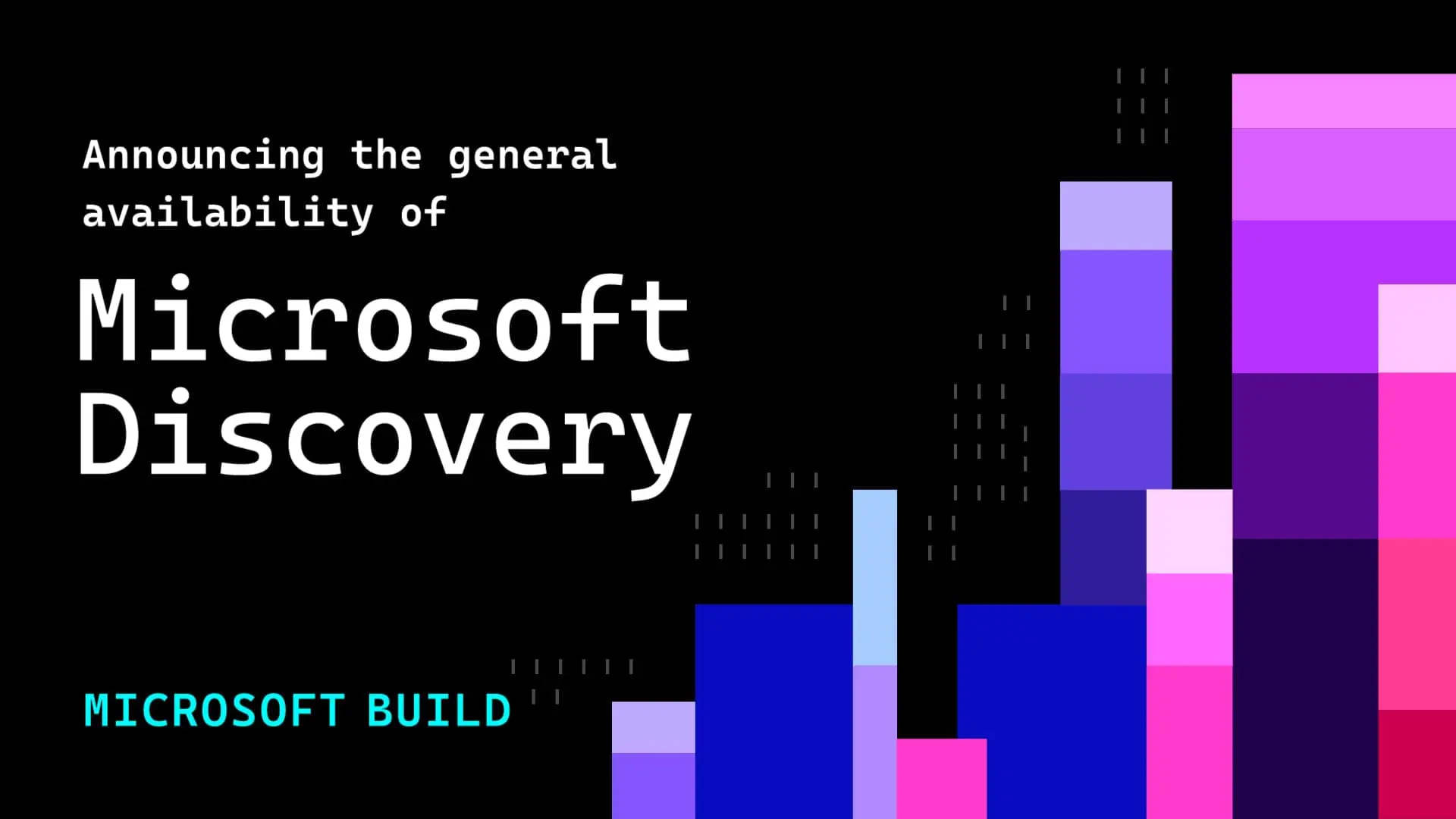
Microsoft is now making its Discovery platform generally available to all organizations, offering a system designed to govern and build agentic AI workflows specifically for complex research and development. Unlike broadly focused AI tools, Microsoft Discovery was shaped by direct input from teams applying AI to intricate R&D processes; their feedback reinforced the need for agentic AI to support iterative loops, evidence preservation, and tool coordination central to scientific work. The platform aims to integrate with existing institutional knowledge and specialized tools, rather than replace them, keeping human judgment at the core of scientific decisions. Microsoft highlights the platform’s focus on repeatable, evidence-driven exploration within established R&D environments. Microsoft is also previewing a local desktop application, offering researchers offline access to the Discovery platform after its initial release in private preview last year at Microsoft Build.
Microsoft Discovery Enables Agentic R&D Workflows
Last year’s private preview of Microsoft Discovery, beginning at Microsoft Build, has culminated in a generally available platform that is reshaping how scientific and engineering organizations approach research and development. Beyond accelerating existing workflows, Microsoft Discovery aims to fundamentally alter the iterative process of discovery, moving beyond isolated analysis toward repeatable, evidence-driven exploration. The platform’s core strength lies in its ability to coordinate specialized agents, connecting them to institutional knowledge, external scientific data, and crucial analytical tools, a capability directly informed by feedback from organizations applying AI to complex R&D challenges. Teams can now leverage Microsoft Discovery to define agentic workflows, enabling the creation and coordination of specialized AI agents that move from evidence to hypotheses, through execution and analysis, and into the next iteration of a project.
This focus on reproducibility, reviewability, and appropriate governance was central to the platform’s development; workflows must remain transparent and align with established R&D operating models. The platform is designed to work within existing R&D environments, not replace them, ensuring human judgment remains central to scientific and engineering decisions. Available via GitHub with a GitHub Copilot account, the app lowers the barrier to entry for hands-on exploration of agentic AI, offering a practical starting point for literature review, hypothesis generation, and iterative experimentation. As projects mature, work developed locally can be seamlessly integrated into the full Microsoft Discovery platform for more advanced R&D programs. Early adopters are already demonstrating the platform’s potential across diverse fields; a collaboration between Yale Engineering and Microsoft, for example, utilized the Discovery Engine to advance agentic small molecule design for grid-scale aqueous organic redox flow batteries (ORFBs).
Microsoft Discovery Engine Supports Iterative Scientific Loops
The pursuit of scientific breakthroughs increasingly relies on complex, iterative research and development cycles, demanding tools that move beyond simple data analysis to actively support the entire process. While numerous artificial intelligence platforms offer assistance with specific tasks, a growing need exists for systems capable of coordinating workflows, preserving evidence, and integrating diverse data sources, a gap Microsoft aims to address with its Discovery Engine. Central to Microsoft Discovery’s functionality is its ability to define agentic workflows tailored to specific research programs. Teams can construct and coordinate specialized agents, connecting them to both internal institutional knowledge and broader scientific information repositories. This allows for orchestration of work across modeling, simulation, analysis, and validation tools, all driven by the core loop of the Microsoft Discovery Engine.
This engine facilitates movement from initial evidence through hypothesis formation, execution, analysis, and ultimately, the next iteration of exploration, enabling repeatable, evidence-driven research where assumptions can be questioned and search spaces narrowed in a transparent manner. The most challenging problems, Microsoft contends, require more than just a prompt interface or a single model response; they demand integration with specialized tools, access to experimental data, and support for rigorous review processes. A materials scientist, for example, might need to evaluate performance, safety, and cost alongside manufacturability and regulatory constraints, a complex interplay Discovery is designed to manage. This app offers a simplified entry point for exploration, allowing users to begin working with Discovery capabilities without a full enterprise deployment, and can seamlessly integrate with the larger platform as projects evolve.
Together, agentic AI and autonomous labs will change every part of the scientific process. Iteration cycles will get faster, experiments will require less manual hands-on time, and computational analyses will become more systematic and exhaustive. By making both easier to use, Microsoft and Ginkgo aim to bring greater speed, scale and reproducibility to pre-clinical research.
Jason Kelly, CEO, Ginkgo Bioworks, Inc.
Reproducibility and Governance in Production R&D Environments
Following a year-long private preview initiated at Microsoft Build, the Microsoft Discovery platform has reached general availability, signaling a deliberate maturation process informed by real-world application within complex research and development environments. This emphasis on robust workflows stems from recognizing that breakthroughs in science and engineering rarely arise from single insights, but rather from cycles of hypothesis, experimentation, refinement, and rigorous review. A key consideration during development was ensuring workflows remain reproducible, outputs are reviewable, and proprietary knowledge is appropriately governed; these factors, alongside continuous customer feedback, shaped the platform’s capabilities. Microsoft Discovery is explicitly designed to integrate within existing R&D infrastructures, acting as an augmentation to expert judgment rather than a replacement for it. The platform facilitates understanding of the reasoning behind outputs, keeping human oversight at the core of scientific and engineering decision-making.
This approach addresses a critical need for traceability, particularly in fields like materials science, where evaluating performance, safety, cost, manufacturability, and regulatory compliance demands a holistic and verifiable process. Similarly, semiconductor teams exploring expansive design spaces require maintaining physical fidelity and a clear audit trail, while life sciences researchers must connect literature, experimental data, models, and cohort evidence before validation. Expanding access to these capabilities is the newly previewed Microsoft Discovery app, a localized desktop experience intended for researchers, students, and academic labs. This move aims to lower the barrier to hands-on exploration, enabling early-stage research projects and individual investigations to benefit from the platform’s features.
Together, Microsoft and PNNL are pioneering a new model for science, where robotics and autonomous laboratories fuse with AI and cloud infrastructure into one intelligent, closed-loop discovery engine that dramatically reduces the timeline from ideas to breakthroughs and opens the door to a new era of innovation in energy, biology, and material synthesis.
Robert Runkle, Physicist and Lead for Autonomous Discovery Strategy, Pacific Northwest National Laboratory
Microsoft Discovery App Expands Access for Early Exploration
Microsoft is actively addressing this barrier with the general availability of Microsoft Discovery, a platform for building and governing agentic AI workflows, alongside the preview release of the Microsoft Discovery app, designed to democratize access for individual researchers and smaller teams. This expansion isn’t simply about offering another AI tool; Microsoft Discovery specifically targets the complex, iterative workflows characteristic of research and development. Organizations applying AI to these intricate processes informed the platform’s development, reinforcing the need for AI that supports evidence preservation, tool coordination, and the cyclical nature of scientific inquiry. The platform moves beyond simple prompt interfaces, recognizing that challenging R&D problems demand integration with institutional knowledge, specialized analytical tools, and validation data, all while supporting rigorous review processes.
Available for download on the Microsoft Discovery GitHub with a GitHub Copilot account, it allows researchers, students, and academic labs to begin exploring the platform’s capabilities without requiring a full enterprise deployment. This preview extends Microsoft Discovery to earlier stages of exploration, where research ideas often originate as small-team projects or individual investigations. “An important goal for Microsoft is to make advanced AI and computing capabilities more accessible to the people working on some of today’s most difficult scientific and engineering challenges,” the company stated. The app is designed to facilitate literature exploration, hypothesis generation, scientific reasoning, and iterative experimentation within a researcher’s existing environment, with the potential to seamlessly integrate into the larger Microsoft Discovery platform as projects scale.
This tiered approach, from individual exploration with the app to enterprise-level R&D programs, allows for a progressive adoption of agentic AI, ensuring that the benefits of automation and insight are available across the entire spectrum of scientific endeavor. As projects mature and complexity increases, researchers and teams can bring work developed locally into Microsoft Discovery to support more advanced programs, creating a cohesive and scalable research environment.
Scientific discovery depends on connecting trusted evidence with increasingly powerful AI systems. By bringing Wiley’s authoritative life sciences research into Microsoft Discovery, we can help life sciences and pharmaceutical teams accelerate hypothesis generation, experimentation, and results interpretation across a continuous scientific reasoning loop.
Josh Jarrett, Senior Vice President and General Manager of Applied Research Intelligence at Wiley
Agentic Design Advances Aqueous Organic Redox Flow Batteries
The pursuit of sustainable energy storage has long focused on lithium-ion technology, yet a growing body of research suggests aqueous organic redox flow batteries (ORFBs) represent a compelling alternative, offering potential advantages in cost, safety, and environmental impact. Optimizing these systems, however, presents a formidable challenge; electrolytes must simultaneously satisfy a complex interplay of chemical properties, including redox potential, solubility, and synthetic feasibility. Recent advancements demonstrate how agentic AI, specifically through the Microsoft Discovery platform, is accelerating materials discovery in this critical field, moving beyond simple data analysis to actively guide experimental design. The team didn’t simply ask an AI to suggest molecules; they built a system capable of ensuring transparency and trust throughout the process. This involved constructing an agentic loop that drove in-silico exploration, interpreted experimental results, and proposed diagnostic experiments, a process far removed from traditional, static computational chemistry.
Experts at Yale Engineering maintained control, verifying interpretations and assessing the practical applicability of the AI-generated designs for grid-scale aqueous organic redox flow batteries (ORFBs), highlighting a crucial element of the platform: it functions within existing R&D environments. This isn’t merely a tool for accelerating existing workflows, but a platform designed to address the specific needs of complex research and development. The platform’s capabilities extend beyond battery science, as demonstrated by ongoing work at the Georgia Institute of Technology, where researchers are employing a multi-agent AI system to re-evaluate the prebiotic plausibility of histidine, an amino acid central to biological processes. This project, requiring integration of diverse datasets from mass spectrometry, literature, and planetary missions, showcases the platform’s ability to handle inherently multimodal data, a challenge that has historically stymied classical machine learning approaches.
Our collaboration with the Microsoft Discovery team through the Georgia Tech AI for Research program has been highly valuable, both scientifically and operationally. Working together on agentic AI systems to probe questions about the origins of life has given us early exposure to the state of the art embodied in the Discovery platform, while also enabling genuinely close technical collaboration. This hands-on partnership has enabled meaningful bidirectional learning.
Amirali Aghazadeh, Assistant Professor, School of Electrical and Computer Engineering, Georgia Tech



See today’s quantum computing news on Quantum Zeitgeist for the latest breakthroughs in qubits, hardware, algorithms, and industry deals.