He never ran a quantum lab, yet few people have done more to steer how the United States funds and governs the technology.
He shaped quantum policy without running a laboratory. Michael Kratsios has held the most senior technology posts in the US government. Few people have done more to decide how the money is spent.
The National Quantum Initiative is the concrete piece. Signed in 2018, it committed federal funding and set up research centres. It is the framework most American quantum work now sits inside.
He came from finance, not academia. His route to office ran through investing rather than research. From 2014 to 2017 he was a principal and chief of staff at Thiel Capital.
He held the Pentagon research job and the CTO job at the same time. From July 2020 to January 2021 he was acting Under Secretary of Defense for Research and Engineering. The civilian and military research briefs sat with one person.
The Act built two networks of centres, not one programme. The Department of Energy set up five research centres led by national laboratories. The National Science Foundation funded Quantum Leap Challenge Institutes on the university side.
A June 2026 executive order set the current assignment. President Trump signed order 14413 on June 22, 2026, one of two quantum orders signed that month. A White House summit followed on July 7, 2026 to discuss how it would be delivered.
- A politics graduate now runs federal science policy
- He came to the White House from Thiel Capital
- A 2018 law put three agencies under one programme
- He ran Pentagon research while still serving as US CTO
- The Senate returned him to the White House by 74 votes to 25
- Budgets and coordination offices, not experiments
- One office holds the AI brief and the quantum brief
- A June 2026 executive order set the next assignment
- Frequently asked questions
A politics graduate now runs federal science policy
Michael Kratsios directs the White House Office of Science and Technology Policy and serves as science adviser to the President, a post the Senate confirmed him to in March 2025. He is the thirteenth director of that office, and his degree is an AB in politics from Princeton University, taken in 2008. He was born on November 7, 1986 in Salisbury, Maryland. Both facts come from his sworn 2025 questionnaire to the Senate Commerce Committee.
Before this job he was the fourth Chief Technology Officer of the United States, confirmed by the Senate on 1 August 2019 and in office the next day. From July 2020 he also served as acting Under Secretary of Defense for Research and Engineering, holding both roles until January 2021. He reached Washington through investing rather than through research.
He is not a physicist. He has never published quantum research. What he decides instead are budgets, coordination offices and the priorities that federal agencies are told to work to. Quantum computing has run through every post he has held, and it has never been the only item on the desk.
He came to the White House from Thiel Capital
Before entering government Michael Kratsios worked in Silicon Valley finance. From 2014 to 2017 he was a principal and chief of staff at Thiel Capital, the investment firm of the entrepreneur Peter Thiel. Before that he was chief compliance officer at Clarium Capital Management from 2011 to 2014, and at Thiel Capital and Thiel Macro from 2012 to 2014.
Joining the first Trump administration
Kratsios joined the White House in 2017. His title was Deputy Assistant to the President for Technology Policy, and the brief covered artificial intelligence, advanced computing and emerging fields such as quantum information science. Quantum information science was one part of that brief.
On 1 August 2019 the United States Senate confirmed Kratsios by unanimous consent as the fourth Chief Technology Officer of the United States, and he took office the following day. The position sits within the Office of Science and Technology Policy and carries responsibility for advising on the technological dimensions of national policy.
A 2018 law put three agencies under one programme
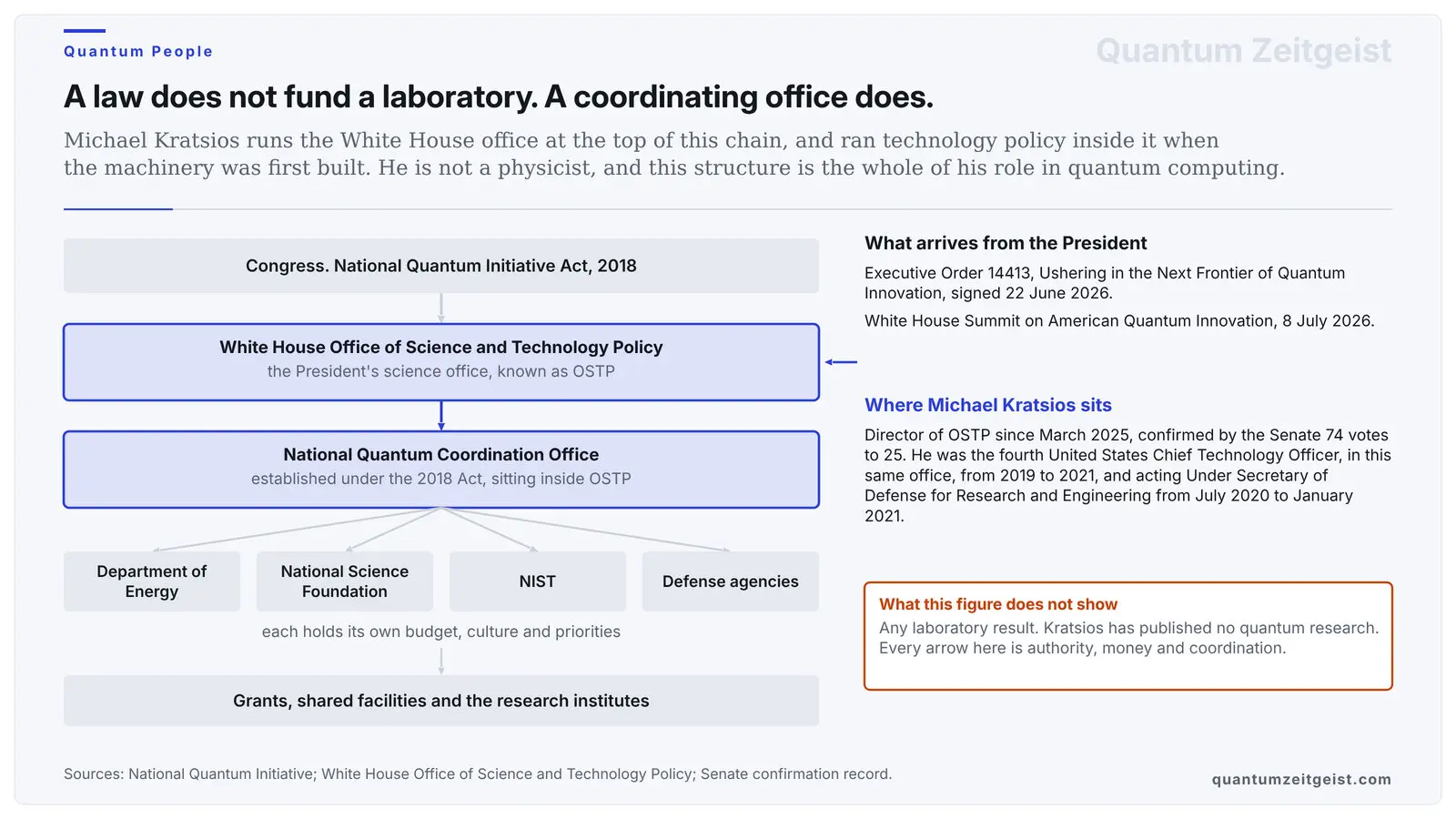
Congress passed the National Quantum Initiative Act in late 2018 and it was signed that December, a bipartisan law to accelerate quantum research and coordinate work across federal agencies, universities and industry. It authorised a coordinated federal programme across the Department of Energy, the National Science Foundation and the National Institute of Standards and Technology. The initial authorisation was $1.275 billion over five years. The challenge after passage was implementation, and that fell heavily on the Office of Science and Technology Policy where Kratsios worked.
Building the coordination machinery
The Act itself required a National Quantum Coordination Office, and it was stood up in March 2019, while Kratsios was the President’s deputy assistant for technology policy at the White House. Before the Act, quantum research was funded through the ordinary grant machinery of several agencies that did not coordinate with each other. The coordination office sits inside the White House science office. Its job is to make the agencies line up.
The Act created two networks of centres rather than one central programme. The Department of Energy established five National Quantum Information Science Research Centers, each led by a national laboratory and each with a different emphasis. The National Science Foundation funded a set of Quantum Leap Challenge Institutes on the university side, and industry participation was written into both rather than encouraged afterwards.
The Act also directed agencies to fund training and education explicitly, on the reasoning that a country cannot buy its way into a technology it has nobody to build. In his sworn 2025 questionnaire to the Senate, Kratsios says he spearheaded a programme to create a network of artificial intelligence and quantum research institutes. He also says he secured a large increase in federal research funding.
He ran Pentagon research while still serving as US CTO
In July 2020 Michael Kratsios became acting Under Secretary of Defense for Research and Engineering, the official responsible for steering the technological edge of the United States military. He held that post until January 2021, and he did not give up the Chief Technology Officer job to take it.
Quantum sensing, secure communications and code-breaking potential all sit within defence planning, and those were the quantum areas that fell under the Pentagon office he was running. For that period he was helping to shape the civilian research budget and the military research budget at once. One person held both briefs.
The Senate returned him to the White House by 74 votes to 25
Michael Kratsios left government in early 2021. From March 2021 until January 2025 he was managing director and head of strategy at Scale AI, a company that supplies data infrastructure for artificial intelligence systems. He left the company in January 2025, a month after the nomination was announced. By then he had worked on technology policy inside the White House, inside the Pentagon and inside a private company.
In December 2024 President-elect Donald Trump announced his intention to nominate Kratsios to lead the Office of Science and Technology Policy. The United States Senate confirmed him on March 25, 2025 by 74 votes to 25. He became the thirteenth director of the office and the science adviser to the President.
He was 38 years old at confirmation, and he does not hold a doctorate. His 2019 confirmation as Chief Technology Officer had passed by unanimous consent, and the 2025 one was recorded at 74 votes to 25.
Budgets and coordination offices, not experiments
Michael Kratsios has not designed a qubit, proved a theorem, or run an experiment that advanced the physics. His relevance is institutional and financial, expressed through budgets, coordination offices, national strategies and the priorities he sets for federal agencies. That is a different kind of contribution from a laboratory result, and it is the one the record supports.
The levers are funding, talent and shared facilities
Quantum progress depends on more than the physics. The field needs stable funding, talent pipelines, shared facilities and clear national priorities, and those are the levers that someone in Kratsios’s position controls.
Decisions about whether to fund a particular qubit technology, or to build a shared national facility, determine which research directions get money. Those decisions are taken by officials and agencies. The researchers applying for the grants do not take them.
One office holds the AI brief and the quantum brief
Quantum computing has rarely been Michael Kratsios’s only focus. He has been closely associated with artificial intelligence strategy across both of his stints in government, and in his second tour the administration’s AI plans have run through his office.
The two agendas are linked in practice. Quantum and artificial intelligence are funded, promoted and governed together, which is why the same official tends to oversee both.
Artificial intelligence produces results on a shorter horizon. Quantum computing does not, and the two therefore compete for attention inside one office, which shapes how the government talks about milestones such as quantum supremacy. Kratsios holds both briefs.
A June 2026 executive order set the next assignment
President Trump signed an executive order titled Ushering in the Next Frontier of Quantum Innovation, numbered 14413, on June 22, 2026. It was one of two quantum orders signed that month, and the second addressed the federal transition to post-quantum cryptography. The White House Summit on American Quantum Innovation followed on July 7, 2026, convening senior government officials and quantum company leaders to discuss how the order would be delivered.
The 2018 Act set up the coordination machinery, and the 2026 order is the next instruction to run through it. Kratsios directs the office where that machinery sits.
What can be checked about him is a list of posts, dates and votes rather than a list of results. He has held the Chief Technology Officer job, the Pentagon research job and the directorship of the science office, and the quantum brief has travelled with him through all three.
Frequently asked questions
Who is Michael Kratsios?
What is Kratsios’s current role?
Is Kratsios a quantum physicist?
What did he do for quantum computing?
What was his background before government?
Was he ever involved with the Department of Defense?
When was Kratsios born and where did he study?
What influence does Kratsios have over quantum research?
What is the National Quantum Initiative?


See today’s quantum computing news on Quantum Zeitgeist for the latest breakthroughs in qubits, hardware, algorithms, and industry deals.