

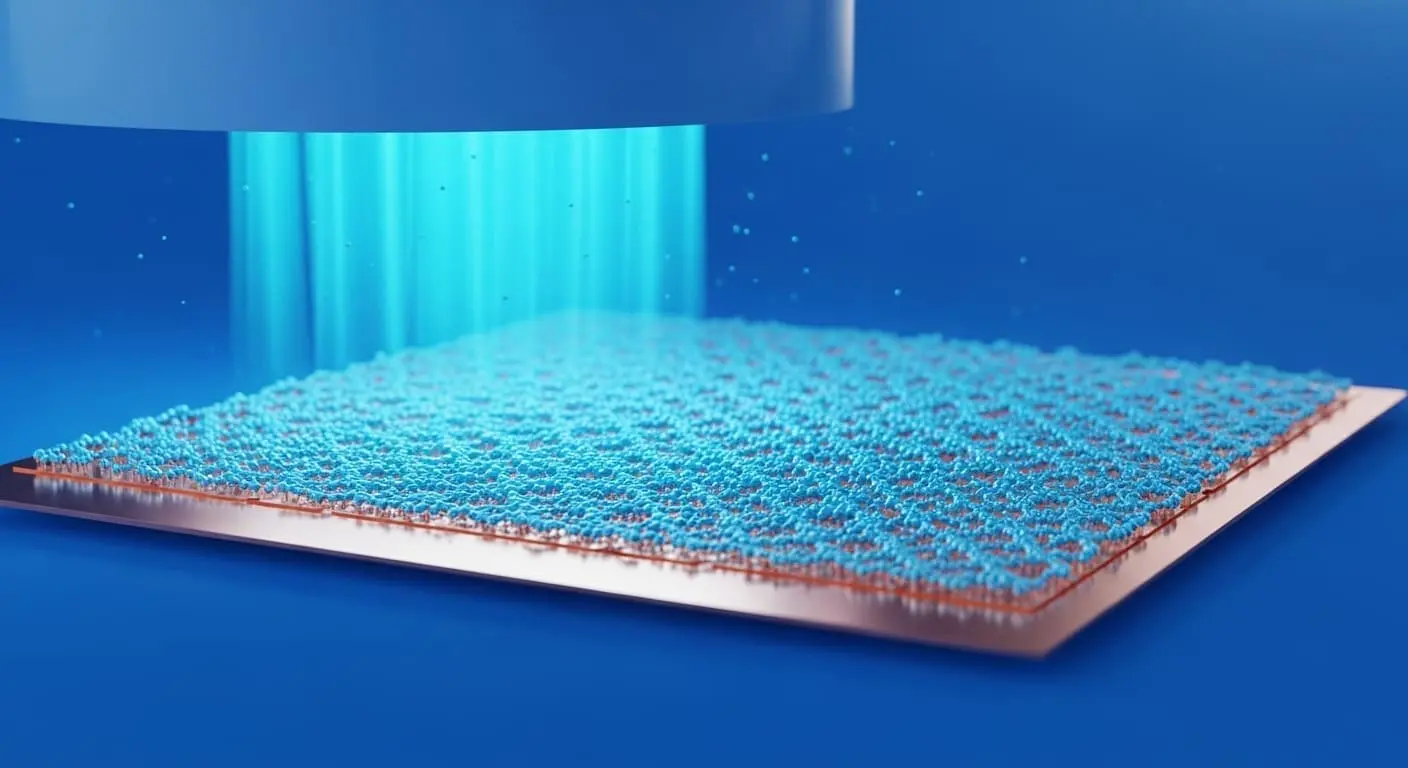
A new method for dynamically controlling visible light enables advanced technologies such as holographic displays and adaptive optics. Tom Hoekstra of the University of Amsterdam and colleagues demonstrate a hybrid-2D excitonic metasurface platform capable of independently controlling both the amplitude and phase of light in the visible regime, overcoming limitations found in existing dynamic metasurfaces. By utilising the excitonic response of monolayer WS 2, the team designed a device exhibiting a full 0-2π phase range with a uniform amplitude profile, and further extended this to achieve reconfigurable beam-steering. The device highlights the potential of hybrid-2D excitonic metasurfaces for electrically tunable wavefront shaping and represents a key advance in the field of nanophotonics.
Visible light manipulation via independent amplitude and phase control using a tungsten diselenide
Independent control of amplitude and phase is now achieved across the full 0-2π range in the visible spectrum, a capability previously limited to the infrared. This advancement is particularly significant as the visible spectrum presents greater challenges for dynamic control due to the higher frequencies involved and the limitations of available materials. A carrier density of 3.5x 10 12cm -2 achieved critical coupling, enabling this previously unattainable level of control. Critical coupling occurs when the rate at which energy is fed into the system equals the rate at which it is lost, maximising the interaction between light and the metasurface. The platform validated its capabilities through a reconfigurable beam-steering metadevice, paving the way for electrically tunable wavefront shaping and advanced optical technologies, surpassing existing technologies that invariably alter light’s brightness when manipulating its phase. Traditional methods of phase modulation often rely on changing the refractive index of a material, which inherently affects the amount of light transmitted or reflected, leading to amplitude variations. This new approach decouples these two parameters.
A second tunable monolayer of tungsten diselenide enabled independent control of both amplitude and phase across the complete 0-2π range, and was then successfully applied to a reconfigurable beam-steering metadevice. The design pipeline employed Bayesian optimisation and an evolutionary algorithm to maximise performance under realistic fabrication constraints, yielding a highly efficient metasurface. Bayesian optimisation is a probabilistic approach that efficiently explores the design space, while the evolutionary algorithm mimics natural selection to refine the metasurface structure. These computational methods are crucial for navigating the complex parameter space involved in metasurface design. While experiments ground simulations in measured material properties, the current models do not yet account for the impact of fabrication imperfections or long-term material stability on device performance. Nanoscale fabrication processes are inherently prone to imperfections, and these can significantly affect the optical properties of the metasurface. Furthermore, the long-term stability of the tungsten diselenide monolayer under electrical bias needs to be investigated.
Harnessing the excitonic response, the way a material absorbs and re-emits light, similar to how a radio antenna receives and transmits signals, was central to this development. Excitons are bound electron-hole pairs created when a material absorbs photons, and their properties can be tuned by external stimuli like electric fields. A metasurface, a tiny surface patterned with nanoscale structures that can bend and shape light like a lens or prism, engineered and integrated with atomically thin layers of tungsten diselenide. Tungsten diselenide (WS 2 ) is a transition metal dichalcide (TMD) with strong excitonic properties and high electron mobility, making it an ideal material for this application. This electrical tunability allows the way it interacts with light to be altered, effectively controlling the amplitude and phase of reflected light waves. The nanoscale structures of the metasurface are designed to resonate with specific wavelengths of light, enhancing the interaction with the excitons in the tungsten diselenide.
Precise manipulation of light’s properties is now possible, enabling the creation of a platform for active optical devices. The device utilises electrically tunable excitons, quasiparticles formed when a material absorbs light, to manipulate reflected light waves. Critical coupling occurred at a carrier density of 3.5x 10 12cm -2, where the metasurface’s radiative loss rate matched overall dissipation, enabling a pi-phase modulation with uniform amplitude. This means that the rate at which light is emitted from the metasurface is equal to the rate at which energy is lost due to absorption and other processes. This balance is essential for achieving efficient phase modulation without affecting the amplitude. This approach circumvents limitations of existing metasurfaces which struggle to maintain amplitude control during broad phase modulation, offering a strong advantage in device design. Previous metasurface designs often exhibit a trade-off between phase modulation range and amplitude stability, limiting their functionality.
Independent phase and amplitude control unlocks dynamic light steering potential
The promise of dynamically steering light with metasurfaces hinges on precise control, but current designs often force a trade-off between manipulating a light wave’s direction and maintaining its brightness. This work elegantly sidesteps that issue, demonstrating independent control of both phase and amplitude, though it relies heavily on numerical modelling. Beam steering is a crucial function in many optical systems, including laser scanners, optical communications, and adaptive optics. A key question remains unanswered: how will imperfections introduced during actual device fabrication impact performance. The sensitivity of the device to fabrication variations needs to be carefully assessed to ensure its practical viability.
It is important to acknowledge that these findings currently rely on simulations. However, this work establishes a clear pathway towards electrically controlled light manipulation, a significant step beyond existing passive metasurfaces which lack dynamic control. Passive metasurfaces are fixed structures that cannot be reconfigured after fabrication, limiting their applications. Demonstrating independent control of both light’s direction and brightness opens possibilities for advanced displays and optical systems, and even imperfect devices built on these principles would represent a substantial improvement. Potential applications include holographic displays with improved image quality, adaptive optics for correcting atmospheric distortions in telescopes, and miniaturized optical sensors.
A new platform for manipulating light by independently controlling its phase and amplitude has been established, a feat previously difficult to achieve simultaneously. By combining nanoscale structures with atomically thin tungsten diselenide, an artificial material engineered to control light, a metasurface was created, capable of full 0-2π phase modulation with consistent brightness. This hybrid design achieves dynamic control in the visible spectrum, validating the potential of this approach for advanced optical technologies, including holographic displays and adaptive optics. The ability to dynamically control light at the nanoscale opens up exciting new possibilities for manipulating light-matter interactions and developing innovative optical devices.
The researchers demonstrated a new metasurface platform capable of independently controlling the phase and amplitude of visible light. This achievement is significant because existing metasurfaces typically struggle to modulate phase without also altering the brightness of light. By combining nanoscale structures with monolayer tungsten diselenide, they created a device offering full 0-2π phase modulation with a uniform amplitude profile. The authors note that further work is needed to assess the impact of fabrication imperfections on device performance.
👉 More information
🗞 Hybrid-2D Excitonic Metasurfaces for Complex Amplitude Modulation
🧠 ArXiv: https://arxiv.org/abs/2604.07619



See today’s quantum computing news on Quantum Zeitgeist for the latest breakthroughs in qubits, hardware, algorithms, and industry deals.



