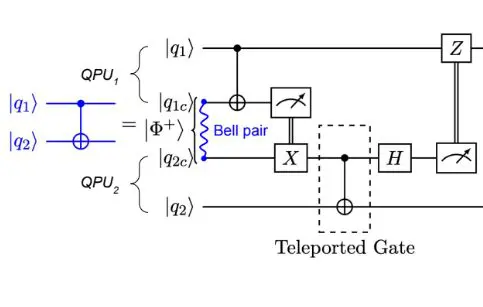
memQ Inc., a Chicago-based company, is directly comparing gate teleportation and circuit cutting as potential solutions for scaling distributed quantum computing. Researchers from memQ Inc. and the Math and Computer Science Division of Argonne National Laboratory published their findings in Advanced Quantum Technologies Volume 9, Issue 9, focusing on linking multiple smaller quantum processors rather than improving single units.
The study models noisy remote gates and circuit cuts, identifying conditions where gate teleportation could outperform traditional methods; the team suggests “a 10-fold reduction in the present M2O transducer noise added figures would favor generating multipartite entangled states with remote gates over circuit cutting.” This work informs hardware metrics and proposes a hybrid approach to minimize quantum runtime.
Modeling Noisy Remote Gates with M2O Transducers
Researchers modeled noisy remote gates utilizing microwave-to-optical (M2O) transducers to entangle superconducting qubits, focusing on the impact of transducer noise on Bell pair state preparation circuits. This simulation injected noisy Bell pairs into remote CNOT gates, allowing for a comparative analysis against circuit cutting as a method for generating Greenberger-Horne-Zeilinger (GHZ) states between processor modules. The study assessed Hellinger fidelity’s dependence on dominant error parameters for both approaches, pinpointing conditions where each technique performs optimally.
The work identifies specific break-even points where noisy remote gates achieve comparable performance to gate cuts, suggesting a nuanced relationship between the two methods rather than a simple superiority of one over the other. This finding highlights a clear pathway for improving the viability of remote gate techniques through targeted hardware development.
The research team’s work, conducted by researchers from memQ Inc. and the Math and Computer Science Division of Argonne National Laboratory, demonstrates a focus on practical implications for distributed quantum computing, rather than solely on enhancing single-processor performance.
This emphasis on linking multiple smaller quantum processors is increasingly important as the field moves towards more complex and scalable architectures, as evidenced by publications like “Scalable Networking of Neutral-Atom Qubits: Nanofiber-Based Approach for Multiprocessor Fault-Tolerant Quantum Computers.” The simulation results contribute to a growing body of work, including “Freely Scalable Quantum Technologies Using Cells of 5-to-50 Qubits with Very Lossy and Noisy Photonic Links,” that explores the challenges and opportunities of building interconnected quantum systems.
Freely Scalable Quantum Technologies Using Cells of 5-to-50 Qubits with Very Lossy and Noisy Photonic Links.
Circuit Cutting Overhead and Exponential Scaling
Distributed quantum computation traditionally relies on circuit cutting, a technique now understood to generate exponentially increasing demands for sub-circuit sampling and classical post-processing as the number of cuts rises. This scaling issue presents a fundamental challenge to building larger, more complex quantum systems, as computational resources required for verification grow rapidly with each additional cut. While gate teleportation sidesteps the exponential overhead of sampling, it demands high-fidelity quantum interconnects, a significant engineering hurdle in itself.
Researchers from memQ Inc. The team’s work builds on prior investigations into modular quantum architectures.
Gate Teleportation in Noisy Quantum Networks with the SquidASM Simulator.
Hellinger Fidelity Comparison of GHZ State Generation
Hellinger fidelity served as the key metric in evaluating the performance of GHZ state generation via remote gates and circuit cuts, allowing for a direct quantitative comparison of the two approaches. Researchers from memQ Inc. and the Math and Computer Science Division of Argonne National Laboratory focused on this specific measure to assess the quality of entanglement produced under noisy conditions, acknowledging that maintaining high fidelity is paramount for practical quantum computation.
Simulations revealed that the optimal strategy isn’t universally defined; instead, it depends heavily on the characteristics of the quantum interconnects and the degree of noise present. This modeling approach contrasts with simply assessing improvements to individual quantum processing units; the focus is explicitly on the challenges of linking multiple smaller processors. Specifically, the simulations explored how the Hellinger fidelity degrades as noise increases, identifying a threshold where circuit cutting becomes more advantageous.
This network-aware approach, where both quantum links and circuit cuts are strategically employed, is presented as a promising route toward minimizing quantum runtime in the near term.
The EU Quantum Flagship’s Key Performance Indicators for Quantum Computing.
Break-Even Points for Gate Teleportation and Cuts
The balance between gate teleportation and circuit cutting hinges on specific performance thresholds, according to new simulations detailed in Advanced Quantum Technologies. While circuit cutting has been the dominant strategy for distributing quantum computation, its overhead grows exponentially as the number of cuts increases, demanding significant classical post-processing. Researchers from memQ Inc. A key finding centers on the role of microwave-to-optical transducer noise. The researchers report that prioritizing reductions in transducer noise could improve the performance of remote gate-based architectures for distributed quantum computing.
The simulations considered the impact of this noise on Bell pair creation and subsequent use in remote CNOT gates, providing a detailed model of end-to-end performance. The team’s modeling approach contrasts with assessments of single-processor improvements, instead emphasizing the interplay between quantum links and circuit cuts.
Review of Distributed Quantum Computing: From Single QPU to High Performance Quantum Computing.
Impact of Transducer Noise on Entangled States
Simulations reveal a direct link between microwave-to-optical transducer noise and the viability of gate teleportation as a method for distributed quantum computation; specifically, the research indicates a 10-fold reduction in existing transducer noise would shift the advantage toward remote gate-based entanglement generation over circuit cutting. The team modeled noisy remote gates utilizing superconducting qubits entangled through these transducers, injecting imperfect Bell pairs into remote CNOT gates to assess performance under realistic conditions.
Comparative simulations of Greenberger-Horne-Zeilinger (GHZ) states, generated using both remote gates and gate cuts, demonstrated a dependence of Hellinger fidelity on the dominant error parameter for each technique. Shapira, et al., “ Scalable Architecture for Trapped-Ion Quantum Computing Using RF Traps and Dynamic Optical Potentials,” details related work on entanglement distribution, but this study focuses on the specific noise profile of M2O transducers. The research, published in Advanced Quantum Technologies, highlights the potential of remote gate techniques, but underscores the critical need for minimizing transducer noise to unlock their full capabilities.
Scalable Architecture for Trapped-Ion Quantum Computing Using RF Traps and Dynamic Optical Potentials.

See today’s quantum computing news on Quantum Zeitgeist for the latest breakthroughs in qubits, hardware, algorithms, and industry deals.