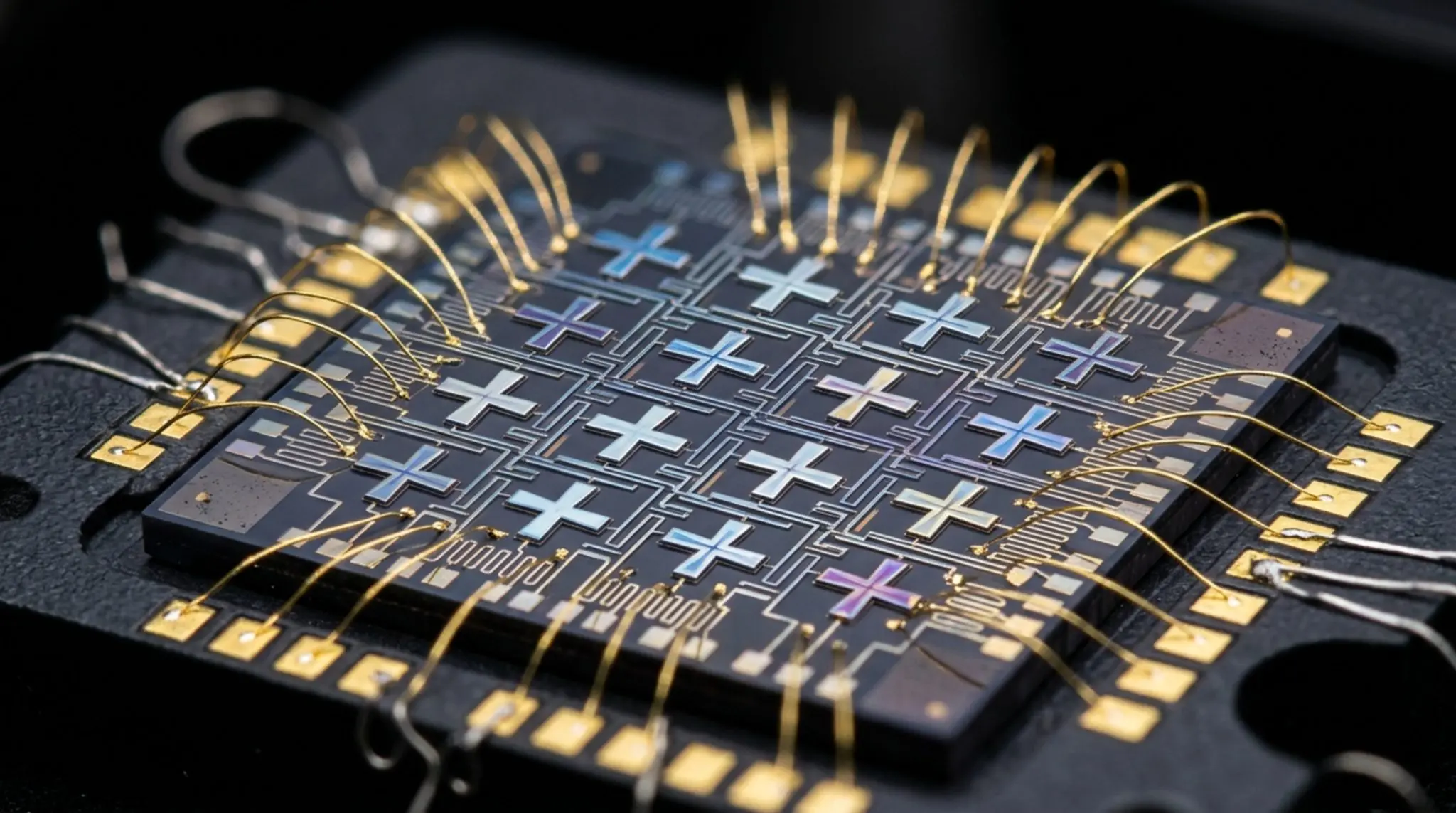
Researchers at the Max-Planck-Institut für Quantenoptik have extended the coherence of nuclear spin qubits to exceed 0.2 seconds, a duration that significantly advances the feasibility of practical quantum memory. The team achieved this milestone by embedding erbium dopants within yttrium orthosilicate and utilizing a cryogenic Fabry-Perot cavity with a linewidth of 65 MHz, smaller than the 0.9 GHz separation of hyperfine levels, to enable frequency-selective enhancement. This combination of nuclear-spin qubits, frequency-selective addressing, and photon emission in the minimal-loss telecommunications C-band positions erbium as a leading candidate for long-range, fiber-based quantum networks.
Cavity-Enhanced Readout of 167Er Nuclear Spin Qubits
A coherence time exceeding 0.2 seconds has been demonstrated in nuclear spin qubits embedded within yttrium orthosilicate, expanding the potential for practical quantum memory and long-distance quantum communication. Researchers at the Max-Planck-Institut für Quantenoptik achieved this milestone by carefully controlling the environment of erbium-167 dopants, effectively silencing disruptive magnetic noise that typically limits qubit performance.
This extended coherence is crucial because it dictates how long quantum information can be reliably stored and processed, a primary bottleneck in building scalable quantum technologies. The team’s approach centers on embedding the 167Er dopants within a YSO crystal and subjecting the system to a magnetic field of 6.8 T. This strong field, as the researchers explain, “freezes” the electronic spins of both the erbium dopants and any paramagnetic impurities present in the material.
These impurities, if left unchecked, introduce fluctuating magnetic fields that rapidly degrade the delicate quantum states of the nuclear spins. By aligning all spins with the applied field, the researchers effectively eliminated this source of decoherence, even in materials with relatively high impurity concentrations, allowing for sustained nuclear spin coherence. This result is an improvement over previous attempts to harness nuclear spins for quantum information storage.
This specific design enables frequency-selective enhancement of photon emission, a technique that allows for the precise targeting and readout of individual nuclear spin qubits. The researchers report a single-shot readout fidelity of 91(2)%.
These dopants exhibit an optical transition at a wavelength of 1536.4 nm, falling within the minimal-loss telecommunications C-band. This is a critical feature for building long-range quantum networks, as it allows for efficient transmission of quantum information over existing fiber optic infrastructure. The team demonstrated frequency-selective spin initialization through optical pumping, repeatedly exciting the system on transitions that change the nuclear spin quantum number by one unit.
This process aligns the nuclear spins, preparing them for coherent manipulation and readout. Spectroscopic analysis of individual erbium dopants revealed distinct peaks corresponding to different hyperfine structures, allowing the researchers to identify and address each qubit individually. When an optical pumping sequence initializes a 167Er dopant into the |−7/2⟩g state, it exhibits a stronger fluorescence intensity on the corresponding spin-preserving transition, allowing for the identification of the eight nuclear spin levels of the dopant as highlighted in the fluorescence trace.
The observed steady increase in frequency from |−7/2⟩e → |−7/2⟩g to |+7/2⟩e → |+7/2⟩g further confirms the precise control over the nuclear spin states. The ability to achieve both extended coherence times and high-fidelity readout, coupled with compatibility with existing telecommunications infrastructure, represents a step toward practical quantum communication.
The researchers emphasize that the frequency-selective addressing allows for coherent control of many individual spin qubits within the same optical mode, up to several hundreds. They write, detailing the precise spectroscopic characteristics of the system, “We study site 1 of Er:YSO, which at zero magnetic field exhibits an optical transition frequency of 1536.4 nm between Z1—the lowest crystal-field level of the ground state—and Y1—the lowest level of the optically excited state.” This level of control, they believe, will be essential for scaling up quantum networks and realizing the full potential of quantum technologies.
Magnetic Field Freezes Impurities, Extending Coherence to 0.2 Seconds
The pursuit of stable quantum memories took a significant step forward as researchers demonstrated coherence exceeding 0.2 seconds. This achievement directly addresses a longstanding challenge in quantum information science: maintaining the delicate quantum state of qubits long enough to perform complex calculations and transmit information over extended distances. Unlike many qubit technologies susceptible to environmental noise, these nuclear spins exhibit remarkable resilience, a quality now amplified by a novel technique for suppressing interference.
A key innovation lies in the application of a substantial magnetic field to effectively “freeze” the behavior of paramagnetic impurities within the yttrium orthosilicate. These impurities, often present in materials, possess fluctuating magnetic moments that introduce noise and accelerate qubit decoherence. The team’s work builds on earlier successes with rare-earth dopant ensembles, previously achieving coherence lasting over a second, but now extends these benefits to individual nuclear spin qubits.
The experimental setup relies on embedding 167Er dopants within the yttrium orthosilicate host crystal and integrating this material into a cryogenic Fabry-Perot cavity. This cavity, meticulously engineered to have a linewidth of just 65 MHz, is significantly narrower than the 0.9 GHz separation of neighboring hyperfine levels. This precise control over the optical environment is crucial for enhancing the frequency-selective emission of photons, enabling a single-shot readout fidelity of 91(2)%.
The ability to generate lifetime-limited photons, those with minimal spectral width, further enhances the efficiency of long-distance communication. This initialization process is a critical step in preparing the qubits for coherent manipulation and readout.
The ability to maintain qubit coherence for over 0.2 seconds, while seemingly brief, is orders of magnitude longer than many other qubit platforms and opens up possibilities for more complex quantum algorithms and longer-distance quantum communication. The team’s findings represent a step in overcoming the limitations that have previously hindered the development of robust and scalable quantum memories.
65 MHz Fabry-Perot Cavity Selectively Enhances Emission
Coherence exceeding 0.2 seconds, a duration crucial for realizing practical quantum memories and long-distance quantum communication networks, has been achieved. The core of this advancement lies in the ability to isolate and control individual nuclear spins, which are naturally shielded from environmental noise and therefore promising candidates for quantum information storage. Previous attempts to directly initialize, control, and read out these qubits faced significant challenges, but the team overcame these by leveraging the unique properties of erbium-doped yttrium orthosilicate.
This material emits photons in the telecommunications C-band, a critical feature for compatibility with existing fiber optic infrastructure, and exhibits exceptional optical coherence even without the cavity enhancement. The 65 MHz linewidth of the Fabry-Perot cavity is a crucial element for achieving high-fidelity readout. As the researchers explain in their work, this narrow linewidth enables frequency-selective enhancement.
This allows for a single-shot readout fidelity of 91(2)%. The combination of nuclear-spin qubits with frequency-multiplexed addressing and lifetime-limited photon emission establishes 167Er as a leading platform for long-range, fiber-based quantum networks.
Frequency-Multiplexing Controls Hundreds of Individual Qubits
The ability to maintain quantum information for extended periods is paramount for building practical quantum technologies, and a newly demonstrated coherence time exceeding 0.2 seconds represents an advance in the field of quantum memory. Central to this achievement is the application of a magnetic field. By suppressing these fluctuations, the team has created an exceptionally stable environment for maintaining quantum information. The approach allows for nuclear spin coherence exceeding seconds and optical coherence exceeding milliseconds, even in materials with substantial impurity concentrations.
The researchers did not stop at simply creating a stable environment; they also developed a method for individually addressing and reading out the states of hundreds of these nuclear spin qubits. This is accomplished through a sophisticated optical setup incorporating a cryogenic Fabry-Perot cavity.
The cavity’s linewidth of 65 MHz is a crucial element in the process. The design of the experiment relies on the unique properties of 167Er dopants in yttrium orthosilicate. Erbium dopants in this host material emit photons in the telecommunications C-band, a crucial advantage for long-range quantum communication because this wavelength experiences minimal loss in standard optical fibers. This paves the way to multiplexed entanglement generation.
The researchers highlighted all eight spin-preserving transitions of a single dopant in a fluorescence trace, confirming their ability to address individual nuclear spin levels. The ability to maintain coherence for over 0.2 seconds, coupled with the high-fidelity readout and the compatibility with existing telecommunications infrastructure, makes this system particularly promising for realizing practical quantum repeaters, which are essential for extending the range of quantum communication beyond the limitations imposed by photon loss in optical fibers.




See today’s quantum computing news on Quantum Zeitgeist for the latest breakthroughs in qubits, hardware, algorithms, and industry deals.