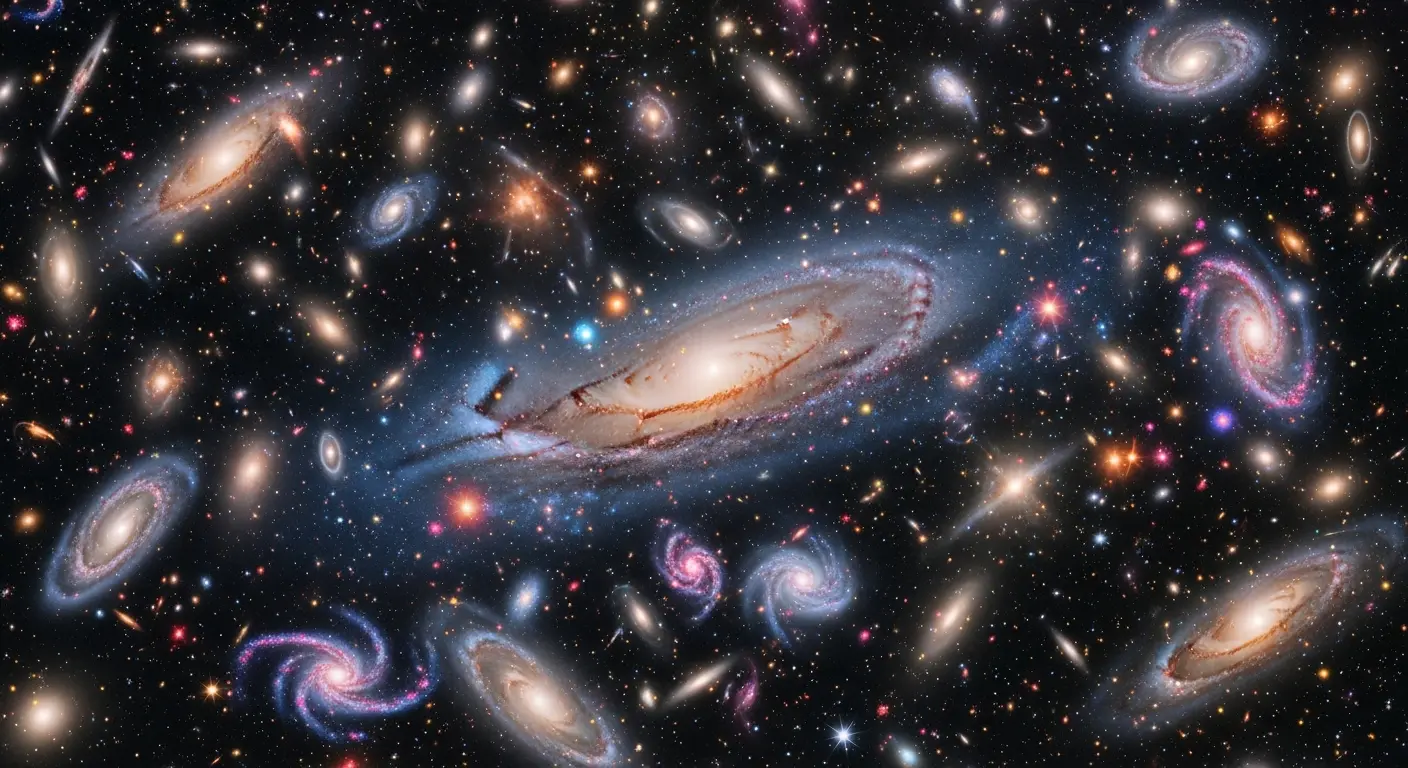
University of California, Riverside research indicates that dark matter, comprising 85% of the universe’s total matter, could explain the unexpectedly rapid formation of supermassive black holes in the early universe. A study led by graduate student Yash Aggarwal demonstrates that the decay of dark matter particles, releasing energy as little as a billion trillionth of that from a single AA battery, may have triggered the direct collapse of primordial gas clouds into these galactic giants. This challenges existing theories that rely on specific stellar conditions to explain such black hole growth so soon after the Big Bang, and aligns with observations from NASA’s James Webb Space Telescope. “Our study suggests that decaying dark matter could profoundly reshape the evolution of the first stars and galaxies,” Aggarwal said, “with widespread effects across the universe,” suggesting a potential bridge between theoretical models and current astronomical data.
Early Universe Black Holes Challenge Standard Formation Theory
This process, previously thought to be rare and dependent on specific stellar conditions, may be far more common than previously understood. The research, published in the Journal of Cosmology and Astroparticle Physics, details how even a minuscule energy release from decaying dark matter particles, a billion trillionth the energy of a single AA battery, could significantly increase the rate of direct collapse. Flip Tanedo, associate professor of physics and astronomy at UCR and Aggarwal’s co-advisor, noted that the team’s work builds on ideas discussed within their group since 2018. “The first galaxies are essentially balls of pristine hydrogen gas whose chemistry is incredibly sensitive to atomic-scale energy injection,” said Tanedo, emphasizing the sensitivity of early galactic conditions. He further suggests that these black holes could serve as a detector for decaying dark matter, a compelling connection between particle physics and astronomical observation, and that the project itself was a product of successful interdisciplinary collaboration.
Dark Matter Decay Models Seed 24-27 eV Direct Collapse
The prevailing understanding of early black hole formation faces increasing scrutiny as observations reveal unexpectedly massive specimens existing within the first billion years after the Big Bang; standard models struggle to account for their rapid growth. University of California, Riverside research suggests a solution lies not within visible matter, but in the enigmatic 85% of the universe composed of dark matter, specifically through a decay process that could significantly accelerate direct collapse black hole formation. The research pinpoints a specific range of dark matter masses, between 24 and 27 electronvolts, as most conducive to seeding these direct collapse events.
Our study suggests that decaying dark matter could profoundly reshape the evolution of the first stars and galaxies, with widespread effects across the universe.
Source: https://news.ucr.edu/articles/2026/04/15/dark-matter-could-explain-earliest-supermassive-black-holes



See today’s quantum computing news on Quantum Zeitgeist for the latest breakthroughs in qubits, hardware, algorithms, and industry deals.