
Scientists at Lanzhou University have developed a new double quasiperiodic mosaic Aubry-André (DMAA) model, revealing the nuanced mechanisms governing transitions between localised and extended quantum states. The model elucidates how these transitions evolve, demonstrating the emergence of multiple localisation-delocalisation phases that extend beyond those observed in simpler quasiperiodic systems. Numerical calculations, corroborated by simulations of experimental polariton modes, confirm the model’s validity and provide a crucial framework for investigating Anderson localisation within quasiperiodic systems.
Continuous modulation reveals doubled transitions in a quasiperiodic system
Researchers have demonstrated a doubling of localisation-delocalisation transitions within a novel quasiperiodic model, exceeding the single transition typically observed in earlier studies. The new double quasiperiodic mosaic Aubry-André (DMAA) model facilitates a continuous evolution from the mosaic Aubry-André (MAA) model, which is characterised by mobility edges, boundaries separating extended and localised states, to the standard Aubry-André (AA) model, which lacks such edges. The AA model, originally proposed by Aubry and André in 1974, exhibits a complete localisation of states for sufficiently strong potential differences, but lacks the more complex behaviour seen with mobility edges. Existing models previously lacked the capacity to smoothly modulate between these two distinct states, hindering a comprehensive analysis of the transition process. The DMAA model achieves this modulation through a carefully constructed superposition of two MAA models, each with distinct potential configurations.
Numerical calculations, employing measures of wavefunction distribution and participation ratios, validate the model’s behaviour and open new avenues for understanding Anderson localisation, the randomising effect of disorder on quantum systems, in complex materials. Specifically, the inverse participation ratio (a measure of wavefunction localisation, with lower values indicating greater localisation), the normalised participation ratio, and the fractal dimension (quantifying the complexity of the wavefunction’s spatial distribution) were all analysed. These calculations confirmed multiple localisation-delocalisation transitions beyond the original single transition predicted by simpler models. The DMAA model’s unique configuration allows for the observation of these additional transitions, providing a more detailed picture of the interplay between order and disorder. Simulations utilising experimental polariton modes, which effectively mimic the behaviour of electrons in solid-state materials, yielded consistent results, validating the model’s potential for real-world application. These simulations explored how the model’s parameters, particularly the amplitude factor controlling the modification of one of the MAA components, affect the number and position of the observed transitions, providing insight into the underlying physics and the sensitivity of the system to external control parameters.
Tunable disorder enables controlled energy flow in novel quasiperiodic structures
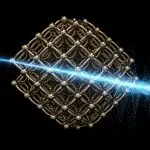
A long-standing goal in condensed matter physics has been to understand how disorder impacts energy flow in materials, a phenomenon known as Anderson localisation. This effect, predicted by Philip W. Anderson in 1958, describes the transition from extended, conducting states to localised, insulating states due to the presence of disorder. Previous work has demonstrated transitions between localised and extended states in quasiperiodic systems, materials exhibiting ordered but non-repeating structures, such as Fibonacci chains and metallic alloys. However, controlling these transitions and harnessing them for technological applications has remained a significant challenge. The double quasiperiodic mosaic Aubry-André (DMAA) model offers a unique approach, allowing a smooth evolution between two distinct states and, crucially, the observation of multiple transitions. The model is constructed by superimposing one primitive MAA model with nonzero even-site potentials and another modified MAA model featuring both nonzero odd-site potentials and a tunable amplitude factor. This allows for a continuous adjustment of the potential landscape experienced by the quantum particle.
A system capable of smoothly transitioning between quasiperiodic structures differing in their energy boundaries was created, and multiple, previously unseen shifts between localised and extended quantum states were observed. This reveals a more complex interaction between order and disorder than observed in simpler systems, potentially enabling the design of materials with tailored energy transport properties. The ability to control the number and position of mobility edges within the DMAA model opens up possibilities for creating materials with specific energy filtering or waveguiding characteristics. Further investigation will focus on exploiting these transitions to control and direct energy flow within the material, potentially leading to advancements in areas such as photovoltaics, thermoelectrics, and quantum information processing. The precise control afforded by the DMAA model represents a significant step towards realising practical applications of Anderson localisation, moving beyond purely theoretical investigations. The 1 and 0 values inherent in the Aubry-André and mosaic Aubry-André models are crucial to the quasiperiodic nature of the potential, and the DMAA model builds upon this foundation to introduce greater complexity and control.
The researchers developed a double quasiperiodic mosaic Aubry-André model demonstrating multiple transitions between localised and extended quantum states. This is significant because it reveals a more complex relationship between order and disorder in quasiperiodic systems than previously understood. By superimposing two mosaic Aubry-André models with tunable parameters, they observed shifts in energy boundaries and multiple localisation transitions. The authors intend to further investigate how these transitions can be used to control energy flow within materials.
👉 More information
🗞 On the localization transition from MAA to AA models
✍️ Hangdong Qiu and Yunhua Wang
🧠 ArXiv: https://arxiv.org/abs/2606.24720



See today’s quantum computing news on Quantum Zeitgeist for the latest breakthroughs in qubits, hardware, algorithms, and industry deals.