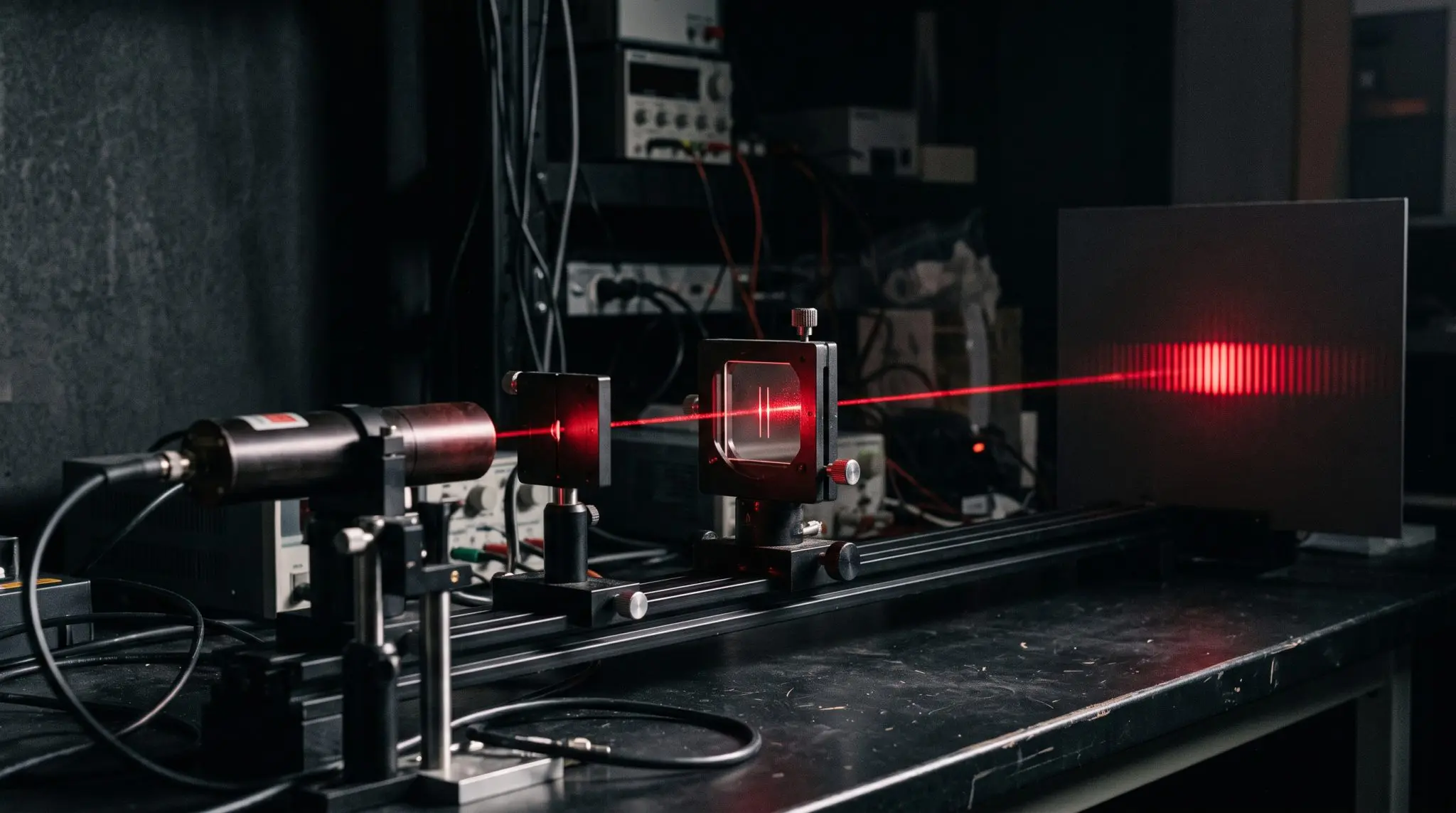
For 20 years, physicists at The University of Texas at Austin have refined a compact laser-plasma accelerator, and that technology will now power LaNeXT, a new facility to reveal nature’s fastest processes in detail. Louisiana State University will host the facility, built in partnership with UT Austin, allowing researchers to capture motion at the atomic and molecular level in billionths and quadrillionths of a second.
“We have been developing these compact laser accelerators at UT for the last 20 years,” said Bjorn “Manuel” Hegelich, associate professor of physics at UT, “And now we are finally at the point where someone else can build one and use it as a tool.” LaNeXT promises to visualize the hidden steps of chemical reactions, material responses and biological processes previously too swift to observe directly.
UT Laser-Plasma Accelerator Drives LaNeXT Facility
LaNeXT, the new Laboratory for X-ray Science and Technology, will generate X-ray pulses as short as 30 femtoseconds, a duration where light travels only approximately the width of a small bacterium. The accelerator’s design allows it to fire 100 times per second, effectively increasing the average power output by a factor of 100 and accelerating the pace of potential experiments. This increased speed is critical for observing processes previously too rapid for direct observation, filling a long-standing gap in scientific methodology.
The unique combination of technologies at LaNeXT, a synchrotron, the UT-designed laser accelerator and advanced sample fabrication, is not found at any other facility globally. Researchers plan to initially expose semiconductor samples to the synchrotron’s beam and then use the ultrafast laser-based X-rays from LaNeXT to measure the resulting changes in the material.
Gerald Schneider, chemistry professor and leader of the LaNeXT team at LSU, said, “For a long time, scientists have had to infer what happens in the middle of a reaction by looking at the starting point and the final result. LaNeXT will let us watch those hidden steps unfold.” Schneider compares the challenge to the wagon-wheel illusion in old Western movies, where a wheel appears to spin backward because the camera isn’t recording fast enough.
Schneider said, “The motion is real, but what we see depends on how fast we take the pictures. LaNeXT gives us a much faster camera for the molecular world.” The facility will also be a testing ground for this new, more energy-efficient particle accelerator design before wider implementation.
We have been developing these compact laser accelerators at UT for the last 20 years.
Bjorn “Manuel” Hegelich, associate professor of physics at UT
LaNeXT Combines Synchrotron and Ultrafast X-ray Probing
Understanding these rapid transformations is particularly relevant to the ongoing effort to revitalize semiconductor manufacturing within the United States, a sector vital to both the tech economy and national security. Beyond semiconductor research, LaNeXT’s technology has the potential to substantially reduce operating costs for existing large-scale synchrotron facilities, offering a path toward more sustainable scientific research.
One of the biggest challenges in modern science is that the most important changes often happen too fast to see directly.
Gerald Schneider, chemistry professor and leader of the LaNeXT team at LSU



See today’s quantum computing news on Quantum Zeitgeist for the latest breakthroughs in qubits, hardware, algorithms, and industry deals.