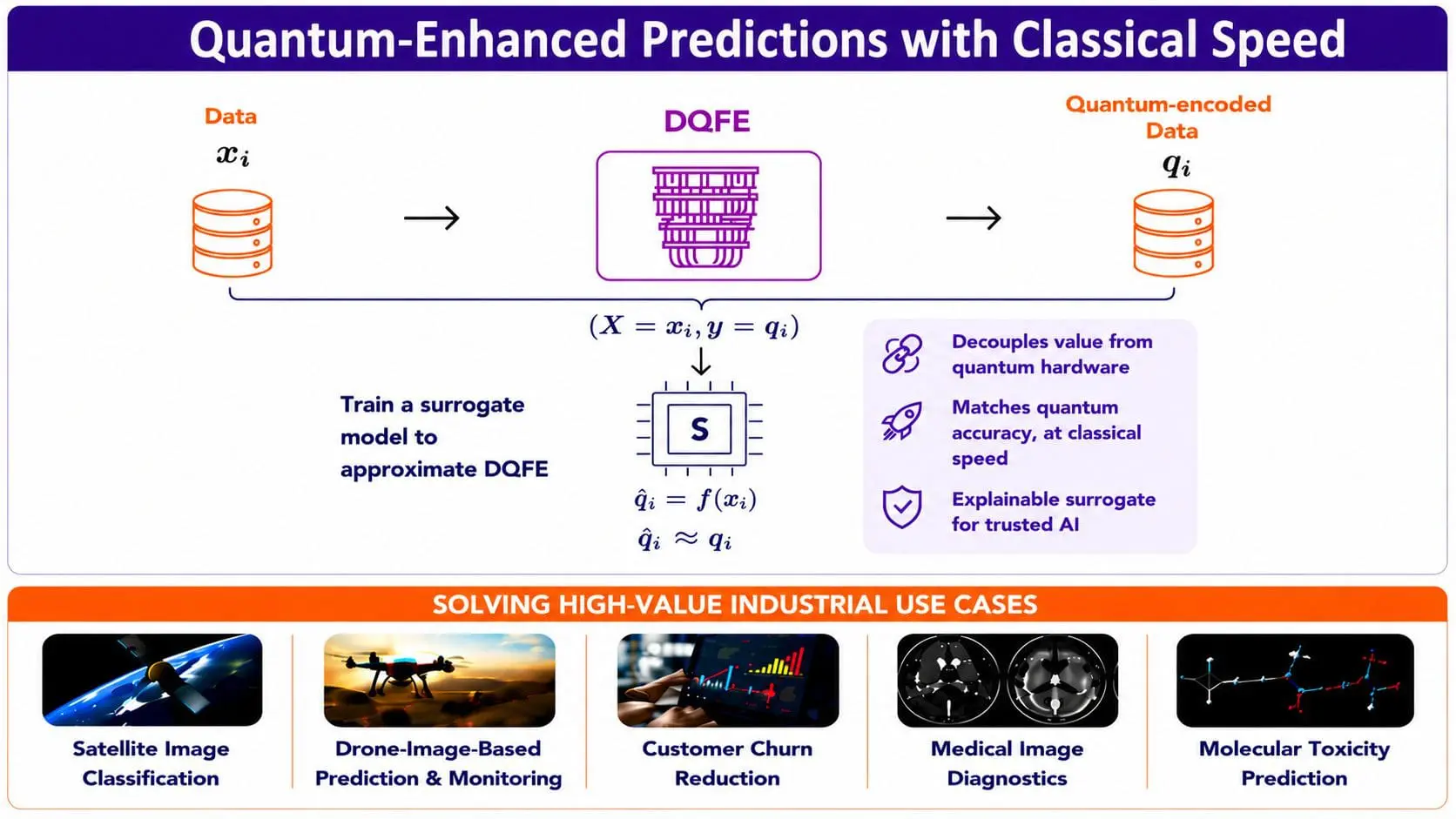
Kipu Quantum has unveiled a new framework that allows machine learning models to be trained on quantum processors and deployed entirely on classical hardware, overcoming a major obstacle to enterprise adoption. Validated using a 156-qubit IBM Quantum Heron r2 processor, the hybrid approach leverages quantum feature extraction to enrich data representations before transferring them to a classical surrogate model for rapid, cost-effective inference. This results in microsecond inference latency and enables retraining on standard machine learning operations cadences, aligning with existing workflows. Demonstrated across commercially significant workloads, the framework delivers approximately 10% accuracy improvement on molecular toxicity classification, an AUC on medical image diagnostics compared to a ResNet-50 baseline, and 3% improvement on satellite imagery, all over strong classical baselines. On a satellite benchmark, the surrogate model perfectly matched the full quantum result, achieving 87% accuracy compared to a classical baseline of 84%. “The quantum feature extraction technique that Kipu Quantum has developed for how quantum and classical compute can work together is another example of finding a cost-effective way to run hybrid, QML workflows,” said a representative from IBM, highlighting the potential for broader industry interest in quantum solutions.
Off-line DQFE Pipeline for Classical Model Training
Quantum machine learning is moving beyond theoretical promise with a new framework enabling deployment on existing classical infrastructure. Kipu Quantum has released a hybrid quantum-classical pipeline designed to extract the benefits of quantum processing for model training, while maintaining the speed and cost-effectiveness of entirely classical deployment. This addresses a primary obstacle to enterprise adoption, as previously quantum machine learning required continuous access to, and processing by, quantum hardware for every prediction. The core innovation lies in an “off-line” approach to quantum feature extraction. Rather than relying on a quantum processor for real-time inference, the system utilizes it solely during a targeted training phase. This phase focuses on identifying correlations best suited to quantum feature extraction, with the resulting data representations then transferred to a lightweight classical surrogate model. Importantly, the quantum processor operates on as little as 20% of the total training data, reducing hardware costs and scaling potential.
Validation of this approach has been demonstrated across several commercially relevant applications, including a 10% accuracy improvement in molecular toxicity classification, an AUC on medical image diagnostics compared to a ResNet-50 baseline, and 3% improvement on satellite imagery. In one benchmark, the classical surrogate model perfectly matched the full quantum result, achieving 87% accuracy against an 84% classical baseline. Industry experts are already recognizing the potential. André König, CEO at Global Quantum Intelligence, notes that “Kipu’s off-line surrogate framework achieves economic quantum advantage by capturing the 2–3% absolute accuracy gains of a quantum processor while running inference entirely on classical hardware.” The framework’s ability to integrate seamlessly with existing infrastructure is also a key advantage, as highlighted by Rika Nakazawa, Chief Commercial Innovation at NTT DATA: “This is the inflection point we’ve been preparing for: measurable accuracy gains, zero quantum dependency at inference, and seamless integration into existing production pipelines.”
Quantum Feature Extraction Improves Accuracy Across Workloads
Recent advances in quantum machine learning have largely focused on demonstrating potential, but translating those gains into practical, deployable systems has remained a significant hurdle. Kipu Quantum has introduced a hybrid quantum-classical framework designed to bridge that gap, enabling quantum-enhanced models to operate within existing enterprise infrastructure. Kipu Quantum reports achieving approximately 10% accuracy improvement on molecular toxicity classification, an AUC on medical image diagnostics compared to a ResNet-50 baseline, and 3% improvement on satellite imagery, all over strong classical baselines. On a satellite benchmark, the classical surrogate model perfectly matched the full quantum result, achieving 87% accuracy compared to a classical baseline of 84%, demonstrating the effectiveness of the transfer learning process.
Rimay Platform Enables Cost-Effective Quantum Advantage
Kipu Quantum is tackling a central challenge in the burgeoning field of quantum machine learning: translating theoretical advantage into practical, cost-effective deployments. This demonstrates the technology’s viability on increasingly sophisticated hardware and moves beyond purely conceptual models. This shift dramatically reduces operational costs and latency; the resulting classical model achieves microsecond inference speeds, comparable to entirely classical machine learning systems. Importantly, this surrogate model isn’t static; it can be retrained on a normal MLOps cadence, aligning with existing enterprise workflows and eliminating the need for constant quantum resource allocation.
The quantum feature extraction technique that Kipu Quantum has developed for how quantum and classical compute can work together is yet another great example of finding a cost-effective way to run hybrid, QML workflows.
Scott Crowder, Vice President, IBM Quantum Adoption



See today’s quantum computing news on Quantum Zeitgeist for the latest breakthroughs in qubits, hardware, algorithms, and industry deals.