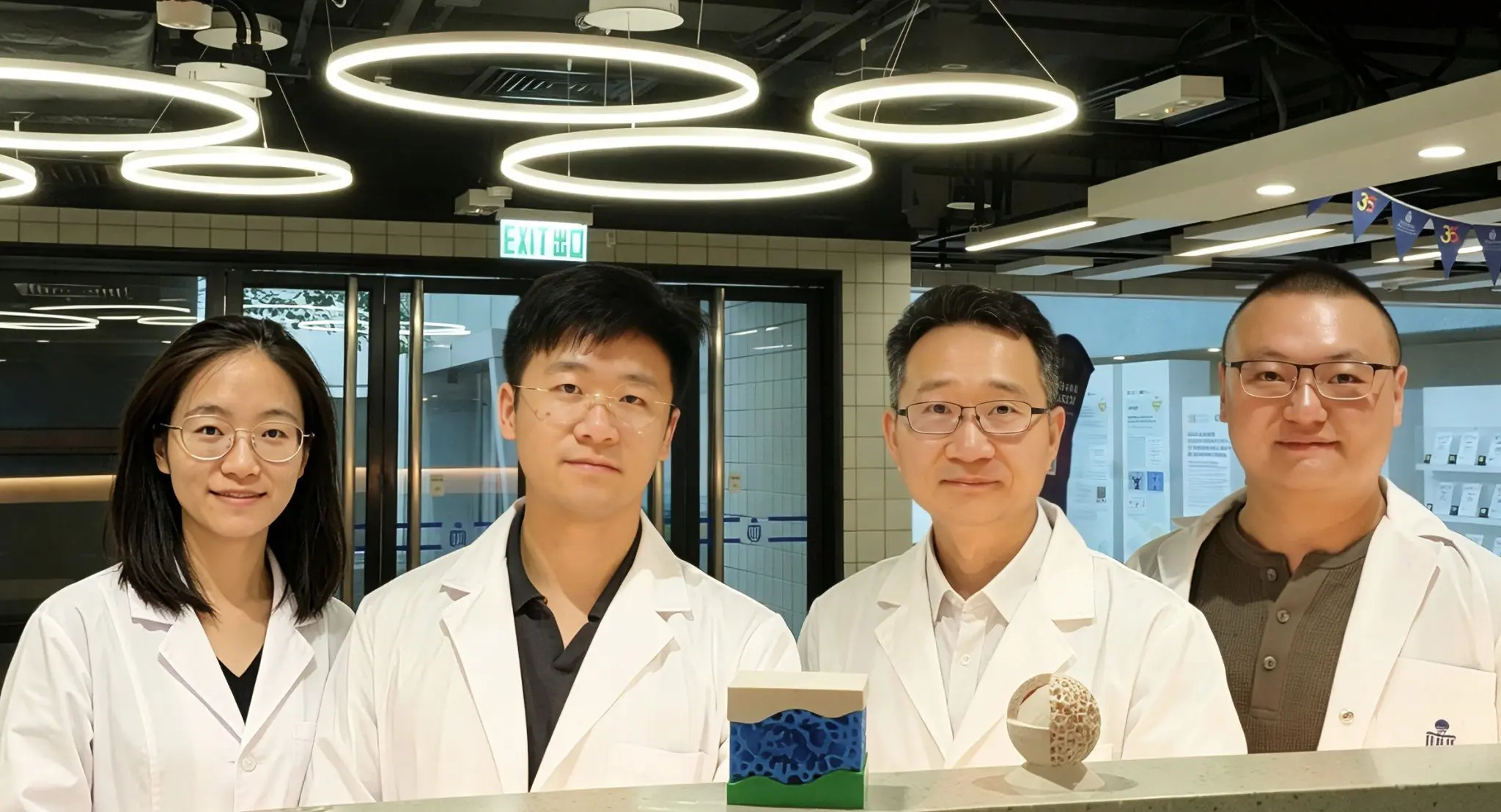
Researchers at The Hong Kong University of Science and Technology have revealed that a single water molecule is a key driver in accelerating interfacial polymerization, a surprising discovery explaining how this crucial reaction speeds up. Professor Yang Jinglei of HKUST’s Department of Mechanical and Aerospace Engineering led a collaborative team with researchers from the California Institute of Technology, the Chinese Academy of Sciences, and The Chinese University of Hong Kong, Shenzhen, to achieve these breakthroughs. The team also developed a physics-informed, data-driven platform that shifts microcapsule design from trial-and-error toward a predictive science, with implications for fields like water purification. “This work provides direct evidence of how water facilitates interfacial polymerization at the molecular level,” Yang said, adding that understanding this mechanism is key to controlling reaction kinetics and membrane nanomorphology.
Water Molecule Mechanism Accelerates Interfacial Polymerization Reactions
The team’s investigation focused on the rapid reaction between an amine and an isocyanate at the interface between water and oil, revealing water’s unexpected role as a proton-transfer bridge, effectively lowering the energy required for the reaction to occur. This atomistic insight provides a foundational understanding for controlling both the speed of the reaction and the ultimate structure of the resulting polymer. Dr. Zhang Yonglin, a postdoctoral fellow within Yang’s group, was a co-first author on the ACS Catalysis paper detailing the quantum mechanical calculations. The research not only clarifies the catalytic role of water but also opens avenues for manipulating reaction kinetics and tailoring the resulting polymer’s nanoscale morphology, with implications for membrane technology and materials science. Traditionally reliant on trial-and-error, the process of creating microcapsules with specific properties is now shifting towards a predictive science.
By constructing a comprehensive experimental database and integrating it with interpretable symbolic machine learning algorithms, the researchers established a quantitative framework that links chemical properties, processing conditions, structure, and performance. This AI-driven platform allows for the rational design of microcapsules with tailored characteristics for diverse applications, ranging from self-healing materials to targeted drug delivery; Yang noted that the platform’s ability to precisely control underlying design principles has transformed microencapsulation from an experience-driven craft into a predictive science.
This approach further elucidates the rational design rules governing encapsulation efficiency, particle size, and shell thickness, enabling the programmable design of microcapsules with tailored properties and functions.
AI-Driven Platform Predicts Microcapsule Design and Properties
Traditionally, formulating microcapsules, tiny spheres encapsulating active ingredients, relied heavily on iterative experimentation, a process that proved both time-consuming and resource intensive. The team’s recent work, published in Advanced Materials, details a physics-informed, data-driven platform designed to circumvent this trial-and-error methodology, offering a pathway toward rationally designed microcapsules with specific, predetermined characteristics. Central to this advancement is the ability to predict key attributes like encapsulation efficiency, particle size, and shell thickness, allowing for the programmable design of microcapsules tailored to diverse applications. The researchers demonstrated that this AI-driven platform can decipher complex causal relationships previously hidden within the manufacturing process, moving beyond simple empirical formulations. Further research illuminated the process, and the team also uncovered a surprising detail regarding the fundamental chemistry at play.
Their research, detailed in ACS Catalysis, revealed that a single water molecule acts as a critical catalyst in interfacial polymerization, the chemical reaction used to form the microcapsule shell. Through quantum mechanical calculations, they determined that this lone water molecule facilitates proton transfer, dramatically lowering the energy barrier of the reaction. This combined approach, fundamental mechanistic insight coupled with data-driven prediction, represents a significant step forward in materials science.
This work provides us direct evidence of how water facilitates interfacial polymerization at the molecular level.
Source: https://hkust.edu.hk/news/hkust-uncovers-mechanism-behind-accelerated-interfacial-polymerization
See today’s quantum computing news on Quantum Zeitgeist for the latest breakthroughs in qubits, hardware, algorithms, and industry deals.