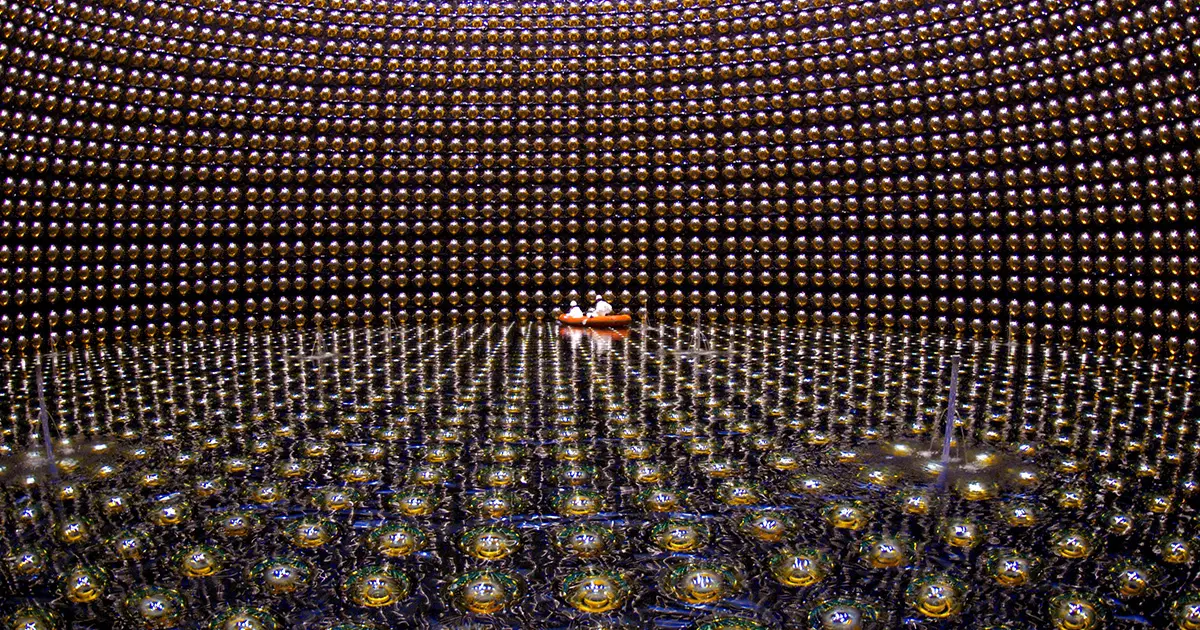
The Super-Kamiokande neutrino detector underwent a complete rebuild after a catastrophic chain-reaction implosion of 6,600 of the 11,151 photomultiplier tubes lining its walls. This dramatic failure underscores the immense challenges of tracking a particle so elusive that, in 1930, Wolfgang Pauli famously lamented he had “done a terrible thing” by postulating its existence, a particle he believed could not be detected. Pauli proposed the neutrino to explain missing energy in beta decay, a mystery that drove Clyde Cowan and Frederick Reines to construct a 10-ton detector, surrounded by thick lead walls and wet sandbags, near the Savannah River Plant in South Carolina. Their goal, as early as the 1950s, was to capture a ghost, a pursuit that has since led to some of the most ambitious and expansive experiments in the history of physics.
Project Poltergeist: Initial Neutrino Detection with Reactor Experiment
This experiment arose from a deeper theoretical puzzle; physicists had observed apparent energy loss during beta decay, a phenomenon lacking explanation within existing frameworks. In 1930, Wolfgang Pauli proposed the existence of a nearly undetectable particle to account for the missing energy while attempting to resolve this discrepancy. He famously lamented to a friend, “I have done a terrible thing,” acknowledging the seemingly impossible nature of experimentally verifying his hypothesis. The design of Project Poltergeist hinged on the principle that while neutrinos interact weakly with matter, a sufficiently large detector placed near a strong neutrino source, the nuclear reactor, could register a statistically significant event. The team sought to observe the inverse beta decay process, where a neutrino interacts with a proton to produce a neutron and a positron.
Detecting these secondary particles proved incredibly difficult, requiring meticulous shielding with thick lead walls and wet sandbags to minimize background noise from other radiation sources. The experiment’s success, confirmed in June 1956 with a telegram sent to Pauli announcing the detection, marked a pivotal moment in particle physics, transitioning the neutrino from a theoretical construct to an experimentally verified reality. Following this initial confirmation, scientists turned to leveraging neutrinos as probes of astrophysical phenomena, reasoning that if neutrinos could be detected from terrestrial sources, they could also be used to study the nuclear processes occurring within stars, including our sun. This presented a new set of challenges, as the flux of solar neutrinos is significantly lower than that from a reactor, necessitating detectors of unprecedented scale and sensitivity.
Raymond Davis Jr.’s experiment in the Homestake mine, utilizing 400,000 liters of perchloroethylene, represented a crucial step in this direction, though it ultimately revealed a perplexing discrepancy, the observed number of solar neutrinos was only one-third of the theoretical prediction. This spurred the construction of even more massive detectors, like Kamiokande and Super-Kamiokande, ultimately leading to the understanding that neutrinos oscillate between different “flavors,” and therefore possess mass, a revelation that continues to reshape our understanding of fundamental physics.
The event, from , corresponds to a high-energy neutrino generated by sources within the Milky Way.
IceCube Collaboration
Homestake Experiment & The Solar Neutrino Problem
Following the initial detection of neutrinos at Los Alamos in 1956, physicists turned their attention to a far more ambitious goal: using these elusive particles to probe the heart of the sun. The Homestake experiment, positioned 1.5 kilometers underground in the Homestake mine in South Dakota, represented a pivotal, if initially perplexing, step in this endeavor. Raymond Davis Jr. and his colleagues constructed a massive detector, a tank holding nearly 400,000 liters of perchloroethylene, to detect the rare interaction between neutrinos and chlorine nuclei, transforming the latter into detectable radioactive argon. However, the results were immediately troubling. The Homestake experiment consistently registered only approximately one-third of the neutrinos predicted by the Standard Model of particle physics, based on established theories of solar fusion. This discrepancy, quickly dubbed the solar neutrino problem, persisted for decades, challenging fundamental assumptions about both stellar processes and neutrino behavior.
The sheer scale of the undertaking underscored the difficulty; creating a trap large enough to detect these particles required a tank one-fifth the volume of an Olympic-size swimming pool filled with chlorine-rich dry-cleaning fluid and buried almost 1.5 kilometers underground. Confirmation of the shortfall came from a different approach in Japan. Masatoshi Koshiba’s Kamiokande detector, utilizing 3 million liters of ultrapure water, similarly observed fewer neutrinos than expected. Canada’s Sudbury Neutrino Observatory ultimately provided the crucial insight: neutrinos aren’t fixed entities, but rather oscillate between three “flavors”, electron, muon, and tau. This oscillation, requiring neutrinos to possess mass, a property not predicted by the original Standard Model, resolved the solar neutrino problem. The legacy of the Homestake experiment, therefore, wasn’t a failed prediction, but a catalyst for a deeper understanding of these fundamental particles and the physics governing the universe, paving the way for experiments like JUNO and Hyper-Kamiokande to further refine our knowledge of neutrino behavior.
Creating a large enough trap for neutrinos required a tank one-fifth the volume of an Olympic-size swimming pool filled with chlorine-rich dry-cleaning fluid and buried almost 1.5 kilometers underground.
Brookhaven National Laboratory/Science Photo Library
Kamiokande & Super-Kamiokande: Detecting Cherenkov Light
Built deep within the Kamioka mine in Japan, these observatories represent a significant leap in scale and sensitivity, designed to capture the faint signals produced when neutrinos interact with matter. This principle allowed researchers to visualize the paths of electrons created when neutrinos collided with water molecules, providing crucial data about the incoming particles. Masatoshi Koshiba’s team confirmed the findings of Raymond Davis Jr., demonstrating a shortfall in the number of solar neutrinos reaching Earth, a discrepancy that puzzled scientists for decades. However, the Super-Kamiokande, intended to resolve this, suffered a dramatic setback in 2001 when approximately 6,600 of the 11,151 photomultiplier tubes lining its walls imploded in a catastrophic chain-reaction.
These delicate detectors, responsible for capturing the faint Cherenkov light, were destroyed by shockwaves from the initial tube failures, necessitating a complete rebuild of a crucial component of the experiment and highlighting the inherent risks of operating such a large-scale apparatus. This oscillation necessitates that neutrinos possess mass, a finding that challenged the Standard Model of particle physics, which originally predicted them to be massless. The article explains the complexity of these particles. Newer detectors, like China’s Jiangmen Underground Neutrino Observatory (JUNO), launched in 2026; initial data published in June 2026 provided the most precise measurements of neutrino oscillation reported to date, and Japan’s Hyper-Kamiokande continue this tradition of ambitious experimentation, pushing the boundaries of neutrino physics and seeking to unravel the remaining mysteries surrounding these fundamental particles, building upon the legacy established by Kamiokande and Super-Kamiokande’s innovative use of Cherenkov light detection.
LAB produces signals 50 times brighter than those produced by heavy water.
Volker Steger/Science Photo Library
Neutrino Oscillations & Evidence of Particle Mass
The pursuit of understanding neutrinos has driven the construction of increasingly ambitious experiments, fundamentally reshaping our understanding of particle physics and offering insights into stellar processes. However, the experiment consistently registered only one-third of the predicted neutrino flux, a puzzle known as the solar neutrino problem. Subsequent detectors, like Kamiokande with its 3 million liters of ultrapure water, confirmed this shortfall, prompting a search for explanations beyond simple measurement error. Canada’s Sudbury Neutrino Observatory provided key evidence for this oscillation, demonstrating that neutrinos emitted as one flavor could transform into another during their journey to Earth. More recent facilities, such as China’s Jiangmen Underground Neutrino Observatory (JUNO), launched in 2026; initial data published in June provided the most precise measurements of neutrino oscillation to date, while Japan’s Hyper-Kamiokande and the Deep Underground Neutrino Experiment (DUNE) promise even greater precision in the coming years. These experiments, along with the IceCube Neutrino Observatory at the South Pole and the KM3NET on the Mediterranean seafloor, continue to probe the mysteries of these fundamental particles, slowly revealing their secrets and challenging the boundaries of our current understanding of the universe.
It began collecting data in August ; one of its main goals is to determine the outstanding mystery of how heavy each flavor of neutrino is.
Xinhua
Modern Neutrino Observatories: IceCube, KM3NET, JUNO, DUNE
The expectation that neutrino detection demands ever-larger experiments has driven a remarkable escalation in scale and ingenuity, yet the underlying principle remains surprisingly consistent: maximizing the volume of interaction. While early efforts, like with its ten-ton detector and thick lead walls and wet sandbags, proved the concept, modern observatories represent a quantum leap in ambition and technological sophistication. The catastrophic chain-reaction implosion of 6,600 of the 11,151 photomultiplier tubes within the Super-Kamiokande detector in 2001, a failure requiring complete rebuild, underscored the fragility of these massive undertakings and the relentless demands placed upon their components. IceCube, located at the Amundsen-Scott South Pole Station, uniquely utilizes Antarctic ice as its detection medium. Simultaneously, the Cubic Kilometer Neutrino Telescope (KM3NET) on the Mediterranean seafloor has detected the highest-energy cosmic neutrino on record.
China’s Jiangmen Underground Neutrino Observatory (JUNO) launched in 2026; initial data published in June 2026 provided the most precise measurements of neutrino oscillation reported to date. These installations aren’t merely larger versions of earlier designs; they represent fundamentally different approaches to harnessing the elusive nature of neutrinos. These experiments are not simply seeking to confirm existing theories; they aim to unravel the fundamental properties of neutrinos, including their mass hierarchy and potential role in the matter-antimatter asymmetry of the universe. The recipe for discovery hasn’t changed in seven decades: Think big, go deep, and summon patience, highlighting the enduring challenges and rewards of neutrino physics. Because of these and other audacious experiments, the particle that Pauli was sure could never be caught has slowly been revealing its secrets, and the pursuit continues to push the boundaries of experimental physics.
We are happy to inform you that we have definitely detected neutrinos.


See today’s quantum computing news on Quantum Zeitgeist for the latest breakthroughs in qubits, hardware, algorithms, and industry deals.