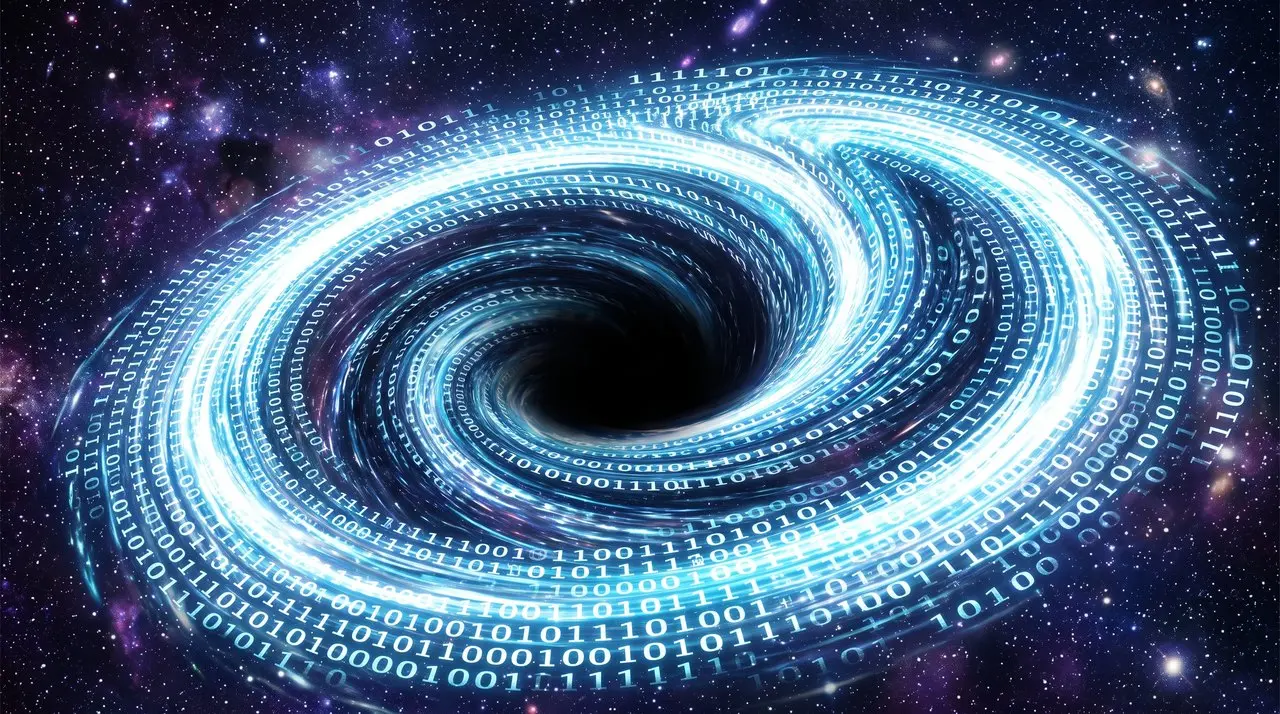
Researchers have linked gravity to the organization of quantum information, potentially illuminating the origin of spacetime itself. Building on work dating back to 1995, when Ted Jacobson derived Einstein’s equations from thermodynamics, the team published their findings in Physical Review Letters, reconstructing that derivation by connecting quantum information to spacetime geometry. They used quantum relative entropy, a measure of how distinguishable quantum states are, to reach their conclusion. The work replaces earlier analogies with a mathematically rigorous framework, suggesting gravity may emerge from the quantum world.
Quantum Relative Entropy Links Horizon Energy to Spacetime
The energy flowing across a horizon directly corresponds to a measure of quantum distinguishability, according to recent work reconstructing Einstein’s theory of general relativity. Researchers at the Institute for Theoretical Physics, Leipzig University, Germany, connected this energy to quantum relative entropy, a concept quantifying how easily two quantum states can be differentiated. The team’s derivation uses well-defined quantities, replacing previously heuristic arguments that suggested gravity’s emergence from quantum phenomena.
Dr. Albert Much, Assistant Professor of Quantum Field Theory and General Relativity, explained that the calculated quantum relative entropy, when evaluated at a horizon, precisely equals the energy crossing that boundary. “Combined with the well-established relation between entropy and the area of horizons, as illustrated by Bekenstein and Hawking, this leads directly to the equations that describe how quantum matter curves spacetime,” he said.
This builds upon the 1995 work of Ted Jacobson, who first demonstrated the derivation of Einstein’s equations from thermodynamic principles, suggesting gravity isn’t a fundamental force. The research deepens understanding of nature’s foundations. The team’s approach differs from traditional quantum field theory in curved spacetime, which treats gravity as a background element. Instead, they propose that local spacetime curvature is intrinsically tied to quantum information.
Philipp Dorau, a theoretical physicist at the Institute for Theoretical Physics, noted that while the core ingredients of this connection have been known for decades, recent advances in understanding relative entropy provided the link between quantum information, thermodynamics and gravity. Physicists have long studied how quantum matter behaves near horizons, such as those of black holes, as well as the thermal properties of empty space,” Dorau maintained.
The concept of relative entropy, the researchers explain, can be visualized by considering the surface of the sea and its constant rippling, representing the quantum vacuum. A wave passing across this surface allows for a comparison between the wave and the background ripples, and relative entropy quantifies how well these two states can be distinguished. This analogy illustrates how information, in the form of quantum states, can be linked to the geometry of spacetime, suggesting that the very fabric of space and time may be governed by the distinguishability of these quantum states.
This rigorous mathematical framework, according to Dr. Much, is a meaningful step toward understanding quantum gravity. “This supports the view that spacetime and gravity may emerge from more fundamental quantum information, a key clue in the search for a theory of quantum gravity.” The researchers are now focused on generalizing their findings to encompass more complex scenarios, including diverse forms of quantum matter and light-like surfaces, which are central to the study of black holes.
The long-term goal, Dr. Much stated, is to determine the extent to which gravity can be derived solely from quantum information, potentially providing guidance toward a complete theory of quantum gravity. “We are currently trying to generalize this to full quantum gravity, and it seems to me that this connection that we have identified will serve as a testbed for the various theories of quantum gravity,” he said. The team intends to formulate the quantum component of these equations and verify if the resulting output aligns with Einstein’s equations, potentially with quantum corrections.
We are currently trying to generalize this to full quantum gravity, and it seems to me that this connection that we have identified will serve as a testbed for the various theories of quantum gravity.
Dr. Albert Much, Assistant Professor of Quantum Field Theory and General Relativity
See today’s quantum computing news on Quantum Zeitgeist for the latest breakthroughs in qubits, hardware, algorithms, and industry deals.