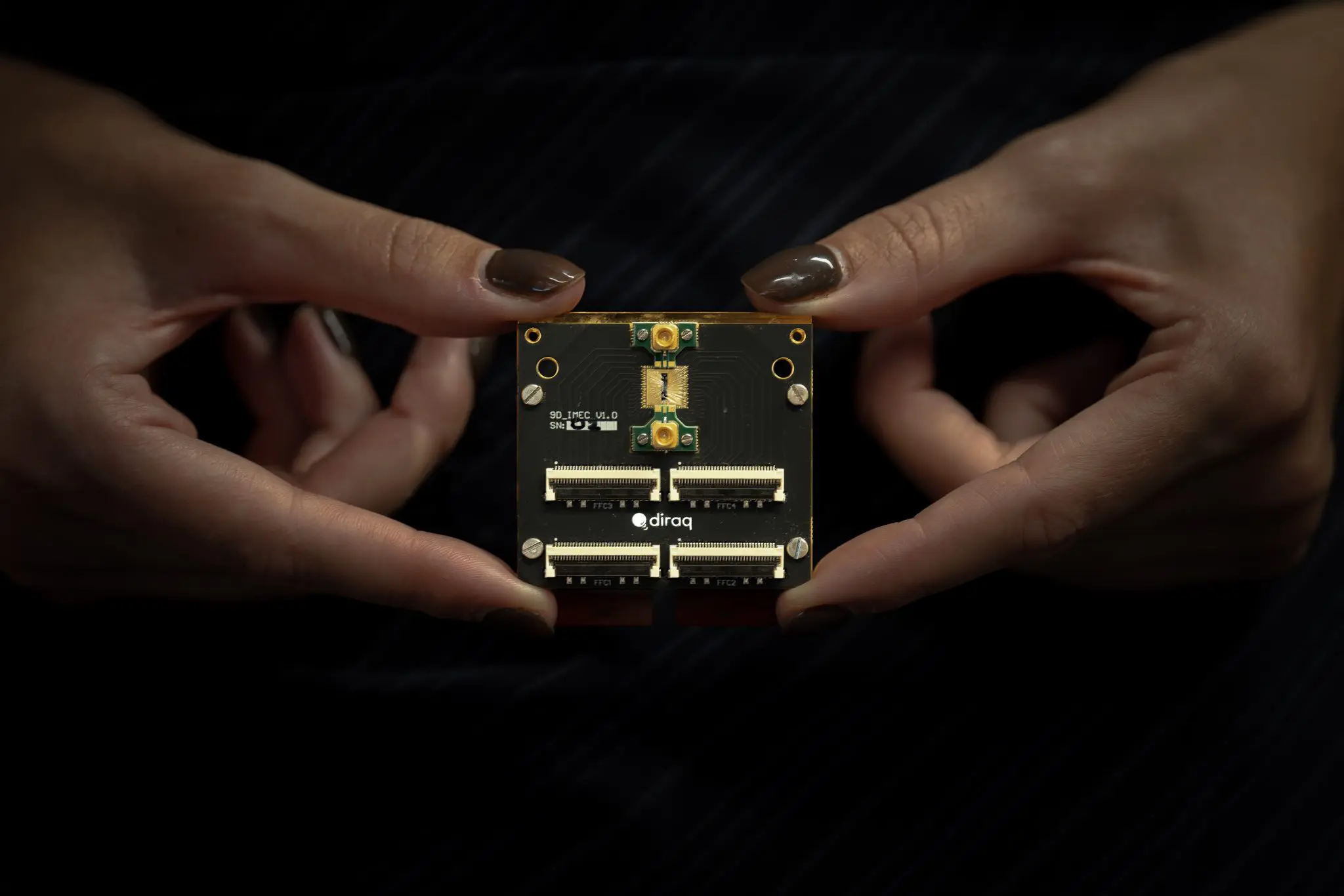
Imec and Diraq report demonstrating coherent operation and readout of eight silicon MOS spin qubits, fabricated using a standard 300mm CMOS-compatible manufacturing process. This achievement expands upon previous demonstrations of single or dual qubits, indicating progress toward building larger arrays essential for scalable quantum computing.
The results, detailed in a recent Nature Communications paper, show that existing industrial semiconductor manufacturing can support quantum processors beyond the two-qubit level. “The future of quantum computing depends not only on qubit quality but also on the ability to manufacture increasingly complex quantum processors,” said Kristiaan De Greve, fellow and program director quantum computing at imec.
300mm CMOS Foundry Enables Eight-Qubit Silicon MOS Array
Silicon manufacturing techniques commonly used for everyday electronics have now successfully produced an eight-qubit processor while maintaining qubit coherence, a critical factor for quantum computation, according to imec and Diraq. The significance lies in the manufacturing process itself; imec leveraged its existing 300mm CMOS technology, a standard in the semiconductor industry, rather than requiring entirely new fabrication facilities.
This approach addresses a major hurdle in scaling quantum computing by utilizing established infrastructure and supply chains. The readout architecture for the expanded array did not necessitate a substantial increase in sensor count, wiring density, or thermal load, suggesting a pathway to compact, large-scale processors.
The team built upon earlier work published in Nature in 2025, which established the viability of individual silicon spin qubits achieving fidelity levels suitable for quantum error correction. Andrew Dzurak, Founder and CEO of Diraq, added that this is what an industrial pathway to quantum computing looks like. Diraq demonstrated the reliability of silicon MOS qubits fabricated using imec’s platform nine months ago, and imec has now scaled the process to an eight-qubit array without compromising coherence, a cadence the companies aim to maintain as they pursue utility-scale quantum computers.
The future of quantum computing depends not only on qubit quality but also on the ability to manufacture increasingly complex quantum processors with the reproducibility, yield and scale of the semiconductor industry.
Kristiaan De Greve, Fellow and Program Director Quantum Computing at imec


See today’s quantum computing news on Quantum Zeitgeist for the latest breakthroughs in qubits, hardware, algorithms, and industry deals.