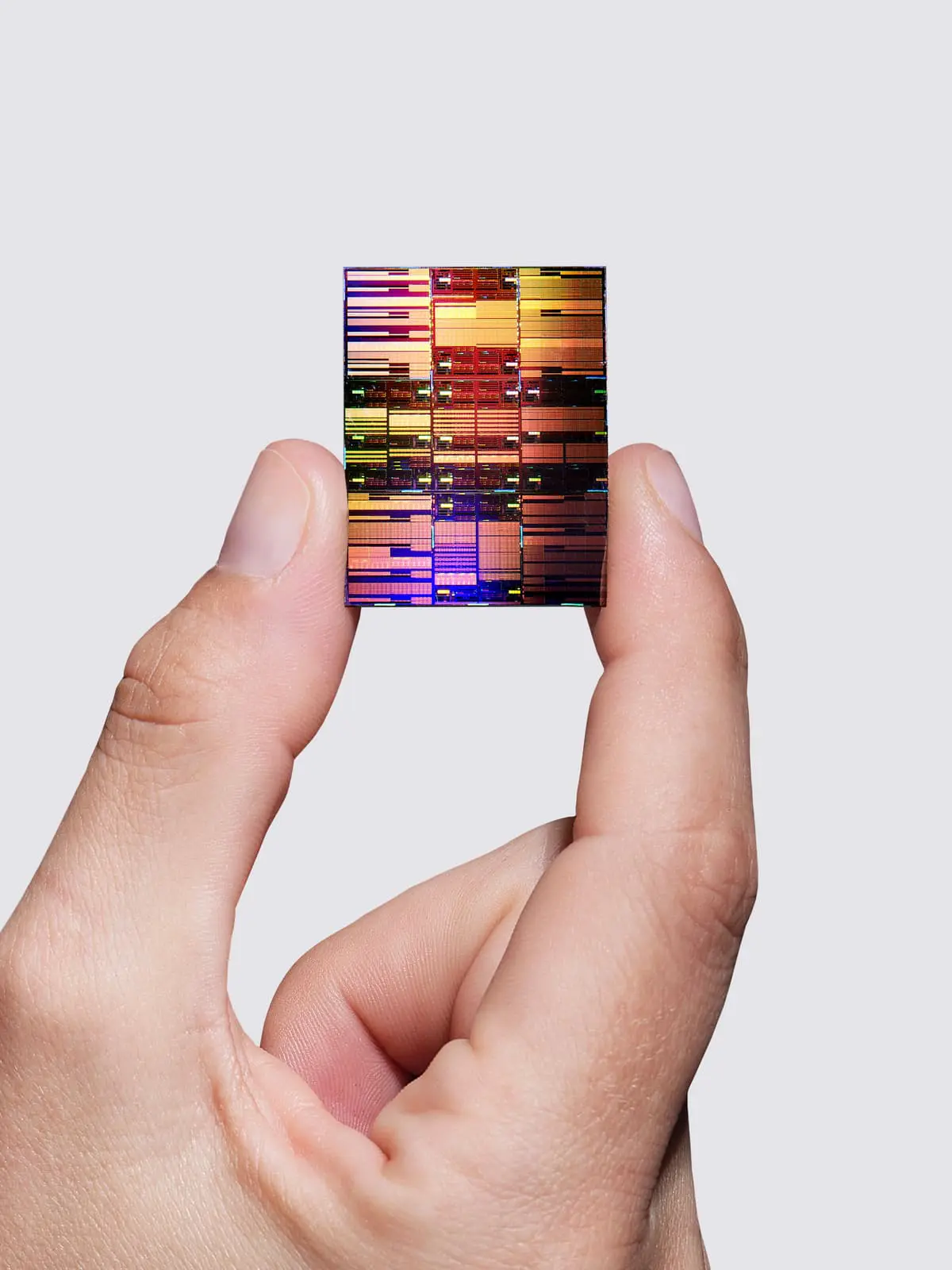
IBM has unveiled a computer chip built with transistor nodes measuring 0.7 nanometers, or 7 angstroms wide. This achievement marks the first time transistors at this scale have been realized, surpassing the current industry standard of 2 nanometer chips. In a chip the size of a fingernail, the team at IBM has packed roughly 100 billion transistors, a density never before attained; a human red blood cell is approximately 10,000 times larger than a single node on the new chip. According to IBM, these 7 angstrom chips are 70% more efficient, or 50% more powerful, than their previous 2 nanometer designs, potentially revolutionizing fields like artificial intelligence.
IBM Achieves Sub-1nm Chip Technology with 7 Angstrom Nodes
This breakthrough involved fundamentally rethinking chip architecture, not simply shrinking existing designs. IBM researchers developed a new design called the nanostack, moving beyond two-dimensional scaling to explore a third dimension. The company explains that the team considered the z-axis, detailing the shift towards vertically stacking transistors. This approach, enabled by breakthroughs in thin dielectric wafer bonding, allows for roughly double the transistor density compared to 2 nanometer chips. The team’s new wafer bonding technique minimizes defects, creating a stable, multilayered structure and a true 3D transistor. Beyond density, the 7 angstrom chips demonstrate significant performance gains.
The team also managed to scale up static random-access memory, or SRAM, by 40%, a leap in capacity the industry hasn’t seen in over a decade. Accessing on-chip memory is a key bottleneck in AI computing, and the team addressed this with the new 7 angstrom design, ensuring faster processing speeds. These chips could deliver around 9,000 TOPS (trillions of operations per second), six times the capacity of current AI accelerators, and drastically reducing training times for large language models.
Today’s popular AI accelerators can produce about 1,500 TOPS (or trillions of operations per second), and IBM researchers estimate one using 7 angstrom technology could deliver about six times more, or around 9,000 TOPS.
IBM researchers
Nanostack Architecture Enables 3D Transistor Density
IBM researchers pursued a fundamentally different approach to increasing density, building upwards instead of refining two-dimensional layouts. This led to the development of the nanostack architecture, a design intended to underpin a decade of silicon innovation and now realized in the new 7 angstrom chip. The team devised a technique to fuse two wafers, creating a multilayered structure with minimal defects and precise alignment. This process yields a true 3D transistor, demonstrating both scalability and extensibility for future processor generations. This isn’t merely about cramming more transistors into the same space; the stacked configuration allows for independent optimization of each transistor channel using new materials, maximizing performance. The design features staggered field-effect transistors, improving cell designs and paving the way for even smaller nodes.
Both NFET and PFET channels are optimized within a “gate stack” solution, allowing independent performance characteristics. Static random-access memory capacity has been increased by 40% in the 7 angstrom design, a leap the industry hasn’t witnessed in over a decade. By minimizing the physical footprint of memory, greater capacity can be achieved within the same area, promising substantial gains for demanding applications.
It’s a massive leap in memory capacity – the likes of which the industry hasn’t seen in over a decade.
7 Angstrom Chips Deliver 70% Efficiency & 9,000 TOPS
The relentless pursuit of miniaturization at IBM has yielded a chip boasting transistor nodes measuring just 0.7 nanometers, or 7 angstroms, a significant leap beyond the current 2-nanometer standard. These advancements aren’t simply about shrinking existing designs; they represent a fundamental shift in chip architecture. The team achieved this density through breakthroughs in wafer bonding, SRAM scaling, and channel material innovation, culminating in a design they call the nanostack. This approach moves beyond traditional two-dimensional scaling by effectively building upwards, exploring the third dimension to maximize transistor density. The result is a 70% increase in efficiency, or a 50% boost in power, compared to previously unveiled 2-nanometer node chips. The implications for artificial intelligence are particularly striking. The company reports that if 7 angstrom chips were used to train today’s massive, frontier-model LLMs, training time could be drastically cut from around three months to a couple weeks. Beyond AI, these chips promise to unlock innovations across a range of applications, from autonomous machines to long-lasting monitoring devices, and potentially, technologies yet unimagined.
These are the first sub-1 nanometer node chips, designed with transistor nodes that are just 0.7 nanometers, or 7 angstroms, wide.
IBM
Wafer Bonding & SRAM Scaling Drive Performance Gains
The relentless pursuit of miniaturization in chip technology has yielded a significant leap forward, not simply through shrinking existing designs, but through fundamentally new approaches to construction. Central to IBM’s recently unveiled 7 angstrom chips is a breakthrough in thin dielectric wafer bonding, a technique allowing for the creation of three-dimensional transistor structures. The team developed a new method to bond two wafers, resulting in a multilayered structure with remarkably few defects and precise alignment. Beyond stacking, material science played a critical role. This staggered design for field-effect transistors not only improves cell designs but also suggests a pathway toward even smaller nodes in the future. The innovation extends beyond transistor density; the team has also achieved a 40% increase in SRAM capacity within the 7 angstrom design. This substantial leap in memory capacity, unseen in over a decade, is crucial for demanding applications like artificial intelligence. The combination of wafer bonding and SRAM scaling isn’t just about creating smaller transistors; it’s about building a foundation for a new era of computing, one where previously intractable problems become readily solvable.




See today’s quantum computing news on Quantum Zeitgeist for the latest breakthroughs in qubits, hardware, algorithms, and industry deals.