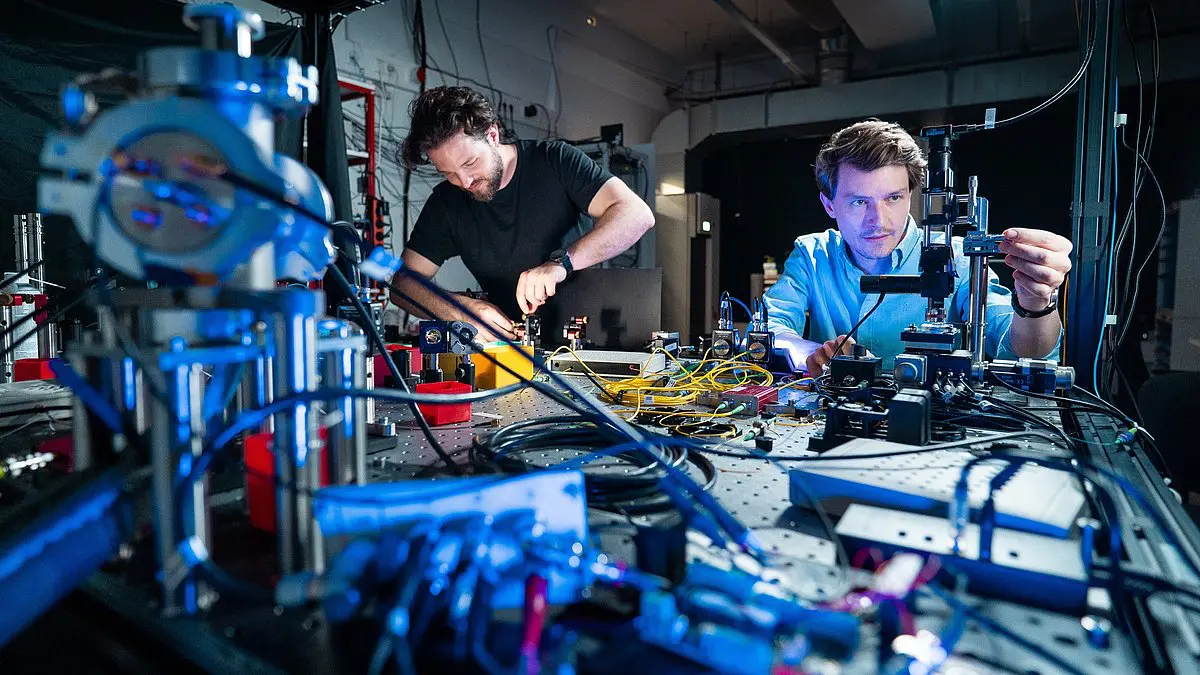
Researchers at the Technical University of Munich (TUM) and the Munich Center for Quantum Science and Technology (MCQST) are pursuing a more scalable method for generating single photons crucial to quantum communication by suppressing unwanted light frequencies. Unlike previous technologies relying on precisely tuned resonators, the team utilizes photonic crystal waveguides, nanostructures that block pathways for unwanted photon emission while preserving desired frequencies.
Initial experiments demonstrate a threefold increase in the proportion of desired photons, achieving 72 percent compared to the 23 percent attained with earlier methods. “If photons are generated too quickly, it’s difficult for us to control their properties,” explains Andreas Reiserer, professor of quantum networks at TUM, highlighting the benefits of this new approach.
Photonic Crystal Waveguides Suppress Unwanted Frequencies for Single Photons
Unlike prior technologies that relied on amplifying specific frequencies with resonators, this new method actively suppresses unwanted light frequencies through the use of photonic crystal waveguides. These nanostructures, measuring only a few micrometers, function by creating patterns that block pathways for photon emission at undesirable wavelengths, preserving the desired frequencies. The team’s design circumvents a key limitation of resonators, which operate within a narrow frequency range and demand precise tuning to the photon source.
Photonic crystal waveguides offer greater flexibility; they do not require such precise tuning, making them compatible with a wider range of emitters and enabling the simultaneous use of multiple photon sources within a single device, a feat difficult to achieve with resonator-based systems. Initial experiments utilized erbium as the photon source, an element already integrated into existing fiber-optic technologies, suggesting potential for seamless integration with current infrastructure.
This slower rate of photon generation, while a change from previous methods, is actually advantageous for quantum communication protocols. Florian Burger, the first author of the published research, highlights the broader implications of this work, stating, “Quantum networks are expected to connect many quantum systems with one another one day.
This requires interfaces that can reliably transfer information from a quantum system to individual photons and then transmit them, for example, via optical fibers.” The research, published in Nature Communications, was funded by the Federal Ministry of Education and Research and the Free State of Bavaria.
If photons are generated too quickly, it’s difficult for us to control their properties.
Andreas Reiserer, professor of quantum networks at TUM
Beyond efficiency gains, the photonic crystal waveguide approach offers increased scalability and flexibility. “Our approach is therefore significantly better suited for many emitters than the resonators used to date,” Reiserer asserts. This work lays the foundation for future quantum networks.
Quantum networks are expected to connect many quantum systems with one another one day. This requires interfaces that can reliably transfer information from a quantum system to individual photons and then transmit them, for example, via optical fibers. Our work lays the foundation for this.




See today’s quantum computing news on Quantum Zeitgeist for the latest breakthroughs in qubits, hardware, algorithms, and industry deals.