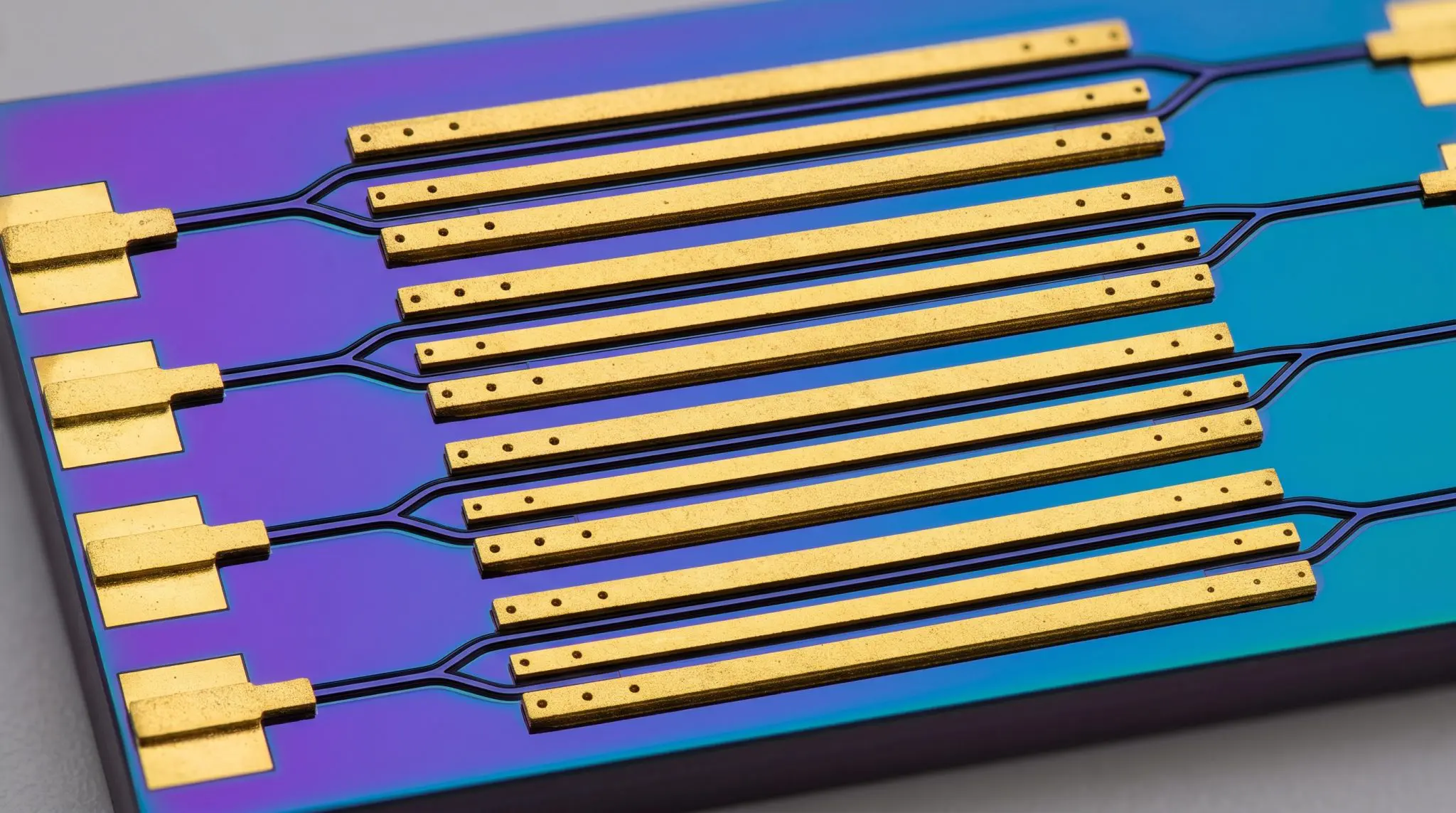
Distinguishable photons impinging on a balanced beam splitter bunch into the same output port. A giant atom (GA), coupled to two waveguides via two coupling points each, functions as a programmable HOM interferometer, enabling continuous control over single-photon beam splitting and two-photon interference. This programmability originates from coupling-phase differences within the GA, which tune its self-interference and directionality, thereby modifying its scattering response.
To characterise the two-photon interference, analysis of the scattering of two Gaussian single-photon wave packets injected through differing waveguides evaluates the bunching and antibunching (coincidence) probability. Work conducted at Hainan University and Chalmers University of Technology details these findings.
Enhanced parameter estimation reveals dynamic photon manipulation using giant atomic systems
A two-fold improvement in sensitivity for parameter estimation has been realised utilising two-photon scattering statistics compared with earlier methods. This surpasses limitations inherent in binary coincidence measurements that formerly restricted precision. The advancement allows detection of subtle changes in coupling phases within ‘giant atoms’, artificial structures manipulating light via multiple waveguide connections; this opens new possibilities for quantum technologies.
These giant atom beam splitters function as programmable Hong, Ou, Mandel interferometers controlling single photon behaviour and two-photon interference through precise adjustments to these coupling phases. Tuning those phases demonstrated continuous control over photons, switching between bunching into one output port and antibunching across separate ports, a feat not achievable using conventional fixed optical devices. When operating at the point where the giant atom acts as an effective fifty-fifty beam splitter for single photons, a distinct HOM dip was observed when varying the delay between incoming wave packets, confirming quantum behaviour.
Sensitivity gains of up to a factor of two were achieved in estimating deviations within these crucial coupling phases compared with previous techniques utilising binary coincidence measurements. This precise parameter estimation relies on quantifying changes in photon statistics following interaction with the device; however, current results do not yet demonstrate scalability beyond this controlled laboratory setting or address practical limitations imposed by signal loss within complex systems.
Tunable photonic interactions via artificial atoms enable dynamic quantum circuit design
The ability to sculpt single photons offers tantalising prospects for building more powerful quantum devices, but achieving precise control over their behaviour remains a significant hurdle. Conventional methods rely on carefully engineered structures possessing fixed properties like conventional beam splitters; instead, this giant atom architecture introduces tunable phases offering greater flexibility. Despite acknowledging that scaling up this ‘giant atom’ technology will certainly prove complex, the demonstration of programmable two-photon interference represents a step forward.
Hainan University and Chalmers University of Technology researchers have created an alternative to fixed optical components such as beam splitters, conventional devices directing single photons yet lacking adaptability. The team demonstrated a new level of control over individual photons using an artificial ‘giant atom’ configured as a programmable interferometer, manipulating how light particles split and interact without relying on static elements.
By carefully adjusting coupling phases within their giant atom, effectively tuning how light enters and exits the structure, they achieved both bunching and antibunching of photon pairs at different output points; these behaviours were previously difficult to achieve simultaneously in integrated systems.
The research demonstrates that a “giant atom” can function as a controllable device for two-photon interference. This is important because it provides a way to manipulate single photons dynamically, offering greater flexibility than traditional fixed optical components like beam splitters. Researchers observed both bunching and antibunching of paired photons by altering coupling phases within the artificial atom, achieving this control without static elements. The study also showed improved sensitivity, up to a factor of two, in estimating deviations in those crucial coupling phases compared with existing methods.
👉 More information
🗞 Programmable Hong–Ou–Mandel interference in a giant-atom beam splitter
✍️ Ruolin Chai, Lei Du, Guoqing Cai, Alejandro Vivas-Viaña, Anton Frisk Kockum and Yong Li
🧠 ArXiv: https://arxiv.org/abs/2609.18530




See today’s quantum computing news on Quantum Zeitgeist for the latest breakthroughs in qubits, hardware, algorithms, and industry deals.