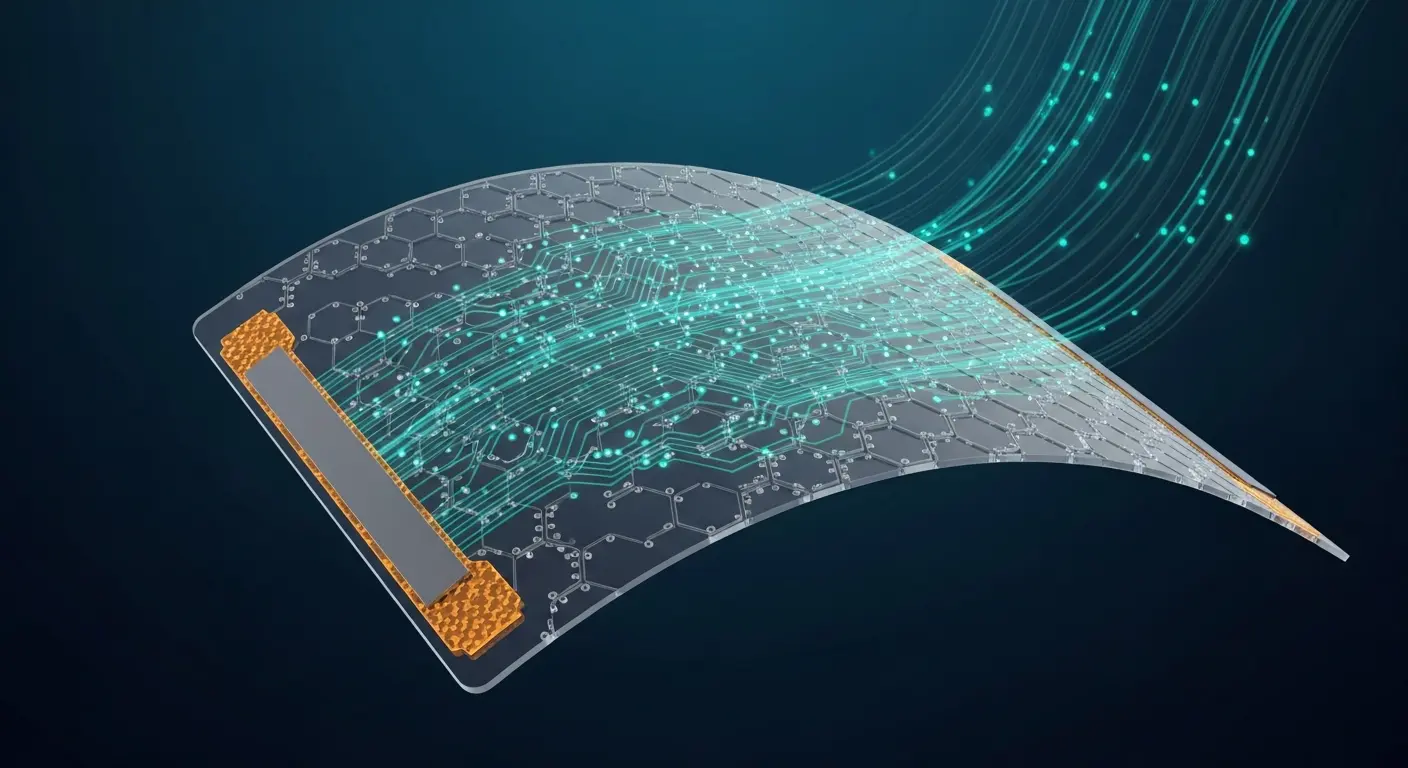
Researchers have achieved a new record in microwave detection, engineering graphene bolometers capable of sensing signals as faint as 40 zW/Hz at a frigid 40 mK. This leap in sensitivity, detailed in a new study from Aalto University and Chalmers University of Technology, is crucial for advancing superconducting quantum processors which demand increasingly precise signal measurement. The team accessed a state by carefully controlling carrier densities within the graphene, a method that dramatically reduces thermal conductance and enhances bolometer performance. These scalable graphene bolometers, operating at temperatures just above absolute zero, promise improvements in quantum computing and new avenues for exploring the fundamental thermodynamics of quantum systems.
Epitaxial Graphene Bolometers for Gigahertz Photon Detection
A new generation of microwave detectors, leveraging the unique properties of graphene, has achieved a record sensitivity of 40 zW/Hz. The devices, termed epitaxial graphene bolometers, are designed to capture gigahertz-range photons, the frequencies crucial for controlling superconducting quantum processors. Central to this performance is the manipulation of graphene’s electronic properties. Researchers achieved this by engineering low and uniform carrier densities, a technique that dramatically reduces thermal conductance. This isn’t simply about utilizing graphene’s inherent characteristics, but actively tailoring them to minimize heat flow and maximize signal detection. The bolometers operate at an incredibly frigid 40 mK, a temperature just above absolute zero, demonstrating their compatibility with the cryogenic environments typical of quantum systems. The steep temperature dependence of thermal conductance, described as G th ∼ T 4 for T < 100 mK, is a key enabler of this sensitivity.
This advancement establishes these graphene bolometers as versatile detectors, opening avenues for improved quantum processors and investigations into the thermodynamics and thermalization pathways of strongly entangled quantum systems, according to the research team. The team’s data is openly available via Zenodo, at https://doi. org/10. 5281/zenodo. 8023788, facilitating further exploration and development in this rapidly evolving field.
Strong Localization Regime Enhances Bolometer Performance
The pursuit of increasingly sensitive detectors for microwave signals is driven by demands from quantum computing and fundamental physics research; current bolometric technologies, devices that measure incoming radiation by detecting temperature changes, are continually refined to capture ever-fainter signals. This level of performance is critical for applications requiring the detection of extremely weak signals, particularly in the gigahertz range essential for superconducting quantum processors. A key innovation lies in accessing a state within the graphene itself. This extreme cooling underscores the technology’s compatibility with cryogenic quantum systems, allowing for exceptionally precise temperature measurement and improved signal detection.
Thermal Conductance Scaling as Gth ∼ T⁴ at Low Temperatures
Yu-Cheng Chang of Aalto University and colleagues have engineered a new class of microwave detector leveraging the unique thermal properties of graphene, pushing the boundaries of sensitivity for quantum computing applications. The team’s bolometers, fabricated from epitaxial graphene, achieve a noise equivalent power of 40 zW/Hz, a measurement of incredibly faint signals, by exploiting a specific temperature-dependent phenomenon. The implications extend beyond mere sensitivity; the team notes that these bolometers are versatile and low-backaction detectors, opening possibilities for improved quantum processors and investigations into the fundamental thermodynamics of entangled quantum systems. The ability to finely tune graphene’s properties through carrier density control represents a significant advance in materials engineering for quantum technologies, potentially paving the way for even more sensitive detectors in the future.
Scalable Fabrication Enables Quantum-Limited Microwave Sensing
The demand for increasingly sensitive detectors of microwave signals is driven by advances in quantum technologies, particularly superconducting quantum processors; these devices require precise measurement of faint signals without introducing excessive noise. Central to this achievement is a fabrication process that allows for scalable production of these graphene bolometers. The ability to fabricate these detectors reliably and at scale represents a significant step toward realizing more complex and powerful quantum computing architectures, and potentially, new avenues for exploring the quantum world.




See today’s quantum computing news on Quantum Zeitgeist for the latest breakthroughs in qubits, hardware, algorithms, and industry deals.