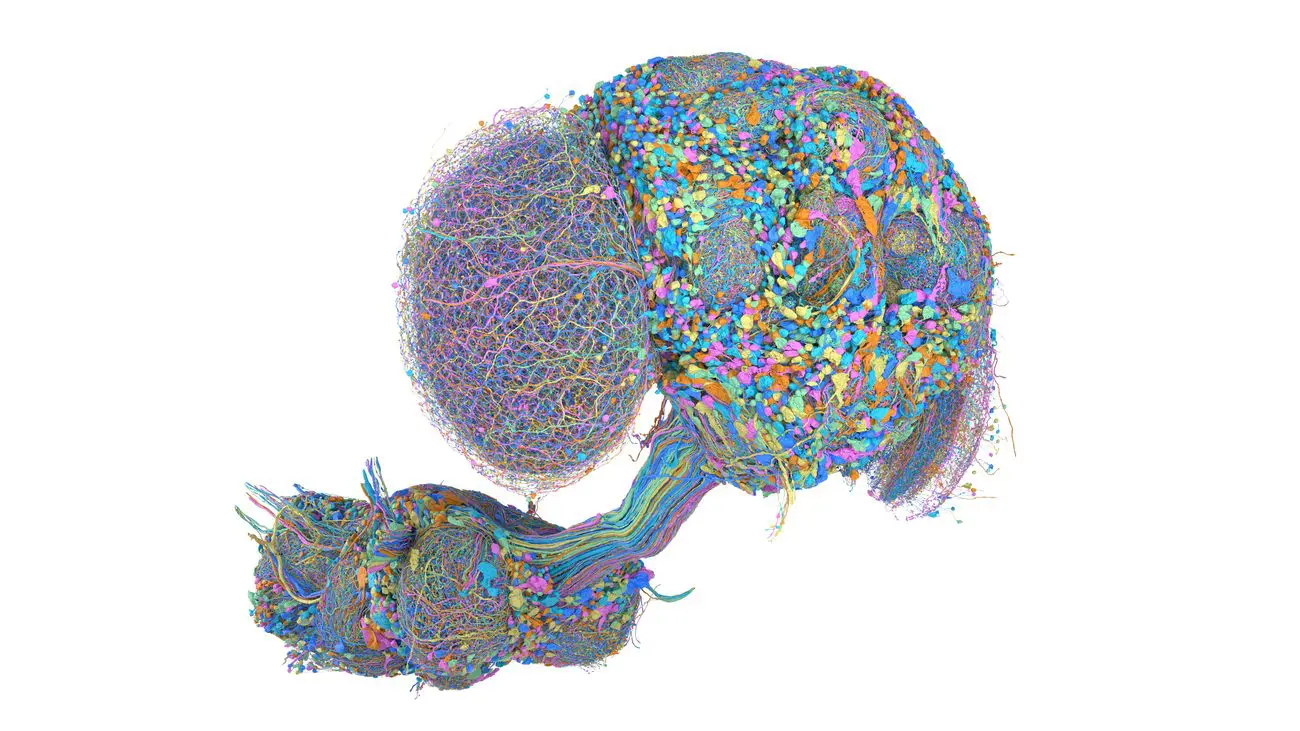
Scientists have completed the most detailed map yet of a male fruit fly’s nervous system, charting a record-breaking 166,000 neurons. The years-long project, a collaboration between HHMI Janelia Research Campus and Google Research, details not only the brain but also the ventral nerve cord, an anatomical feature analogous to a human spinal cord.
This complete map builds on earlier work mapping the female fruit fly brain and promises to be a foundational resource for neuroscience for years to come, enabling researchers to exponentially scale projects in the field of connectomics, according to Google Research. Like humans, the fly relies on a retractable proboscis for sensing and feeding, a unique biological detail now illuminated within this neural atlas.
A record-breaking map
The newly completed map details the brain and ventral nerve cord, a structure functionally similar to the human spinal cord, revealing connections within 166,000 neurons. To achieve this level of detail, researchers employed advanced imaging techniques alongside computational tools for reconstruction and analysis, allowing for a comprehensive visualization of neural circuitry. This contrasts with previous connectomic efforts that focused on smaller brain regions or utilized less-detailed methodologies, resulting in incomplete datasets.
Consider the implications for understanding sensory processing; the fly’s reliance on a retractable proboscis for both smell detection and liquid food intake presents a unique biological challenge for mapping sensory pathways. The map reveals how signals from this proboscis are relayed through specific neurons and brain regions, offering insights into the neural basis of chemoreception and feeding behavior.
Google Quantum AI made progress developing a real-time decoding system on April 16, 2026, which may help analyze the vast datasets generated by such detailed connectomes, enabling faster and more accurate reconstruction of neural circuits. This builds a comparative dataset, allowing researchers to identify conserved neural circuits and those unique to each sex, potentially revealing the neural basis of sexually dimorphic behaviors. Google’s dual-modality strategy, announced in March 2026, suggests a future where both superconducting qubits, like those in the 105-qubit Willow processor, and neutral-atom systems contribute to the computational demands of connectomics.
Brain + nerve cord
The detailed map reveals a clear connection between sensory input and motor control within the fly’s nervous system; a thick nerve cord relays signals from the brain to the body, dictating behavior. Creating the map required imaging thin brain and body sections, then combining millions of two-dimensional images into three-dimensional neural shapes using computational tools and artificial intelligence. This reconstruction process isn’t simply about visualization, but about establishing the physical pathways for neural communication.
Knowing the brain’s structure enables neuroscientists to investigate the mechanisms driving function, and the team’s approach uses AI to manage the immense data generated during imaging, Google Research says. “Knowing the structure of the brain allows neuroscientists to understand the mechanisms behind brain function,” stated a Research Scientist at Google Research.
Willow, Google’s 105-qubit superconducting processor, released in December 2024, provides a foundation for complex data processing, while the new neutral-atom program led by Professor Adam Kaufman at Boulder expands computational possibilities. This combined hardware capacity, alongside AlphaQubit, a transformer-based neural network decoder for quantum error correction published in November 2024, offers tools to analyze the map’s intricate details and potentially model neural activity with greater precision. The resulting map is a dynamic resource for exploring the complexities of the insect brain and, by extension, neural systems more broadly.
Inside the black box
Visualizing nearly 11,700 neuron types within the male fruit fly’s central nervous system is now possible thanks to a new map, allowing researchers to explore neuronal diversity with unprecedented detail. The project categorized these cells by characteristics including size, shape, function, and gene expression, beginning with core neurons and extending to those at the extremities of the fly’s body.
This granular level of classification facilitates targeted study of specific neuronal roles and their contribution to behavior, according to Google Research. Computing and artificial intelligence were instrumental in classifying the neurons identified, a process that would have been impossible through manual analysis alone.
Google Research’s contribution extended beyond data processing; the team developed tools to aid human experts in accurately categorizing each neuron, accelerating the mapping process significantly. “Neurons can be categorized by size, shape, function, gene expression, or other factors,” explained a Research Scientist at Google Research, highlighting the multi-faceted approach to neuronal identification.
This detailed understanding of the fly’s neural architecture provides a powerful platform for testing hypotheses about brain function and behavior, potentially informing studies of more complex nervous systems. The ability to visualize these connections, coupled with advanced analytical tools, may reveal new insights into the biological basis of behavior.
Vive la différence
Differences in neural connections between male and female fruit flies extend beyond simple presence or absence of specific neurons, revealing a complex interplay of isomorphic, sex-specific, and dimorphic cell types. Researchers identified a third category of neurons, dimorphic cells, present in both sexes but forming unique connections, expanding understanding of how neural circuitry diverges. These dimorphic neurons connect to neighbors that can be either shared between sexes, unique to each sex, or even themselves dimorphic, creating a nuanced network of variation.
One example, neural type AOTU012, processes sensory and taste inputs, demonstrating that even paired neurons exhibit differing connectivity in male and female brains. Consider how this level of granular detail impacts future research; the ability to map these subtle variations allows scientists to move beyond generalized models of brain function and investigate sex-specific neural pathways.
To achieve this, researchers are using the complete map to trace connections and understand how sensory information translates into distinct behavioral responses in males and females. The team reports that understanding these differences is important for accurately modeling complex behaviors and evolutionary adaptations.
Google Quantum AI made progress developing a real-time decoding system on April 16, 2026, and its advancements in quantum computing are increasingly relevant to this type of detailed analysis, as the sheer volume of data generated by connectomics projects demands new computational approaches. The partnership with JILA, announced in March 2026, reflects a dual-modality strategy for quantum processing.
Fly see
The newly completed map of the male fruit fly brain details pathways connecting visual processing to movement, revealing how stimulus translates into action within the insect’s nervous system. Specifically, researchers charted connections from R1-R6 visual neurons, responsible for detecting environmental cues, to the DNg13 motor neuron, which initiates movement. Intermediary neurons, including the male-specific LoVP92 linked to courtship behavior, demonstrate the map’s granular detail and potential for studying complex behaviors.
These companion studies, released alongside the map, focus on visual systems, taste, and social interactions, expanding the initial dataset’s applications. This level of detail allows for tracing specific neural circuits, offering insights into how sensory information drives motor control. The ventral nerve cord, mapped alongside the brain, provides a comparative anatomical structure analogous to the human spinal cord, broadening the relevance of the findings.
Google Research scientists emphasize the map’s utility in dissecting the neural basis of behaviors like courtship, where the LoVP92 neuron is important, and understanding how these mechanisms differ between sexes. The release of these visuals and accompanying data underscores a shift toward more dynamic analysis of neural networks, moving beyond merely static representations of brain structure.
REPLIQA, the Research Program at the Intersection of Life Sciences and Quantum AI, launched in May 2026, commits $10 million across five universities, and the ongoing partnership with JILA at CU Boulder supports both superconducting and neutral-atom quantum computing platforms. This combined approach aims to expand connectomics projects and tackle the immense computational challenges inherent in mapping and analyzing complex brains.




See today’s quantum computing news on Quantum Zeitgeist for the latest breakthroughs in qubits, hardware, algorithms, and industry deals.