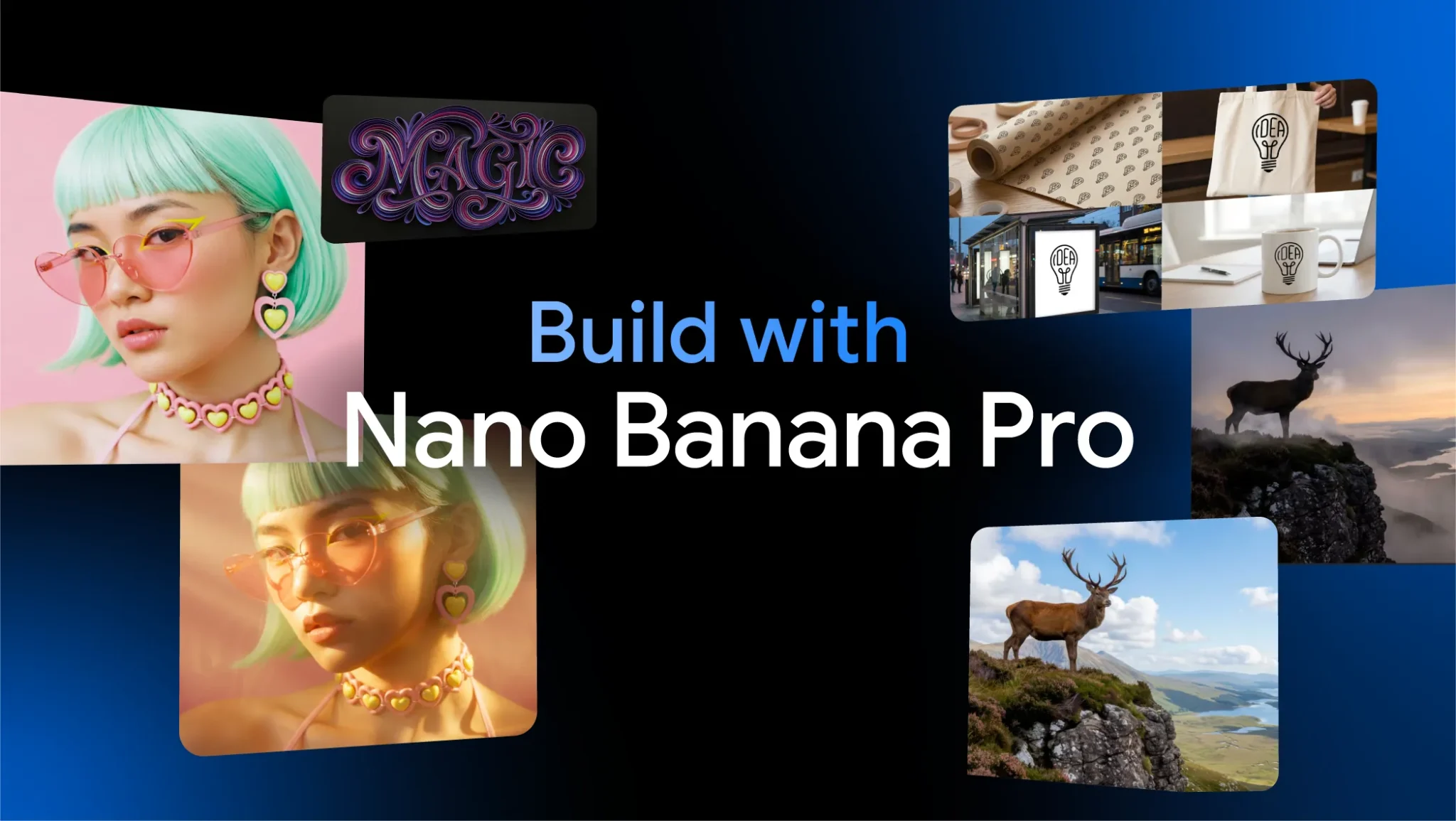
Google has released Nano Banana Pro, a higher-fidelity image generation model built on Gemini 3 Pro and now available to developers through paid preview in Google AI Studio and Vertex AI. This new model expands upon the capabilities of Nano Banana, released a few months ago, and offers advanced features including improved text rendering, robust world knowledge, and the ability to blend up to fourteen standard inputs into a single, polished ad. According to Google, Gemini 3 Pro Image performs well on Text to Image AI benchmarks and unlocks high-resolution outputs at 2K and 4K resolutions suitable for professional production. The release is also expanding to creative platforms like Adobe and Figma, and is being integrated into Google’s new agentic development platform, Antigravity, allowing coding agents to generate detailed UI mockups.
Gemini 3 Pro Image Enables High-Fidelity Visual Control
A new image generation model from Google DeepMind is redefining the fidelity and control available to developers seeking studio-quality visuals. Nano Banana Pro, built on the Gemini 3 Pro foundation, moves beyond simple image creation to offer precise manipulation of visual elements, promising a significant leap forward for applications requiring detailed and accurate outputs. Alisa Fortin and Naina Raisinghani, Product Managers at Google DeepMind, detailed the release, positioning it as a tool for building “a new wave of intelligent, multimodal applications” through the Gemini API. The model’s capabilities extend beyond aesthetic improvements; Gemini 3 Pro Image unlocks higher accuracy in text rendering and robust world knowledge, a crucial advancement for applications demanding clarity and factual correctness. This is achieved, in part, through the model’s ability to integrate with Google Search, allowing it to retrieve and incorporate real-time data into generated images.
This integration with Google Search is particularly valuable for applications needing precise representations, such as complex biological diagrams or historically accurate maps. With 2K and 4k resolution available, outputs can meet the standards of professional production environments. The system allows for granular control over image physics, including lighting, camera angles, focus, and color grading, enabling the creation of professional-quality outputs. It can consistently resemble up to five individuals, integrate six high-fidelity shots, or blend as many as fourteen standard inputs into a single, polished ad.
Improved Text Rendering & Multilingual Image Localization
Current text-to-image artificial intelligence models frequently struggle with accurately rendering legible text within generated images, and even more so when asked to translate that text into another language. However, a new model released by Google, Gemini 3 Pro Image, is demonstrably improving upon these limitations. Gemini 3 Pro Image “excels in handling logic and language, and delivers clear, accurate text integrated in your images.” This advancement moves beyond simply creating visually appealing images to generating functional assets suitable for professional applications. It is also an ideal solution for developing marketing collateral, educational content and numerous other applications. Google’s developers have effectively removed the barrier between image generation and localization logic, allowing for effortless translation of text within images, such as menus, signage, or documents, using image-to-image generation while preserving the original artistic style and layout.
A demonstration of this functionality showcases “accurate translation and rendering of English text into French,” highlighting the potential for creating multilingual marketing materials and educational content with ease. Beyond simple translation, the model’s ability to connect to a vast knowledge base, and when enabled, to utilize integration with Google Search, ensures greater factual accuracy in generated assets. This is particularly impactful for applications demanding precise visual representations, like biological diagrams or historical maps.
With Gemini 3 Pro Image, we’ve removed the barrier between image generation and localization logic.
Google Search Grounding Enhances Factual Image Generation
Underpinning this advanced capability is an evolution in the model’s latent space structure, suggesting a move beyond pure diffusion processes alone. Industry analysts speculate that Nano Banana Pro leverages advanced conditioning mechanisms, potentially involving explicit structural guidance or ControlNet-like inputs, to ensure semantic consistency across vast, complex scenes. This architecture allows the model to maintain object persistence and geometric coherence even when blending disparate source materials, addressing the common ‘discontinuity artifact’ seen in multi-stage generative pipelines.
The ability to integrate real-time search data implies a sophisticated RAG (Retrieval-Augmented Generation) layer operating pre-diffusion. Instead of merely interpreting text descriptions, the system is likely injecting structured, verified information (such as specific coordinates, material properties, or established historical facts) directly into the prompt embedding space. This mechanism elevates the output from artistic interpretation to technically verifiable representation, crucial for fields like engineering and scientific visualization.
From a development standpoint, the reliance on Google AI Studio and Vertex AI indicates a commitment to enterprise deployment models. This suggests the API exposes granular parameters beyond simple prompting, allowing developers to define multimodal inputs (e.g., combining a reference image, a depth map, and a text overlay) and manage the computational overhead of 4K generation through structured workflows, rather than relying solely on a single text-to-image endpoint.
This connection to a vast knowledge base represents a significant advancement over previous image generation models, addressing a key limitation in producing factually accurate visuals. Developers can now leverage this feature to dynamically create infographics, tailoring educational materials to specific audiences with data-driven visuals. The model’s integration with Google Search extends to language translation within images, enabling accurate rendering of text in different languages on elements like signs or menus while preserving the original artistic style. This capability, demonstrated in a beverage campaign concept translating English text into French, moves beyond simple translation to contextual understanding. Google has also integrated SynthID digital watermarks into every image created or edited with Gemini 3 Pro Image, aiming for transparency regarding the origin of AI-generated media. The company encourages developers to explore the model’s potential through demo apps and direct integration via the Gemini API.



See today’s quantum computing news on Quantum Zeitgeist for the latest breakthroughs in qubits, hardware, algorithms, and industry deals.