

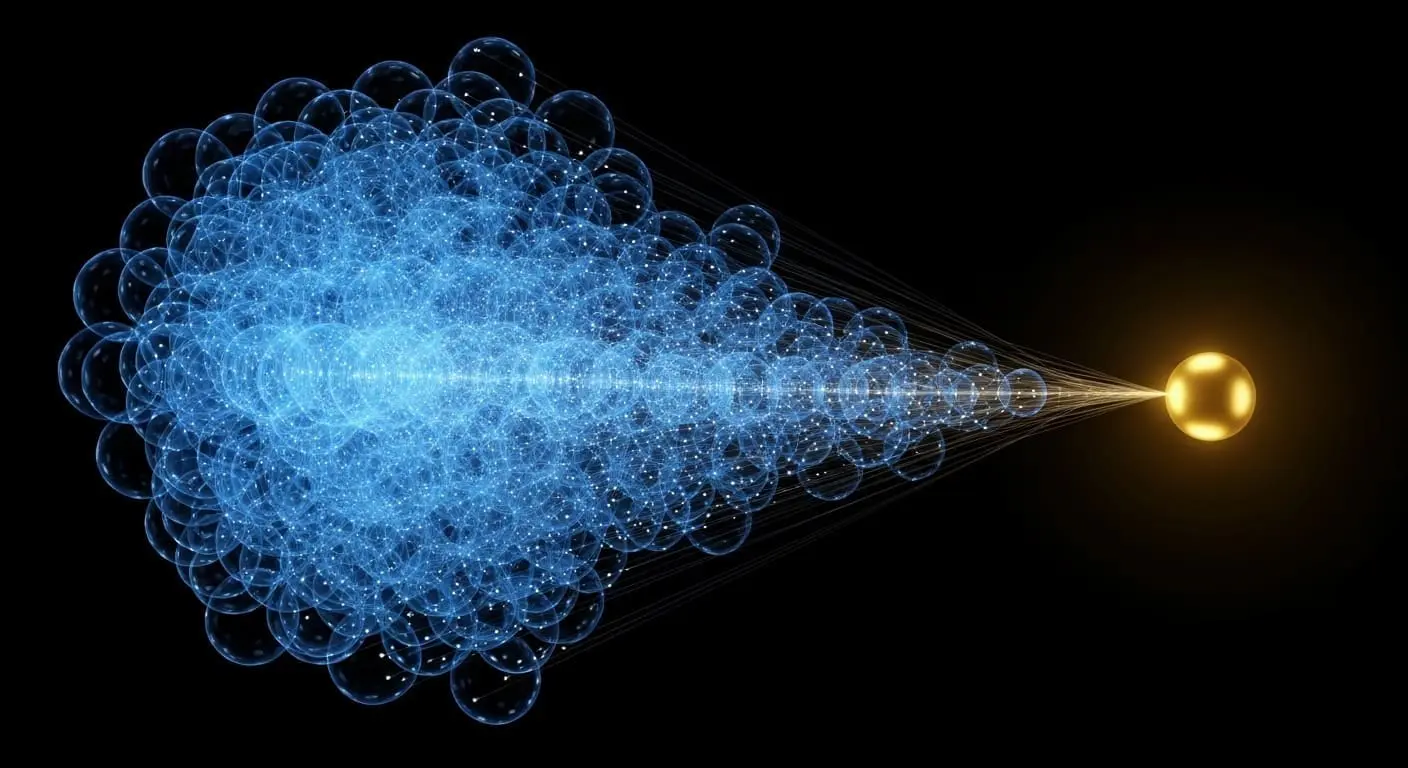
Scientists at Xi’an Jiaotong University, led by Meixue Chen, have demonstrated a novel ghost imaging technique capable of reconstructing images without any photons directly interacting with the object being imaged. This counterintuitive advancement, termed “ghost imaging with zero photons”, leverages photon-number projection measurement and the inherent statistical properties of thermal light to achieve image retrieval. The findings provide crucial insight into the fundamental physics governing ghost imaging and refine our understanding of the interplay between quantum and classical correlations within the imaging process.
Image reconstruction from zero photon interactions using thermal light statistics
Ghost imaging, a technique initially demonstrated using entangled photon pairs, traditionally relies on correlating two beams of light: a signal beam illuminating the object and a reference beam that does not interact with it. The image is formed through correlation, even though the signal beam itself carries no spatial information. Now, for the first time, ghost imaging has been achieved with a metric of one or fewer photons per pixel, representing a substantial improvement over previous methods that required multiple photons for successful image reconstruction. This breakthrough crosses a critical threshold, enabling image formation even when no photons interact with the imaged object, a departure from conventional ghost imaging principles which demanded some level of photon-object interaction. The process, “ghost imaging with zero photons”, fundamentally alters the approach by discarding all photons that would normally carry object information, instead focusing on analysing the timing of zero photon detections. This is not simply about detecting the absence of light, but rather about exploiting the statistical information contained within those null detections.
Discernible results were achieved utilising thermal light, a readily available and inexpensive light source, even when no photons directly interacted with the test object. The team observed antibunching, a phenomenon characterised by a reduction in photon coincidence, in measurements of zero photons using a Hanbury Brown-Twiss interferometer. This observation confirms the importance of specific statistical properties for image formation; specifically, this was observed for g10, the correlation function representing the probability of detecting one photon by one detector and zero by the other. Reconstructed images approached a resolution of one pixel, mirroring the capabilities of computational imaging techniques that can form images with fewer than one photon per pixel. This level of resolution, achieved with minimal photon interaction, opens possibilities for imaging in scenarios with extremely low light levels, potentially surpassing the limitations of conventional methods and enabling applications previously considered impossible. The implications extend to scenarios where minimising illumination is paramount, such as observing sensitive biological samples or conducting surveillance in challenging conditions.
The significance of achieving imaging with effectively zero photon interaction lies in its potential to overcome fundamental limitations in traditional imaging systems. Conventional imaging is limited by the shot noise inherent in photon detection, and the need for sufficient photon flux to create a detectable signal. By focusing on the statistical properties of zero photon events, this technique circumvents these limitations, offering a pathway towards ultra-sensitive imaging. Furthermore, the use of thermal light, as opposed to more complex and expensive sources like entangled photon pairs, makes this technology potentially more accessible and practical for a wider range of applications.
Reconstructing images from null photon detections using thermal light correlations
Photon-number projection measurement is the core of this imaging breakthrough. This technique, akin to measuring the volume of water in a bucket rather than simply confirming its presence, allows for precise quantification of the number of photons detected, or rather, not detected. This precise measurement is crucial for extracting the image information from the seemingly random pattern of zero photon events. A pseudothermal light source, generated by a continuous-wave laser and rotating ground glass, created the necessary photon statistics. The rotating ground glass effectively randomises the phase of the laser light, mimicking the characteristics of a true thermal light source. One beam was then directed to illuminate the object after being split using a non-polarizing beam splitter, ensuring that the polarisation of the light did not affect the imaging process, while the other served as a spatially resolved reference beam. The non-polarizing beam splitter ensures equal distribution of all polarisation components into both paths.
Reconstructing images from instances of no photon detection using thermal light statistics
Conventional ghost imaging relies on correlated beams, one illuminating the object and one acting as a spatial reference; however, this new technique discards photons interacting with the object, reconstructing images solely from instances registering zero photons. While seemingly paradoxical, this “ghost imaging with zero photons” hinges on precise photon-number projection measurement and the subtle statistics of thermal light, a departure from established methods utilising entangled pairs or classical correlations. The statistical properties of thermal light, specifically its tendency to exhibit fluctuations in photon number, are exploited to encode the image information within the zero photon detections. This demonstration is significant because it challenges fundamental assumptions about how images are formed and expands the set of tools for utilising thermal light sources. It suggests that image formation is not necessarily dependent on direct photon-object interaction, but rather on the statistical correlations between different parts of the light field.
Readily available light sources are utilised by the technique, introducing a new approach to low-light imaging with potential applications in areas such as surveillance and biomedical imaging. The ability to image with minimal illumination could be particularly valuable in sensitive applications where minimising exposure to light is crucial, such as imaging live cells or conducting covert surveillance. Challenging conventional understandings of image formation, it employs only instances registering zero photon detection; traditional ghost imaging relies on correlating beams where photons do interact with the object. This process, combined with the statistical properties of thermal light, commonly available from sources like lightbulbs, is central to the technique and allows for image reconstruction even when no photons directly interact with the object. Further research will focus on optimising the technique for higher resolution imaging and exploring its potential for real-world applications, potentially leading to a new generation of low-light imaging systems.
The researchers successfully reconstructed images using a ghost imaging technique that did not require any photons to interact with the object. This finding demonstrates that image formation can occur based on statistical correlations within light, rather than direct photon-object interaction. The experiment utilised thermal light and photon-number projection measurement to achieve imaging with zero photons, challenging previous assumptions about how images are created. The authors intend to optimise the technique for higher resolution and explore practical applications.
👉 More information
🗞 Ghost imaging with zero photons
🧠 ArXiv: https://arxiv.org/abs/2604.07782


See today’s quantum computing news on Quantum Zeitgeist for the latest breakthroughs in qubits, hardware, algorithms, and industry deals.



