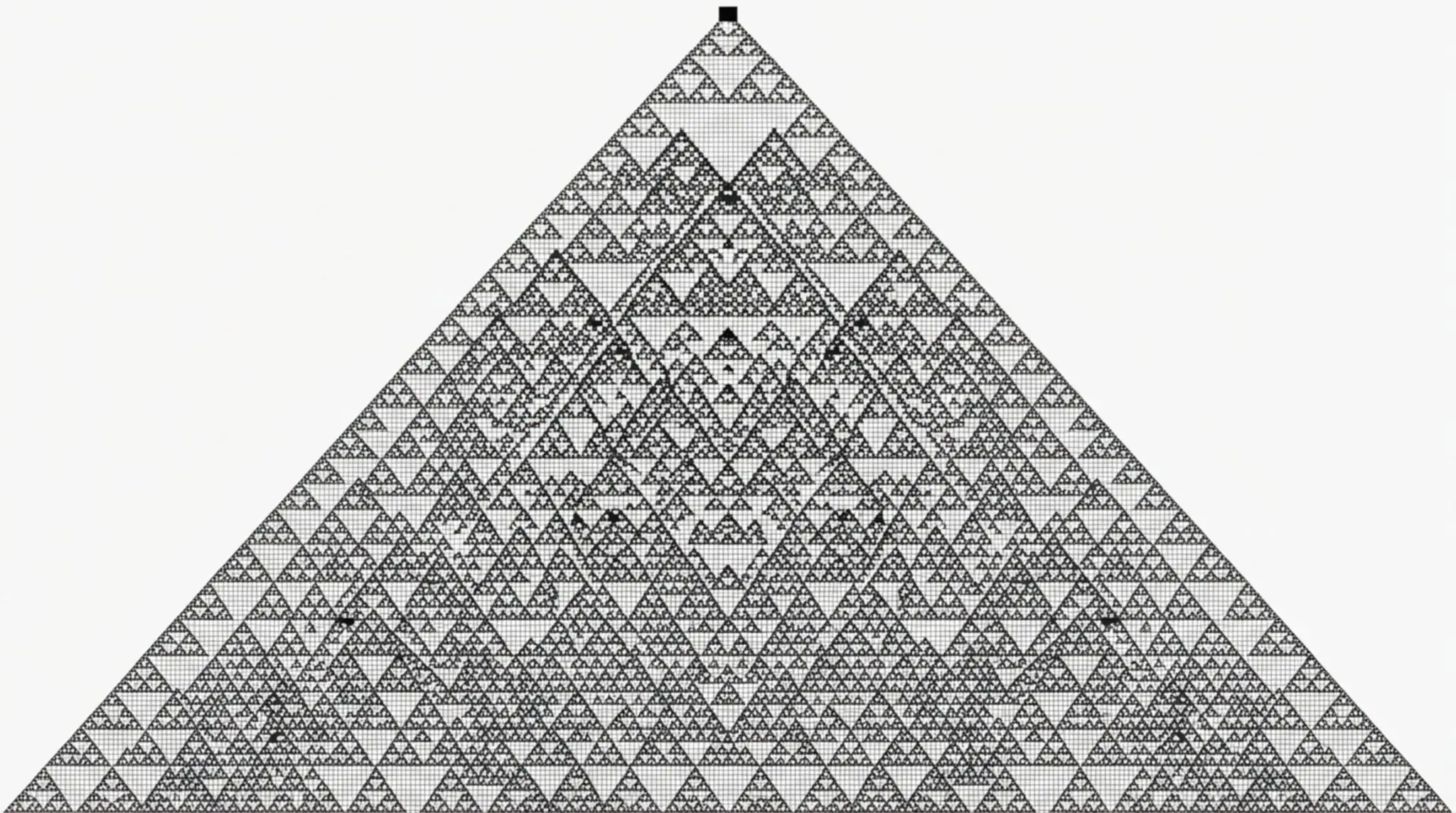
Determining whether all transformations of operator algebras originate from local physical processes has long challenged theoretical physicists. Any two-dimensional fermionic quantum cellular automaton, a mathematical tool describing how quantum information evolves locally, can be built from basic operations called local automorphisms and a ‘fermionic shift’. All two-dimensional quantum cellular automata possessing certain characteristics can now be constructed from simpler components; specifically, local transformations combined with shifts of fermions. A quantum cellular automaton describes how quantum information changes locally over time, acting as a fundamental step in modelling physical processes.
These complex systems are not necessarily built upon intricate interactions but instead rely on key building blocks. A quantum cellular automaton acts as a mathematical tool describing how quantum information evolves locally over time; essentially it is a set of tools governing how particles with intrinsic angular momentum, like electrons, evolve in space and time, similar to a simplified computer program running on a grid. The team proved this by showing any such system is ‘Brauer trivial’, meaning it possesses a limited degree of complexity enabling breakdown into essential parts, akin to simplifying a complicated machine.
Fermionic automata construction simplified via universal Brauer triviality properties
Every two-dimensional fermionic quantum cellular automaton, a tool modelling local quantum information evolution, now arises from just two components; previously constructing these automata required arbitrarily complex interactions. Any such system operating on a limited algebraic structure possesses ‘Brauer triviality’, fundamentally resembling simpler fermionic algebras and limiting its potential behaviours. This key reduction in complexity extends to higher dimensional systems, as all locally finite-dimensional fermionic invertible subalgebras within one dimension are also Brauer trivial.
The US Department of Energy funded work clarifying constraints on how localised interactions evolve, impacting designs for future computation and offering new insights into fundamental quantum dynamics. Every locally finite-dimensional fermionic invertible subalgebra within a one-dimensional lattice is ‘Brauer trivial’, meaning it is stably bounded-spread isomorphic to a tensor product fermionic algebra.
Stabilising these algebras with ancillary systems maintains bounded local dimensions uniformly across the lattice structure. Furthermore, employing nonuniform stabilisation, where ancillary algebra size grows away from an origin point, allows a 2 + 1 dimensional shift QCA to be represented as a circuit requiring only a limited number of steps.
Decomposition speeds limit immediate computational benefits despite enhanced theoretical insight
The breakdown of two-dimensional fermionic quantum cellular automata into simpler components offers a powerful new perspective for understanding complex quantum systems and clarifies how local interactions give rise to global behaviour within these models. Determining *how* quickly an automaton decomposes remains unresolved however, potentially proving computationally demanding; this is particularly relevant when considering designs for future computation where minimising algorithmic steps is vital. Quantum cellular automata are mathematical models used to simulate quantum mechanics.
Quantum AI provides strong insight for designing future computational architectures by demonstrating that these two-dimensional models can be broken down into manageable components. This simplification reveals an underlying structure: complex behaviours aren’t necessarily driven by intricate interactions but instead emerge from fundamental building blocks and clarifies constraints on localised dynamics.
The research demonstrated that every two-dimensional fermionic quantum cellular automaton is composed of local automophisms and a fermionic shift. This decomposition provides new understanding of how local interactions create global behaviour within these quantum systems, clarifying their inherent structural limitations. By showing this breakdown into simpler components, researchers have enhanced insight into the mathematical models used to simulate quantum mechanics with implications for designing future computational architectures. The authors note further work will focus on determining the speed of this decomposition process, which currently presents a potential challenge for computation.
👉 More information
🗞 Fermionic quantum cellular automata in 2d are trivial
✍️ Jeffrey Kwan, David M. Long and Jeongwan Haah
🧠 ArXiv: https://arxiv.org/abs/2609.09317



See today’s quantum computing news on Quantum Zeitgeist for the latest breakthroughs in qubits, hardware, algorithms, and industry deals.