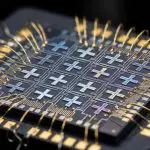
More than 500 scientists worldwide are now using a toolkit developed at Fermilab to advance quantum computing, demonstrating broad adoption of the system. The Quantum Instrumentation Control Kit, or QICK, combines open-source software, radio-frequency electronics, and commercial hardware, drawing on Fermilab’s decades of experience in particle physics to address the challenges of scaling up qubit control. To further optimize performance, Fermilab is collaborating with Harmoniqs to integrate its Piccolo.jl software, a quantum control and calibration package, with QICK, enabling more precise and repeatable qubit manipulation. “We are excited to team up with Harmoniqs,” said Sho Uemura, lead software developer and a core member of the QICK development team at Fermilab. “As we scale QICK to control greater numbers of qubits, we’ll use Piccolo.jl to optimize our control pulses in a way that accounts for both qubit dynamics and the QICK hardware.”
QICK System Enables Precise Quantum State Control
Over 500 scientists across the globe are currently utilizing Fermilab’s Quantum Instrumentation Control Kit, or QICK, demonstrating broad adoption of the system for quantum state manipulation and readout. The system’s ability to precisely synchronize short energy bursts, known as pulses, to control qubits is proving critical for advancing the field beyond theoretical models. To further refine QICK’s capabilities, Fermilab is collaborating with Harmoniqs, integrating the company’s Piccolo.jl software package, a quantum control and calibration tool, to optimize control pulses and accelerate results. This partnership aims to account for both qubit dynamics and the specific characteristics of QICK hardware.
Piccolo.jl’s advanced algorithms, borrowed from robotics and aerospace engineering, allow for finer granularity in pulse shape optimization than standard software, and its open-source nature aligns with the collaborative spirit of the project. Jack Champagne, chief technology officer at Harmoniqs, stated that “Piccolo.jl gives researchers an open path into advanced pulse optimization. When integrated with QICK, it demonstrates what’s possible when open-source foundations meet purpose-built commercial software,” highlighting the synergistic potential of the combined system for simplifying the development and deployment of precise quantum control strategies.
Piccolo.jl Optimizes Pulse Shapes for Qubit Control
Recognizing the need for optimized control pulses, Harmoniqs has integrated its Piccolo.jl software package with QICK, aiming to reduce the time and effort required to achieve peak qubit performance. This collaboration allows users of Piccolo.jl to efficiently test pulse optimizations, refining the shape, frequency, amplitude, and phase of signals that govern qubit behavior. Unlike standard optimization software, Piccolo.jl employs algorithms borrowed from robotics and aerospace, enabling finer granularity and greater stability in quantum hardware control; it makes minute adjustments to identify the optimal pulse shape for specific applications. A key benefit of this integration is streamlined access to Piccolo’s algorithms, eliminating the need for manual setup previously required by QICK users. Both QICK and Piccolo.jl are open-source, fostering a collaborative spirit reminiscent of particle physics research.
We are excited to team up with Harmoniqs. As we scale QICK to control greater numbers of qubits, we’ll use Piccolo.jl to optimize our control pulses in a way that accounts for both qubit dynamics and the QICK hardware.
Sho Uemura, Fermilab
Integration of QICK and Piccolo.jl Accelerates Optimization
Currently, over 500 scientists globally are utilizing QICK, indicating its adoption as a versatile and affordable quantum control system. The integration of Piccolo.jl allows users to test pulse optimizations, the precise shaping of electromagnetic signals that manipulate qubits, without the typically demanding manual setup. Uemura said that “Pairing the two can help you get to a better end result much faster, with fewer trial measurements, less effort testing different sets of parameters and a shorter time to results.”
Piccolo.jl gives researchers an open path into advanced pulse optimization. When integrated with QICK, it demonstrates what’s possible when open-source foundations meet purpose-built commercial software.
Jack Champagne, Harmoniqs
The pursuit of scalable quantum computing increasingly relies on collaborative, open-source development, as evidenced by the integration of Fermilab’s QICK toolkit with Harmoniqs’ Piccolo.jl software. The collaboration with Harmoniqs aims to enhance QICK’s capabilities by incorporating Piccolo. Piccolo.jl optimizes pulse shapes with finer granularity than standard optimization software, borrowing proven algorithms from robotics and aerospace to bring stability and rigor to quantum hardware control. It makes minute adjustments to determine the best pulse shape for a particular use case.
Piccolo.jl gives researchers an open path into advanced pulse optimization. When integrated with QICK, it demonstrates what’s possible when open-source foundations meet purpose-built commercial software.
Jack Champagne, Harmoniqs




See today’s quantum computing news on Quantum Zeitgeist for the latest breakthroughs in qubits, hardware, algorithms, and industry deals.