Researchers at the University of Ottawa and the Nexus for Quantum Technologies Institute have developed a photonic simulator capable of running more than 300 distinct quantum processes using light, offering a new approach to modeling complex material behavior without relying on traditional electronics. The platform utilizes three programmable optical screens, called spatial light modulators, to reconfigure experiments and simulate the movement of particles through various materials with a simple software update. “We program the structure of light the way a musician tunes an instrument,” says Ebrahim Karimi, Full Professor in uOttawa’s Department of Physics. By manipulating the spatial pattern and polarization of photons, the team successfully reproduced the signatures of topological materials, an exotic phase of matter crucial for future electronics, and observed these effects directly with a camera.
Spatial Light Modulators Replicate Material Dynamics with Photons
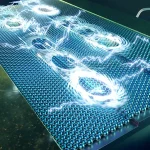
Researchers at the University of Ottawa, collaborating with colleagues from Federico II University in Italy, have engineered a quantum simulator that bypasses the limitations of traditional electronic hardware by utilizing light to model complex material behaviors. The platform’s versatility is underscored by its ability to run over 300 distinct quantum processes, distributing a single input beam across thousands of output channels. This allows researchers to virtually switch between hundreds of different materials simply through software updates, a feat previously unattainable. The system isn’t limited to simple grids, simulating particle motion on complex geometries like toruses and cylinders, shapes rarely replicated in photonic experiments. “A torus or a cylinder might sound abstract, but these shapes encode real physics,” notes Dr. Alessio D’Errico, senior research associate, highlighting the platform’s capacity to explore advanced quantum materials and provide a clearer view of quantum dynamics typically hidden within solid-state devices.
Dr. D’Errico explains that the ability to directly visualize quantum evolution, captured via photography, provides clarity for studying quantum transport and prototyping future technologies.
We program the structure of light the way a musician tunes an instrument,” says Ebrahim Karimi, Full Professor in uOttawa’s Department of Physics.
Ebrahim Karimi, Full Professor in uOttawa’s Department of Physics
The research, detailed in Light: Science & Applications and Advanced Photonics, establishes a new approach to quantum matter studies.
Topology is a hot topic in condensed-matter physics, but measuring its effects directly is notoriously hard,” says Dr Alessio D’Errico, senior research associate at Prof.
Dr Alessio D’Errico, senior research associate at Prof.


See today’s quantum computing news on Quantum Zeitgeist for the latest breakthroughs in qubits, hardware, algorithms, and industry deals.