One of the three people most responsible for modern artificial intelligence has decided that the technology the whole industry is racing to scale is a dead end. Yann LeCun spent twelve years as Meta’s chief AI scientist, and he has now left to bet a billion dollars that the path to machine intelligence runs through world models rather than through ever-larger language models.
- A godfather of AI breaks ranks
- Why LeCun calls large language models a dead end
- What a world model actually means
- Inside JEPA, predicting the representation not the pixel
- The six-part blueprint for a thinking machine
- What has actually shipped
- The Meta departure
- AMI Labs, a bet on a thesis
- The world models gold rush
- The case that LeCun is wrong
- What is actually at stake
- Frequently asked questions
A godfather of AI breaks ranks
The break became concrete over the winter of 2025 to 2026. LeCun signalled his intention to leave Meta in November 2025, departed by the end of the year, and by March 2026 had unveiled a Paris-headquartered startup called AMI Labs. The company raised $1.03 billion in a single seed round at a $3.5 billion pre-money valuation, with roughly a dozen employees and no product, which makes the raise a wager on a scientific idea rather than on any demonstrated traction.
What gives the moment its weight is who is making the argument. LeCun is not an outsider throwing stones at a field he does not understand, but one of its principal architects, and he is now in open disagreement with the leaders of the large language model companies he helped make possible. His decision has pushed the phrase “world models” from a niche research term into the hottest funding category of the year, and it has reopened a question most of the industry considered closed, namely whether scaling text prediction is the road to general intelligence or a detour away from it.
This article walks through the argument on both sides. It explains what LeCun means by a world model, how his JEPA architecture differs from the systems behind ChatGPT and its rivals, what his new company is actually trying to build, and why many of the most credible people in AI think he has picked the wrong hill. The honest summary is that nobody yet knows who is right, and that uncertainty is the point.
Why LeCun calls large language models a dead end
LeCun is careful about what he is not saying. He does not claim that language models fail to work, and he readily grants that they are impressive at generating text and code and will keep getting more useful across many applications. His claim, delivered to Wired and repeated in talk after talk, is narrower and sharper: that this usefulness “is not going to lead to human-level intelligence at all.” The distinction between a useful tool and a route to general intelligence is the crux of the entire debate.
The missing capabilities
His technical case clusters around a handful of capabilities that today’s models lack. The first objection is that language models learn from the wrong kind of data. Everything a model like GPT knows arrives as text, which LeCun treats as a thin and lossy shadow of reality that records conclusions rather than raw observation. He likes to dramatise the gap with a data-efficiency argument, estimating that a four-year-old child has already absorbed far more sensory information through watching and touching the world than the entire text corpus used to train a frontier model. Text can state that an unsupported object falls, but it does not carry the lived experience of watching a thousand things drop.
The second objection concerns memory and causality. A language model predicts the most statistically likely next token rather than holding a stable model of how the world is put together, so it reproduces the surface structure of language without building a durable internal picture of cause and physical constraint. From there the critique extends to reasoning and planning, the abilities to work through a genuinely novel situation and to sequence multiple actions under uncertainty, which LeCun regards as prerequisites for intelligence rather than optional extras. He has put the safety stakes bluntly, noting that in fields like medicine or robotics a confident generative model that hallucinates is not merely awkward but potentially dangerous.
The off-ramp for researchers
His most quoted framing is the advice he gives to young researchers. In an interview with MIT Technology Review he said the next breakthroughs will not come from scaling up language models, and he told academics there is “no point” trying to out-scale industry, urging them to invent new techniques instead. That off-ramp image, in which language models are a side road rather than the main route, predates his new company by years and has become his signature line. In a December 2025 podcast he was blunter still, dismissing the idea that more synthetic data and reinforcement-learning tweaks will reach superintelligence as, in his words, “complete bullshit.”
What a world model actually means
A world model, in LeCun’s sense, is a system that learns an internal model of how the physical world behaves, so that it can predict the consequences of actions and plan accordingly. He has described the goal as building an abstract digital twin of reality that a machine can use to understand its surroundings, anticipate what its actions will cause, and choose among them. Prediction, planning and cause-and-effect are the load-bearing words, and they are what separate this vision from the next-token generation behind chat assistants.
Anyone reading around the subject should be warned that “world model” has become badly overloaded. The phrase now covers at least three different kinds of system that are easy to confuse: renderers that output pixels, simulators that output physically faithful 3D state, and planners that output an agent’s next action. Fei-Fei Li’s World Labs published an essay in June 2026 drawing a similar three-way line, and QZ has covered the broader effort to build an AI that simulates the dynamics of reality. LeCun’s approach sits firmly in the planning and representation-learning camp rather than the pixel-generation camp, and mixing up the categories is the single most common source of confusion in the coverage.
The idea is not new to the research literature. The lineage is usually traced to a 2018 paper titled “World Models” by David Ha and Jurgen Schmidhuber, which showed an agent could learn a compact model of its environment and then train inside its own imagination. What has changed since is scale, hardware and evidence, and the recent arrival of a physics-based test for how good a world model really is, which begins to turn a slogan into something measurable.
Inside JEPA, predicting the representation not the pixel
JEPA stands for Joint Embedding Predictive Architecture, a framework LeCun laid out in his 2022 position paper A Path Towards Autonomous Machine Intelligence. Its defining move is to make predictions in an abstract representation space rather than in the raw space of pixels or tokens. Instead of asking what the next video frame will look like pixel by pixel, a JEPA asks what the abstract representation of the next state will be, which forces it to capture high-level structure and to throw away unpredictable, irrelevant detail such as the exact flutter of leaves behind a moving car.
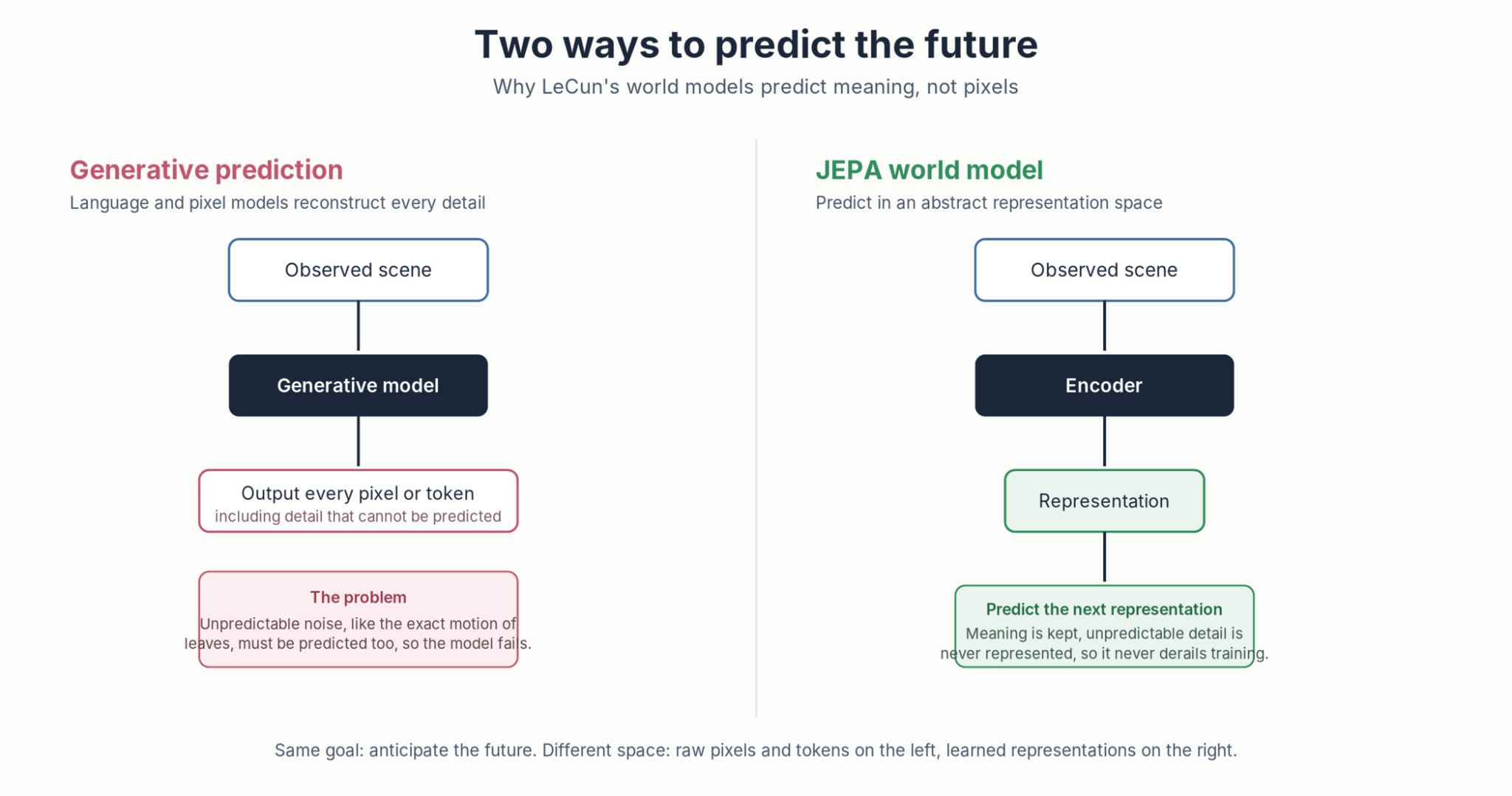
Crucially, LeCun stresses that JEPA is not generative. In his own words to MIT Technology Review, “JEPA is not generative AI. It is a system that learns to represent videos really well.” His technical reason is that the real world is not fully predictable, so a model forced to reconstruct every detail of the future is set up to fail, whereas a model predicting in a filtered representation space can hold on to what matters and discard the rest. The architecture is framed mathematically as an energy-based model, in which two inputs are each encoded into a representation and the mismatch between the predicted and actual representation defines an energy that training drives downward.
This is a genuine departure from the machinery behind today’s chat models, which are trained precisely to generate the next token and are rewarded for reproducing surface detail. It also connects to a quieter research tradition that LeCun has long championed, self-supervised learning, in which a system teaches itself by predicting hidden parts of its input rather than relying on human labels. A JEPA is self-supervised learning applied to the structure of the physical world instead of to the structure of text.
The six-part blueprint for a thinking machine
The 2022 paper is more ambitious than JEPA alone, because JEPA is only one component of a larger design. LeCun proposes a modular, fully differentiable cognitive architecture assembled from six parts, and laying them out shows how far his long-term vision reaches beyond any single model. The blueprint is meant to describe a complete agent rather than a better text predictor.
At the top sits a configurator that acts as executive control and tunes the other modules for whatever task is at hand. A perception module estimates the current state of the world from sensory input, and the world model module, where JEPA lives, fills in missing information and predicts plausible future states as a function of imagined actions. A cost module, split between a fixed intrinsic part and a trainable critic, estimates the agent’s discomfort or risk, a short-term memory stores the running sequence of states and costs, and an actor proposes and refines the sequences of actions the agent might take.
The design deliberately combines fast reactive behaviour, sometimes called System 1, with slow deliberate planning, sometimes called System 2. Each module is differentiable, which in principle lets the whole agent be trained end to end rather than assembled from hand-tuned parts.
LeCun also sketches a hierarchical version, called H-JEPA, in which different levels predict at different time scales and levels of abstraction, which he argues is what would let an agent plan over long horizons rather than only the next instant. It is worth flagging one independent criticism for balance. A published analysis of cognitive architectures points out that JEPA has no dedicated knowledge layer, so factual knowledge is either compressed lossily into the world-model weights or held briefly in short-term memory, with no persistent and source-attributed store of facts. Some researchers see that as a real architectural gap rather than a detail, and it echoes the same problem that makes neural networks in general hard to audit.
What has actually shipped
JEPA is not purely theoretical, and the concrete results are what have turned a contrarian talking point into a funded industrial bet. The architecture has moved through a clear progression, from I-JEPA on still images, to V-JEPA on video in 2024, to V-JEPA 2 in June 2025 as the flagship demonstration set out in Meta’s published benchmarks for world models, with a further V-JEPA 2.1 reported alongside the AMI Labs funding close in March 2026. Each step has kept the same core idea while extending it to richer data and to action.
How small the model really is
V-JEPA 2 is notable for how small it is. According to public reporting it is a 1.2-billion-parameter model, tiny by frontier standards, trained first on more than a million hours of internet video plus around a million images with no action labels, then fine-tuned on a small set of robot-trajectory data of roughly sixty-two hours. Its headline capability is zero-shot robot planning, meaning a robot running the model can be placed in an unfamiliar environment and manipulate objects it has never seen before, without task-specific retraining. The same representation-first idea has been carried into driving, where a JEPA-based system learns multimodal driving from video pretraining.
Proof beyond the lab
Two real-world data points show the approach is more than a laboratory curiosity. Reported benchmark figures for V-JEPA 2 include 77.3 percent top-1 accuracy on the Something-Something v2 motion-understanding benchmark and an 80 percent success rate on a robotic cup-moving task. More striking, a collision-prediction model built on a fine-tuned V-JEPA 2 backbone and released in 2026 was deployed across a fleet of 350,000 dashcams and reportedly outperformed a much larger model that predicts in pixel space, while using roughly ninety-one times fewer parameters. The efficiency claim, that a small model predicting in latent space can beat a large one that generates pixels, is exactly the evidence LeCun points to when he argues the field is scaling the wrong thing.
The Meta departure
The exit is a corporate drama in its own right, and it explains why the split happened when it did. The trigger was structural. In June 2025 Meta paid around $14.3 billion for a large stake in Scale AI and brought in its founder Alexandr Wang, then twenty-eight, to lead a new Meta Superintelligence Labs. That reorganisation folded LeCun’s Fundamental AI Research lab into Wang’s hierarchy, so that a Turing laureate who had reported to Mark Zuckerberg now reported to a manager decades his junior, and several accounts describe the change as making his long-horizon research agenda difficult to pursue.
The tension was as much philosophical as personal. In a Financial Times interview published in early January 2026, LeCun described Wang as lacking research experience and characterised Meta’s new AI team as “completely LLM-pilled,” adding the pointed observation that “you don’t tell a researcher what to do.”
He also linked his departure to the troubled launch of Llama 4 in April 2025, saying Zuckerberg had lost confidence in the generative-AI organisation afterwards, and he alleged that some benchmark results had been massaged. That last claim is his own characterisation rather than an established fact, and it should be read as his account, but it captures how far the relationship had frayed. QZ reported the underlying move at the time, when Meta’s chief AI scientist confirmed he would launch a startup.
Notably, LeCun has been measured rather than bitter on the record. In the MIT Technology Review interview he said there was “no bad blood,” suggested Meta could even become his new company’s first client, and framed the two efforts as non-competing because his work targets physical-world models rather than the generative systems Meta is scaling. His own summary of leaving, now widely quoted, is that he told Zuckerberg he could “do this faster, cheaper, and better outside of Meta.” The surrounding context was turbulent regardless, with Meta cutting around 600 roles from its AI unit in October 2025 and its share price falling sharply after Zuckerberg signalled that AI spending could pass $100 billion the following year.
AMI Labs, a bet on a thesis
The company he built to prove the point is called AMI Labs, short for Advanced Machine Intelligence, and pronounced to echo the French word for friend. It carries forward the Advanced Machine Intelligence research programme LeCun had been pursuing inside Meta and at New York University, where he remains a professor and intends to keep teaching. The company unveiled itself formally in March 2026, headquartered in Paris with additional offices in New York, Montreal and Singapore.
The funding is the part that made headlines. AMI Labs raised $1.03 billion, about 890 million euros, in a seed round at a $3.5 billion pre-money valuation, which QZ covered as a raise built explicitly around world understanding. It is described across the reporting as the largest seed round in European history, surpassing the previous national records by a wide margin, though it is not the largest seed globally. The round was co-led by a group of five firms including Jeff Bezos’ Bezos Expeditions, with strategic participation from names such as NVIDIA, Samsung, Temasek and Toyota Ventures, and individual backers reported to include Bezos, Eric Schmidt and Tim Berners-Lee.
“My prediction is that world models will be the next buzzword. In six months, every company will call itself a world model to raise funding,” predicts Alexandre LeBrun, chief executive of AMI Labs
The structure of the company reflects the bet. LeCun is executive chairman rather than chief executive, having chosen scientific direction over daily management, and the chief executive is Alexandre LeBrun, a serial entrepreneur who earlier founded the medical-AI startup Nabla and worked under LeCun at Meta.
LeBrun has told reporters this is not a typical applied-AI startup and that moving world models from theory to commercial use could take years rather than months, with a first internally usable milestone perhaps a year out. The disclosed target sectors are healthcare, robotics, wearables, industrial automation, manufacturing and aerospace, all domains where a hallucination carries physical rather than merely reputational cost, and Nabla is the first named partner following an earlier partnership tied to LeCun’s world-model work.
On openness, LeBrun has committed to publishing papers and open-sourcing a meaningful share of the code, on the reasoning that research moves faster in the open and that a healthy ecosystem serves the company’s own interest. That continues LeCun’s long advocacy for open research and his criticism of the increasingly closed posture of the frontier labs, and it connects to a separate idea he has floated, a globally distributed and federated open foundation model that would let nations and institutions contribute knowledge without pooling their underlying data. By mid-2026 the company had released early research but no commercial product, and it has been consistent that its roadmap is measured in years.
The world models gold rush
LeCun is far from alone, and the speed at which capital has flowed into the category is part of the story. Well over a billion dollars moved into world-model startups in the first months of 2026, and the field now has several well-funded camps that disagree about what a world model should even do. The three most prominent rivals illustrate the spread, from generating explorable worlds to building the infrastructure others train on.
Beyond these three sit a long tail of entrants, including Runway and Wayve on the video and driving side, Tencent’s open-sourced effort, and a cluster of robotics startups building their own world models. The disagreements between them are not only commercial but conceptual, since a system that renders a beautiful 3D scene and a system that silently plans an agent’s next move are both being sold under the same two words. That ambiguity is why LeBrun’s prediction about the label becoming a buzzword has already started to look accurate.
The case that LeCun is wrong
An honest account has to give the other side its full weight, because the most powerful figures in AI think LeCun has misjudged this. The disagreement is genuine and unresolved, and pretending otherwise would flatter him unfairly. Several distinct objections are worth separating.
The scaling optimists
The scaling optimists believe the current architecture has far more room to run. Dario Amodei of Anthropic argued in early 2026 that models on today’s approach would soon match elite human performance in software and science, and Sam Altman of OpenAI has framed the field as already moving past human-level AGI toward superintelligence, with OpenAI’s enormous funding rounds aimed squarely at bigger language models rather than world models. Their implicit premise is that physical reasoning will emerge from sufficiently capable language processing, and that the walls LeCun predicts have a habit of not appearing. Whether and when AGI will actually arrive is exactly the question they answer differently.
The hybrid camp
A second camp rejects the either-or framing. Demis Hassabis has pushed back on LeCun in public, and DeepMind’s own strategy blends language models with reinforcement learning and structured reasoning rather than discarding them. The common practitioner view is that the winning system will most likely be a hybrid in which language models remain central and world models handle physical reasoning, so that LeCun’s real error, on this reading, is presenting a combination as a replacement. A related criticism notes that his past predictions about where language models would stall have often been wrong, which counsels against treating any single figure, however foundational, as a reliable prophet.
The financial reality
Then there is the sober financial critique. AMI Labs carries a multibillion-dollar valuation with about a dozen staff, no product and a research agenda measured in years, which prices in scientific credibility and option value more than anything shipped.
That creates real pressure to show progress before the next raise, and world models face steep practical obstacles of their own, including heavy compute costs and the absence of any mature benchmark comparable to those that exist for language. It is fair to add that the tide of credibility has shifted somewhat toward LeCun, since dismissing his critique as mere contrarianism became harder after V-JEPA 2’s robotics results and a billion dollars of institutional backing, but shifted is not the same as settled.
What is actually at stake
Strip away the personalities and the funding theatre, and the disagreement is about what intelligence is made of. One side holds that language, scaled far enough, contains enough of the world to reason about it, and the other holds that intelligence is grounded in a model of physical reality that no amount of text can supply. Those are not marketing positions but competing scientific hypotheses, and they imply very different research programmes, different hardware, and different answers to when and how machines might become genuinely capable.
The question matters beyond the AI industry, including for readers who follow computing’s other great architectural bet. LeCun has been a public sceptic of more than one consensus, having previously questioned the near-term future of quantum computing in similar terms, as a technology whose promise he thinks is overstated on current timelines. Whether or not he is right about world models, his track record makes him a useful stress test for whichever paradigm a field has decided to believe in, and the discipline of asking what the dominant approach cannot do is valuable even when the challenger turns out to be wrong.
For now the most defensible position is the least satisfying one. A foundational architect of modern AI has staked his reputation and a billion dollars of other people’s money against the direction the industry is scaling into, the early evidence is real but partial, and the people who disagree with him are neither fools nor followers. The next few years of results from AMI Labs and its rivals, rather than any argument made today, will decide whether the post-LLM turn was a genuine paradigm shift or an expensive detour. That is the rare technology story where the honest answer really is that we will have to wait and see.
Frequently asked questions
What are world models in AI?
World models are AI systems that learn an internal model of how the physical world behaves, so they can predict the consequences of actions and plan accordingly. Unlike a language model, which predicts the next word in a sequence, a world model is meant to understand cause and effect in physical reality, which its advocates argue is closer to how humans and animals actually think. The term is used loosely across the industry, covering systems that generate pixels, systems that simulate 3D state, and systems that plan an agent’s next action.
Why does Yann LeCun say large language models are a dead end?
LeCun argues that language models learn only from text, which he regards as a thin and lossy record of reality, and that they predict likely words without building a durable model of causality, memory, reasoning or planning. He does not claim they are useless, only that scaling them will not by itself reach human-level intelligence. His preferred alternative is to learn how the world works from video and sensory data, the approach behind his world models and the JEPA architecture.
What is JEPA and how is it different from a language model?
JEPA, or Joint Embedding Predictive Architecture, is LeCun’s framework for learning world models by predicting in an abstract representation space rather than by generating raw pixels or tokens. A language model is trained to produce the next token and is rewarded for reproducing surface detail, while a JEPA predicts what the meaning of a future state will be and deliberately ignores unpredictable detail. LeCun stresses that JEPA is not generative AI, which is the sharpest technical difference between his approach and the systems behind today’s chat assistants.
What is AMI Labs and how much did it raise?
AMI Labs, short for Advanced Machine Intelligence, is the Paris-headquartered startup LeCun launched after leaving Meta. It raised $1.03 billion in a seed round at a $3.5 billion pre-money valuation in March 2026, reported as the largest seed round in European history, despite having roughly a dozen employees and no product at launch. The company targets healthcare, robotics and industrial applications where AI errors carry physical consequences, and it has committed to publishing research and open-sourcing part of its code.
Do other AI leaders agree with LeCun about world models?
Mostly not, which is what makes the debate live. Sam Altman of OpenAI and Dario Amodei of Anthropic are scaling optimists who believe the current language-model approach still has far to run, and Demis Hassabis of Google DeepMind has publicly disagreed with LeCun even while pursuing world models of his own. The common practitioner view is that the winning system will be a hybrid that keeps language models central and adds world models for physical reasoning, rather than replacing one with the other.
Has the world-model approach produced any real results?
Yes, though the results are early. Meta’s V-JEPA 2, a 1.2-billion-parameter model, demonstrated zero-shot robot planning, letting a robot manipulate unfamiliar objects without task-specific retraining, and a collision-prediction model built on the same backbone was deployed across 350,000 dashcams while using far fewer parameters than a larger pixel-space rival. These are meaningful demonstrations rather than a finished product, and AMI Labs itself has said commercial applications are years away.




See today’s quantum computing news on Quantum Zeitgeist for the latest breakthroughs in qubits, hardware, algorithms, and industry deals.