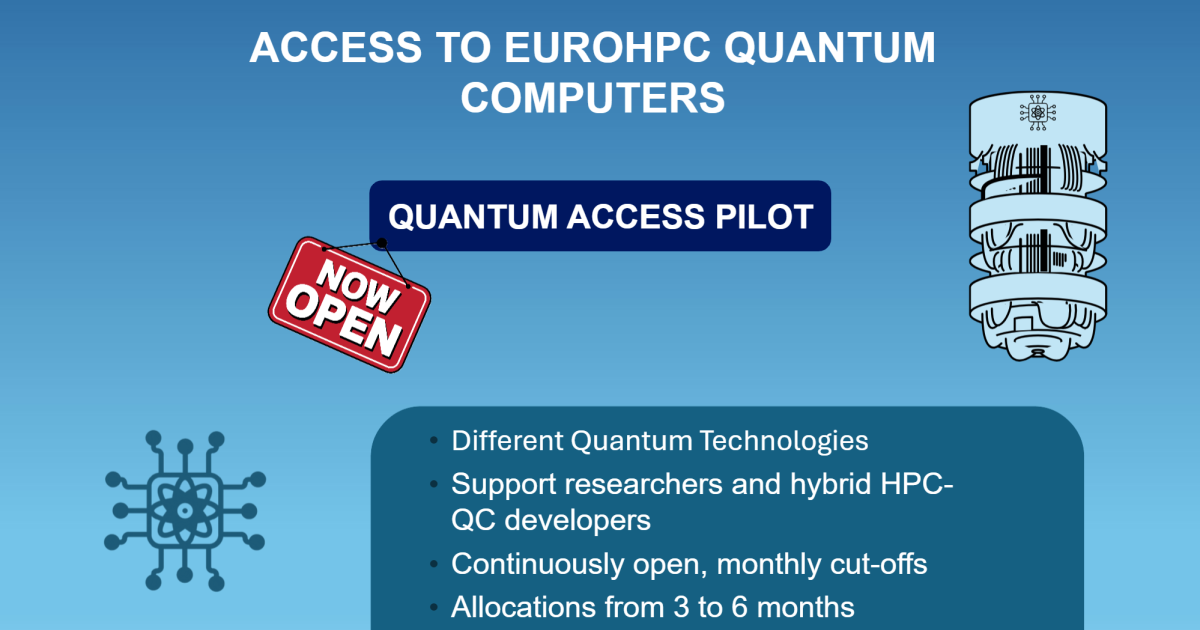
Researchers across Europe will gain access to a diverse portfolio of quantum computing technologies starting August 1st, 2026, as the European High Performance Computing Joint Undertaking (EuroHPC JU) opens its quantum infrastructure to experimentation. The initiative provides access to systems including Euro-Q-Exa, Lucy, Piast-Q, and VLQ, representing superconducting qubits, photonic qubits, and trapped-ions, and aims to integrate quantum computers with existing supercomputing capabilities. This “quantum pilot access mode” is designed for users wanting to document the technical feasibility of their applications and develop essential code and algorithms, rather than simply running existing programs. The EuroHPC JU states that this step enables users to experiment with different quantum technologies to advance scientific discovery and drive innovation, with six quantum computers procured and two more co-funded through the HPCQS project, all located within Europe.
EuroHPC JU Quantum Access for Testing and Development
Europe’s quantum computers are now available for researchers, offering a crucial platform to test and refine emerging applications. This access is not simply about running existing programs on novel hardware, but a deliberate strategy to integrate quantum computers with Europe’s established supercomputing capabilities, enabling quantum-accelerated HPC. The EuroHPC JU’s investment focuses on a diverse portfolio of quantum technologies, including trapped ions, superconducting circuits, photonics, and more, allowing users to evaluate performance across different approaches. The first four quantum computers immediately available through this initiative are Euro-Q-Exa, Lucy, Piast-Q, and VLQ, each utilizing distinct qubit technologies; Euro-Q-Exa and VLQ are based on superconducting qubits, while Lucy employs photonic qubits and Piast-Q utilizes trapped-ions. Researchers, public institutions, and industry stakeholders can submit proposals, with the first application deadline being August 1st, 2026, followed by a monthly evaluation cycle.
This access is specifically designed to facilitate the development of quantum algorithms and workflows, as well as the assessment of application feasibility. The EuroHPC JU explains this focus on practical experimentation. Beyond these initial systems, the EuroHPC JU anticipates additional quantum computers becoming available through future calls, building a comprehensive European quantum ecosystem. The undertaking has already procured six quantum computers and co-funded two more through the HPCQS project, with plans for two additional deployments in the Netherlands and Luxembourg. This expansion reflects the EuroHPC JU’s broader ambition to position Europe as a global leader in supercomputing and quantum computing, complementing its existing network of 12 supercomputers, including the recently deployed exascale systems JUPITER and Alice Recoque.
The first systems accessible through the call, with a first cut-off as of 1 st August 2026, are: Euro-Q-Exa , based on superconducting qubits, Lucy , based on photonic qubits, Piast-Q , based on trapped-ions, VLQ , based on superconducting qubits.
This initiative represents a significant shift towards practical experimentation, allowing users to move beyond theoretical exploration and begin rigorously testing applications on diverse quantum architectures. The EuroHPC JU’s strategy prioritizes a broad portfolio of technologies, encompassing trapped ions, superconducting circuits, photonics, neutral atoms, and adiabatic systems, recognizing that no single approach currently dominates the field. Four systems are immediately available: Euro-Q-Exa and VLQ, both leveraging superconducting qubits; Lucy, utilizing photonic qubits; and Piast-Q, based on trapped-ions. The organization has already established a network of twelve supercomputers across Europe, including the exascale systems JUPITER in Germany and Alice Recoque in France, demonstrating a commitment to integrating quantum capabilities with existing high-performance computing infrastructure. The call will remain continuously open with monthly cut-off dates for proposal evaluation, ensuring a steady stream of experimentation and analysis.
Source: https://www.eurohpc-ju.europa.eu/eurohpc-ju-opens-access-its-quantum-computers-2026-06-25_en


See today’s quantum computing news on Quantum Zeitgeist for the latest breakthroughs in qubits, hardware, algorithms, and industry deals.