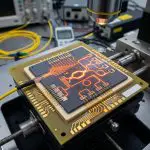
An international research team has created a memristor that senses humidity from a distance of one millimeter, mirroring the function of human skin. The device, built from porous nickel pyrophosphate (Ni₂P₂O₇), modulates its electrical resistance in response to moisture, replicating how synapses strengthen or weaken connections.
This touch-free operation integrates sensory perception and memory in a single device, a key step toward artificial systems that process information like the human brain; researchers report achieving over 97% accuracy classifying humidity states using support vector machine and multilayer perceptron algorithms. The findings, published in eScience, demonstrate a pathway for biomimetic research and intelligent environmental monitoring.
Porous Ni₂P₂O₇ Architecture Enables Touch-Free Neuromorphic Computing
Constructed from porous nickel pyrophosphate (Ni₂P₂O₇), the memristor’s performance stems from a unique synthesis process involving a hydrothermal method, resulting in microsheets characterized by X-ray diffraction and electron microscopy. These structural characteristics allow for analog resistive switching with tunable resistance states responding to relative humidity levels ranging from 42% to 82%, a range mirroring typical environmental conditions.
Quantitative indicators of this humidity-responsive behavior include the hysteresis loop area and charge-driving capacity, both of which consistently increased with rising humidity levels during testing; this correlation establishes a direct link between environmental moisture and the device’s electrical properties. Density functional theory calculations further illuminate the material’s behavior at the atomic level, revealing that water molecule adsorption narrows the material’s bandgap and introduces new hybridized electronic states near the conduction band, directly explaining the observed conductivity enhancement.
Understanding the material’s behavior at the atomic level is important for optimizing its performance and exploring similar materials for other sensing applications. The device also exhibited non-volatile memory, retaining stable separation between high- and low-resistance states over hundreds of switching cycles and maintaining memory for extended durations. The team’s design allows for emulation of both short-term and long-term memory functions by simply adjusting the distance between a moistened finger and the sensor; closer proximity induced stronger, longer-lasting conductance changes, demonstrating the device’s capacity to learn and adapt, eScience says.
The authors said that the most exciting aspect of this device is its ability to not only sense humidity but also remember it, highlighting the potential for creating systems that perceive environmental changes and retain a history of those changes. This capability is particularly valuable in applications requiring contextual awareness and predictive behavior.
The non-contact operation, achieved with a sensing distance of one millimeter, eliminates the need for physical touch, opening possibilities for sterile environments, through-packaging sensing, and future e-skin systems. This integration of sensing and memory within a single device addresses a major hurdle in neuromorphic computing, overcoming the limitations of existing approaches that rely on separate sensing and processing units. The resulting reduction in signal mismatch and response time is critical for creating truly brain-like systems capable of real-time processing and adaptive learning.
Potential applications extend to touch-free human-machine interfaces, smart healthcare monitoring, environmental sensing networks, and soft robotics, all areas where distributed, energy-efficient perception is paramount.
What excites us most is that this device doesn’t just sense humidity – it remembers it.




See today’s quantum computing news on Quantum Zeitgeist for the latest breakthroughs in qubits, hardware, algorithms, and industry deals.