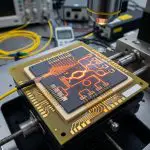
A new method for reading information from quantum bits, or qubits, utilising infrared light has been demonstrated by scientists. B. Göblyös and colleagues at Budapest University, in collaboration with University of Duisburg-Essen and University of Notre Dame, have achieved optically detected magnetic resonance (ODMR) using a previously untapped infrared emission from nitrogen-vacancy (NV) centres in diamond. This process provides a high-fidelity optical readout pathway. It sharply links diamond spin-qubits with standard telecommunication infrastructure in the 1300-1600 nm range, potentially overcoming limitations associated with current frequency conversion technologies and enabling more efficient quantum communication networks.
Infrared ODMR identifies nitrogen-vacancy centre spin states in diamond
Optically detected magnetic resonance (ODMR) served as the central technique in this investigation, reading a material’s quantum state by illuminating it with light while applying a magnetic field and observing changes in emitted light. This technique exploits the interaction between the electron spin of the NV centre and the applied magnetic field, causing shifts in the energy levels and consequently altering the emitted light intensity. The established method was refined to focus on infrared light emitted by nitrogen-vacancy (NV) centres in diamond, tiny defects in the crystal structure behaving like artificial atoms with quantum properties. These NV centres arise from nitrogen impurities replacing carbon atoms in the diamond lattice, alongside an adjacent vacancy. Careful analysis of changes in this infrared signal under a magnetic field allowed discernment of the NV centre’s spin state, effectively ‘reading’ its quantum information. Single crystal diamonds containing approximately one part per million of NV centres, created via neutron irradiation and subsequent annealing, were utilised as spin-qubits. Neutron irradiation introduces vacancies within the diamond lattice, and the subsequent annealing process facilitates the diffusion of nitrogen impurities into these vacancies, forming the NV centres. The analysis focused on infrared light emitted at 1042nm, a previously underutilized signal, instead of relying solely on visible fluorescence typically used in these experiments. This offers a direct interface with standard telecommunication infrastructure, as the 1300-1600 nm range is a standard transmission window for optical fibres, minimising signal attenuation. The significance of utilising the 1042nm emission lies in its origin within the singlet manifold of the NV centre’s optical cycle, a pathway typically considered ‘dark’ due to its lack of strong visible fluorescence.
Infrared optical readout demonstrates high-fidelity spin-state transcription in diamond
Spin-state transcription now extends beyond visible light, reaching into the 1300-1600nm range. This breakthrough establishes a direct interface between diamond spin-qubits and standard fibre optic infrastructure, bypassing limitations inherent in active frequency conversion and utilising existing technologies within that spectral range. Frequency conversion, typically employing non-linear optical crystals, introduces losses and complexities, hindering efficient quantum communication. Detailed analysis revealed field-dependent spectral dispersion of the ODMR signal, proving the NV centre transcribes spin-state information directly into the infrared emission via spin-selective intersystem crossing. Intersystem crossing refers to the transition between singlet and triplet states within the NV centre, and this process is sensitive to the spin state of the electron. The infrared signal at 1042nm originates from the singlet manifold within the NV centre’s optical cycle, demonstrating spin-dependent population of these energy levels, and building on prior work identifying a zero-phonon line at 1046nm and establishing its sensitivity to magnetic fields and stress. The zero-phonon line represents a direct transition between energy levels without involving lattice vibrations, providing a sharp spectral feature for precise measurements. While these results establish a high-fidelity optical readout pathway, practical implementation requires overcoming challenges in signal strength and maintaining coherence at these infrared wavelengths. Coherence, the preservation of quantum superposition, is crucial for quantum information processing, and maintaining it at infrared wavelengths presents a technical hurdle. Further investigation into optimising the process is warranted, including exploring methods to enhance the infrared emission intensity and improve the stability of the NV centre’s spin state.
Direct infrared readout unlocks efficient diamond-based quantum communication
Researchers are forging a path towards practical quantum networks, and this work offers an important building block by demonstrating a direct read-out of quantum information using infrared light. The team acknowledges a persistent challenge, however; the infrared signal remains comparatively weak, demanding sensitive detection equipment. This limitation raises questions about scalability, as amplifying the signal without introducing noise could prove difficult. Maintaining a high signal-to-noise ratio is paramount for reliable quantum communication.
Currently, converting quantum signals between different wavelengths is inefficient and causes data loss; this research bypasses that issue entirely. Reading quantum information directly in the infrared range, specifically the 1300-1600 nanometre band, aligns diamond-based quantum systems with existing fibre optic networks, simplifying integration and potentially accelerating the development of a quantum internet. The compatibility with existing infrastructure significantly reduces the cost and complexity of building quantum communication systems. Optically detected magnetic resonance establishes a new, direct route for reading the quantum state of nitrogen-vacancy centres within diamonds. A signal at 1042nm proved that spin information can be transferred to this infrared emission via a process mirroring how visible light is used to read these quantum systems. In particular, this method extends the range of detectable signals into the 1300-1600nm band, aligning diamond-based quantum technology with existing fibre optic networks and removing the need for inefficient light conversion, potentially enabling long-distance quantum communication. The ability to transmit quantum information over long distances without significant signal degradation is a key requirement for a practical quantum internet, and this infrared ODMR technique offers a promising solution.
The research successfully demonstrated a high-fidelity optical readout of quantum information using infrared light emitted at 1042nm from nitrogen-vacancy centres in diamond. This is significant because it establishes a direct interface between these quantum systems and standard telecommunication infrastructure in the 1300-1600nm range, avoiding the need for inefficient wavelength conversion. Researchers observed optically detected magnetic resonance contrast in the infrared emission, proving that spin-state information is transcribed to the infrared signal. The team noted that further work is needed to address the comparatively weak infrared signal and improve detection sensitivity.
👉 More information
🗞 Telecom-Wavelength-Compatible Quantum Information Transcription Using Nitrogen-Vacancy Centers
🧠 ArXiv: https://arxiv.org/abs/2605.14697



See today’s quantum computing news on Quantum Zeitgeist for the latest breakthroughs in qubits, hardware, algorithms, and industry deals.