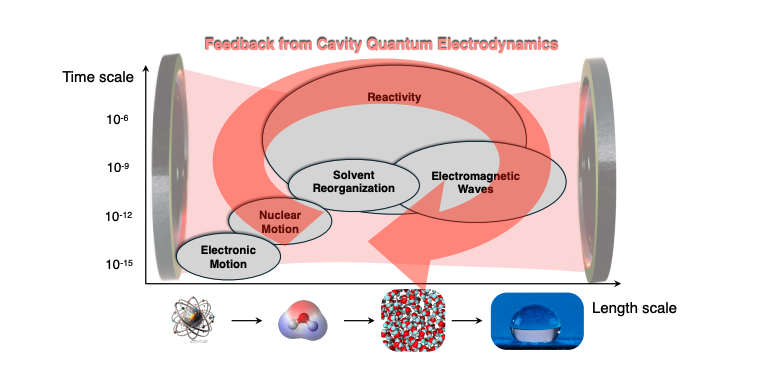
Understanding how light and matter interact at a fundamental level is crucial for developing new technologies, and recent attention has focused on strong light-matter coupling within optical cavities. Dominik Sidler, Carlos M Bustamante, and colleagues at the Paul Scherrer Institute, Max Planck Institute for the Structure and Dynamics of Matter, and Arizona State University, now present a new computational framework that bridges the gap between theoretical descriptions and experimental observations in this field. Their method combines density-functional tight binding with simulations of Maxwell’s equations, allowing for a self-consistent treatment of both the cavity environment and the microscopic details of molecular ensembles. This approach provides unprecedented insight into the complex interplay between light and matter, enabling researchers to calculate key spectroscopic observables, resolve local molecular behaviour, and optimise cavity designs for specific applications, ultimately paving the way for more efficient and targeted light-matter interactions.
Polariton Chemistry and Strong Light-Matter Coupling
Scientists are exploring the emerging field of polariton chemistry, which investigates how strong coupling between light and molecules creates new states called polaritons and modifies chemical reactions. This research combines theoretical modeling with experimental studies to understand how light can influence the rates, pathways, and selectivity of chemical processes. Key areas of investigation include vibrational strong coupling, where molecular vibrations interact strongly with light, and cavity quantum electrodynamics, which examines light-matter interactions within confined spaces like optical cavities. Experimental studies demonstrate modified chemical behavior, altered material properties such as conductivity and magnetism, and changes in spectroscopic signatures under strong coupling conditions. Researchers are also investigating the use of plasmonics to enhance light-matter interactions and developing methods to account for the influence of the surrounding environment on quantum dynamics. This method accurately models the complex interplay between light and matter within optical cavities, addressing limitations of previous approaches that struggled with feedback effects occurring across multiple scales. The framework allows researchers to investigate non-perturbative strong light-matter interactions, providing access to both global and local properties of these systems. This technique calculates two-dimensional spectroscopic observables, directly connecting to established experimental methods used to probe polaritonic systems.
By mapping coupling networks between polaritons and distinguishing broadening mechanisms, scientists can reveal quantum coherences arising from cavity-modified chemistry. The method delivers molecule-resolved information within coupled ensembles, allowing detailed investigation of local properties and interactions, and enabling the rational design of polaritonic devices. This approach overcomes limitations of existing methods that struggle to capture feedback effects across different scales. The framework accurately models how the spatial inhomogeneity of cavity modes influences local chemical properties, revealing crucial insights into the mechanisms of collective strong coupling. This method addresses a long-standing challenge in the field by providing a self-consistent treatment of both the cavity environment and the microscopic details of molecular ensembles, capturing feedback effects across different scales. By bridging macroscopic field propagation with microscopic molecular resolution, the framework offers quantitative insights into spectroscopic observables and detailed access to local chemical changes induced by light-matter hybridization. The team successfully demonstrated the capabilities of this approach by calculating two-dimensional spectroscopic data, providing molecule-resolved information within coupled ensembles, and showing how cavity designs can be optimized for specific applications.
This work moves beyond simplified models by accurately representing the complex interplay between light and matter, offering a more complete understanding of these phenomena. The resulting computational toolkit offers a pathway towards interpreting experimental setups and designing novel industrial applications without relying on extensive high-performance computing infrastructure. The framework’s speed and simplicity make it a promising tool for both fundamental research and practical innovation.
🗞 Density-Functional Tight Binding Meets Maxwell: Unraveling the Mysteries of (Strong) Light-Matter Coupling Efficiently
🧠 ArXiv: https://arxiv.org/abs/2509.10111




See today’s quantum computing news on Quantum Zeitgeist for the latest breakthroughs in qubits, hardware, algorithms, and industry deals.