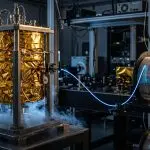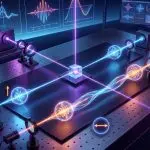
A single particle interaction detected by the LUX-ZEPLIN experiment is generating excitement in the search for dark matter, a substance estimated to comprise 85% of the universe’s mass. While not yet a confirmed discovery, this event represents the most compelling hint of dark matter observed by the experiment to date.
“We’re very intrigued to see this event in the data,” said Rick Gaitskell, a professor of physics at Brown University and the LZ spokesperson, “and the competing backgrounds are very low.” Light sensors constructed at Brown University were crucial in capturing this potential signal, designed to record the tiny flash of light created when a dark matter particle interacts with xenon atoms.
LZ Experiment Records Potential Dark Matter Particle Interaction
Approximately 85% of the universe’s mass remains unseen, composed of a substance known as dark matter, and the LZ experiment is designed to directly detect its elusive interactions. The international collaboration, involving 250 scientists and engineers from 39 institutions, recently recorded a single particle interaction that defies easy explanation by known sources of background noise.
A crucial component of the LZ experiment’s detection system is an array of specialized light sensors constructed at Brown University. This detailed study focused on a previously unexplored region within the dataset, requiring months of additional effort to rule out conventional explanations for the observed signal; the team’s meticulous approach underscores the challenges inherent in isolating potential dark matter interactions from the constant stream of background radiation.
The LZ collaboration presented these findings at the 2026 TeV Particle Astrophysics conference in Japan, with a corresponding paper submitted to Physical Review Letters and made available on the arXiv repository. While cautious about claiming a definitive discovery, the researchers emphasize the importance of sharing this intriguing result with the broader scientific community. “With only one event, we don’t want to get ahead of ourselves.
We are not claiming to have seen dark matter. But we have seen something interesting that we want to share with the scientific community for their input.” The team acknowledges that alternative theoretical models, such as inelastic or momentum-dependent scattering, could potentially account for the single observed event. This finding suggests a clear target for ongoing dark matter research, not only at LZ but also at other complementary experiments seeking to unravel the mysteries of this pervasive, invisible component of the universe.
We’re very intrigued to see this event in the data, in the region where we expect dark matter to show up, and the competing backgrounds are very low.
Rick Gaitskell, a professor of physics at Brown University and the spokesperson for LZ
Brown University Light Sensors Detect Single Event in Xenon Tank
The search for dark matter gained a potential focal point as researchers utilizing the LUX-ZEPLIN experiment detected a single, unexplained particle interaction. This event, while not yet definitive proof, represents the most promising signal observed by LZ to date, prompting detailed analysis and discussion within the physics community. The LZ detector, located nearly a mile underground at the Sanford Underground Research Facility in South Dakota, is designed to directly detect Weakly Interacting Massive Particles, or WIMPs, a leading dark matter candidate.
These sensors are engineered to capture the faint flashes of light produced when a dark matter particle collides with xenon atoms within the 10-ton liquid xenon detector. The team’s meticulous approach involved developing new machine learning algorithms, led by Brown University undergraduate Woody Hulse, graduate student Charles Kong, and postdoctoral fellow Shawn Dubey, to analyze the vast quantities of data generated by the experiment.
The single event’s characteristics do not align with known background signals from normal matter, leading researchers to consider alternative explanations, including theoretical extensions to the standard WIMP model. The researchers caution against prematurely claiming a discovery, stating that further data and analysis are necessary to confirm the nature of the interaction, and that this work will continue to refine our understanding of dark matter.
This was a detailed study in a region we hadn’t explored within this dataset, and we spent months of additional effort to understand all the possible causes of background events.
Sam Eriksen, a senior research associate at the University of Bristol in the U.K. and lead author of the study



See today’s quantum computing news on Quantum Zeitgeist for the latest breakthroughs in qubits, hardware, algorithms, and industry deals.