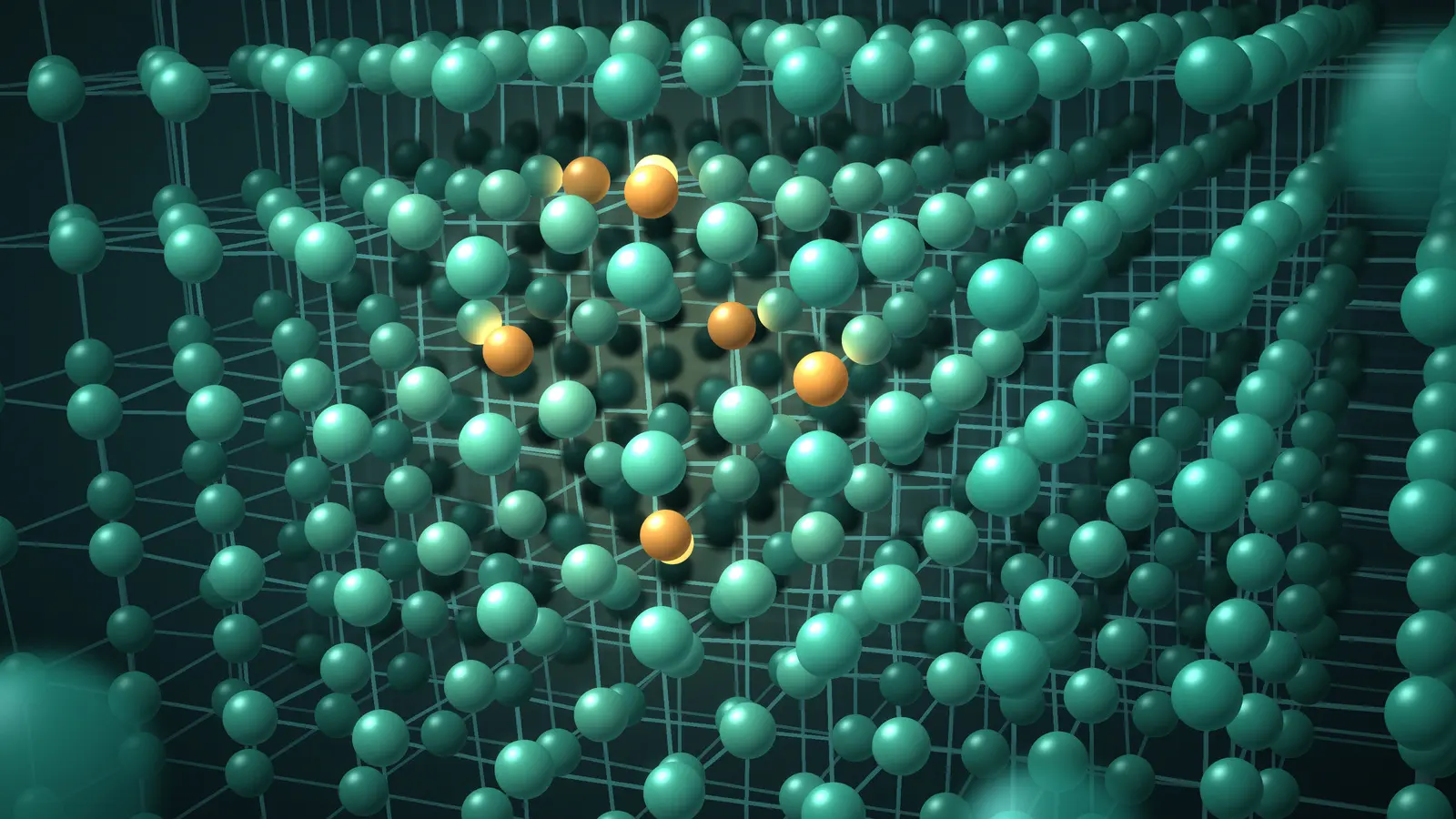
Researchers at Sun Yat-Sen University and the Chinese Academy of Sciences have observed superconductivity in a novel form of lanthanum nickelate, La₃Ni₂O₇, but only when subjected to extreme pressure. Synthesizing a monolayer-trilayer phase of the material, the team found a superconducting transition at 3.6 K above 19 GPa, a stark contrast to the 80 K achieved in the bilayer structure. This difference demonstrates that the temperature at which superconductivity occurs is directly linked to how layers within the material interact, identifying the bilayer NiO₆ block as essential for achieving high-temperature superconductivity in these nickelates.
Ruddlesden-Popper Nickelate Superconductivity: Bilayer vs. 1313 Phase
The 1313 phase of La₃Ni₂O₇ exhibits a superconducting transition at 3.6 K when subjected to pressures exceeding 19 GPa, a finding that sharply contrasts with the 80 K superconductivity observed in the bilayer form of the same material. This newly synthesized structural polymorph, created using the high-pressure floating-zone method, presents a uniquely clear comparison point for understanding the mechanisms driving superconductivity within Ruddlesden-Popper (RP) nickelates.
Researchers meticulously documented a structural shift from orthorhombic Cmmm to tetragonal P4/mmm symmetry at 13 GPa, preceding the onset of the superconducting state at higher pressures. The observation confirms superconductivity exists across the RP nickelate family, despite variations in crystal structure and resulting transition temperatures. The stark difference in superconducting temperatures between the bilayer and 1313 phases underscores the critical influence of interlayer coupling on achieving high-temperature superconductivity in these materials.
The 1313 phase, characterized by alternating monolayer and trilayer arrangements of nickel-oxygen octahedra, demonstrates a significantly reduced transition temperature compared to the bilayer structure. This suggests that the specific stacking sequence and resulting electronic interactions play a decisive role in determining the material’s superconducting properties.
The separation between structural and superconducting transition pressures in the 1313 and 1212 phases, in contrast to their coincidence in the bilayer and trilayer phases, highlights the crucial role of the 180° Ni-O-Ni bond angle along the c-axis in the emergence of superconductivity in RP nickelates. A systematic comparison of the RP nickelate family reveals a clear hierarchy in superconducting transition temperatures, ranging from approximately 80 K in the bilayer phase to 40 K in the trilayer phase, 64 K in the hybrid 1212 phase, and finally, 3 K in the 1313 phase.
This progression suggests that the degree of structural frustration, specifically, the presence of non-bonding electronic states, influences the strength of electron correlations and, consequently, the superconducting transition temperature. The trilayer structure, viewed as an exhibits weakened correlations due to these non-bonding states, potentially explaining its lower Tc compared to the bilayer phase. The discovery of superconductivity in the 1313 phase confirms the universality of pressure-induced superconductivity across the RP nickelate family, providing further evidence for the potential of these materials as high-temperature superconductors.
“Given the unique lattice structure of hybrid RP phase nickelates, investigating the superconducting properties of the pure 1313 phase of La₃Ni₂O₇ is of significant importance for verifying the superconducting mechanism of both the trilayer and bilayer RP phase nickelates,” the researchers write. The successful synthesis of high-purity single crystals was essential for definitively establishing the superconducting properties of this phase, as earlier attempts yielded inconclusive results.
Measurements revealed an of 3.6 K and an of 2.3 K at 24.3 GPa, confirming the existence of a zero-resistance state indicative of superconductivity. The structural transition observed at 13 GPa, from orthorhombic to tetragonal symmetry, is a key feature and likely contributes to its unique electronic properties. This transition alters the arrangement of nickel-oxygen octahedra, influencing the electronic band structure and potentially enhancing the superconducting pairing mechanism.
The team’s findings suggest that the NiO₆ octahedral block is an essential structural motif for achieving high-Tc superconductivity in RP nickelates, emphasizing the importance of understanding the interplay between crystal structure and electronic correlations. Further investigation into the electronic structure and pairing symmetry will be crucial for unraveling the underlying mechanisms responsible for its superconducting behavior and for guiding the development of even higher-temperature nickelate superconductors.
High-Pressure Synthesis and Structural Transition of La₃Ni₂O₇
High-pressure floating-zone synthesis enabled the creation of high-purity single crystals of the hybrid 1313 phase of La₃Ni₂O₇, an important step in observing its behavior under stress. Synchrotron X-ray diffraction revealed a distinct structural transition occurring at 13 GPa, shifting the material from an orthorhombic Cmmm structure to a tetragonal P4/mmm arrangement, a change confirmed by concurrent Raman spectroscopy measurements. This transition, preceding the onset of superconductivity, demonstrates a strong interplay between the material’s lattice structure and its electronic properties, suggesting a fundamental connection between structural order and the emergence of zero resistance.
Determining the precise pressure at which the structural transition occurs proved challenging due to the limited X-ray scattering from oxygen atoms, but analysis of Raman spectra provided corroborating evidence. Specifically, the convergence and eventual merging of two prominent peaks, designated P2 and P3, in the Raman spectra at approximately 13.0 GPa signaled the shift in symmetry.
The researchers observed that this structural change is accompanied by a substantial alteration in electrical resistance, further solidifying the link between the material’s atomic arrangement and its ability to conduct electricity. The 1313 phase of La₃Ni₂O₇ exhibits superconductivity emerging above 19 GPa, with a superconducting onset temperature of 3.6 K and a zero-resistance temperature of 2.3 K at 24.3 GPa.
This discovery confirms that pressure-induced superconductivity is a universal characteristic across the RP nickelate family, but also highlights key differences between structural phases. The researchers propose that maintaining this 180° angle is essential for facilitating the flow of electrons without resistance.
An anomaly observed at 243 K may originate from the monolayer of NiO₆ octahedra, inheriting antiferromagnetic order from La₂NiO₄, indicating a complex interplay of magnetic and structural properties. Detailed examination of the electronic transport properties, presented in the accompanying phase diagram, demonstrates a pronounced resistance change at the structural transition, visually representing the strong coupling between the material’s lattice and its electronic behavior.
The team’s methodology involved carefully preparing feed and seed rods by mixing La₂O₃ and NiO powders in a 3:4 molar ratio, followed by repeated grinding and sintering at 1100°C for 48 hours to ensure homogeneity. This meticulous sample synthesis was critical for obtaining the high-purity single crystals necessary for accurate measurements under extreme pressure.
The resulting phase diagram, summarizing the electronic transport and structural properties from 0 to 36 GPa, visually illustrates the relationship between pressure, resistance, and the structural transition, providing a comprehensive overview of the material’s behavior. “The orthorhombic-to-tetragonal structural transition occurs at 13.0 GPa, preceding the emergence of superconductivity at 19 GPa,” the researchers state, emphasizing the sequential nature of these critical events. The observation of superconductivity, coupled with the detailed analysis of its structural transition, provides valuable insights into the mechanisms governing superconductivity in RP nickelates.
The data presented in the phase diagram, with its color scale representing normalized resistance R/R50K, clearly highlights the superconducting region and the significant resistance change coinciding with the structural transition. This detailed mapping of the material’s properties under pressure offers a foundation for future investigations aimed at optimizing these materials for potential applications, and understanding the fundamental physics driving high-temperature superconductivity.
13 GPa Orthorhombic to Tetragonal Phase Change in 1313 Nickelate
Synchrotron X-ray diffraction revealed a critical structural shift in the 1313 phase of La₃Ni₂O₇ at 13 GPa, marking a transition from orthorhombic to tetragonal crystalline symmetry. This transformation, observed under high pressure, precedes the material’s emergence into a superconducting state, a finding that clarifies the relationship between crystal structure and superconductivity in Ruddlesden-Popper nickelates. Researchers utilized both synchrotron X-ray diffraction and Raman spectroscopy to characterize this phase change, providing a detailed picture of the material’s behavior under extreme conditions.
The observed tetragonal P4/mmm space group represents a significant departure from the initial orthorhombic Cmmm structure. Measurements of lattice constants, specifically along the a, b, and c axes, further illustrate the structural distortion occurring at 13 GPa. The Ni-O-Ni bond angle along the c-axis, previously proposed as a critical parameter for superconductivity, remains at 180 degrees in the orthorhombic structure, even as the material undergoes this initial transformation.
Superconductivity emerges within the tetragonal structure, mirroring observations in its trilayer counterpart, though at a significantly reduced transition temperature. A systematic comparison of these different phases, bilayer, trilayer, 1212, and 1313, reveals a trend where increasing structural complexity correlates with decreasing superconducting transition temperatures. This frustration appears to diminish the superconducting potential compared to the simpler bilayer arrangement.
The 1313 phase, as a hybrid structure, further exemplifies this trend, achieving superconductivity at a much lower temperature than the bilayer material. Raman spectroscopy provided complementary data, confirming the structural transition through changes in vibrational modes under pressure.
The color map of Raman intensity as a function of pressure and wavenumber clearly illustrates the evolution of these modes, providing further evidence for the structural transformation at 13 GPa. These spectroscopic measurements, combined with the X-ray diffraction data, offer a comprehensive understanding of the material’s structural behavior under pressure. The findings demonstrate that the superconducting transition temperature is directly governed by the nature of the interlayer coupling, and the bilayer NiO₆ block remains the essential structural motif for achieving high-T_c superconductivity in the RP nickelates.
Superconductivity Emerges in 1313 Phase at 19 GPa and 3.6 K
This distinction provides a uniquely clean experimental comparison for understanding the factors governing superconductivity within this family of nickelate materials. This arrangement appears to influence the strength of interlayer coupling, a critical factor in determining the superconducting transition temperature.
Researchers found that the maximum ratio is not provided. This suggests that electron pairing, essential for superconductivity, is more confined to the coupled nickel oxide layers, limiting its overall superconducting potential. Interestingly, this value is comparable to the approximately 0.44 observed in the 1212 hybrid phase. The 1313 phase’s emergence of superconductivity within the tetragonal structure mirrors that of its trilayer counterpart, exhibiting a of approximately 40 K, suggesting shared mechanisms at play.
This frustration appears to be further amplified, resulting in the lowest observed transition temperature among the studied RP nickelates. Subtle kinks observed at 240 K and 181 K at 1.0 GPa, consistent with previously measured anomalies, were suppressed by increasing the pressure to 11. The substantially reduced μ₀Hc2(0) relative to Tc in both hybrid phases suggests that superconducting electron pairing is confined to the coupled NiO₆ layers. The detailed analysis of these materials provides a foundation for further research into high-temperature superconductivity.
👉 More information
🗞 Superconductivity in Monolayer-Trilayer Phase of La₃Ni₂O₇ under High Pressure
✍️ Chaoxin Huang et al.
🧠 DOI: http://link.aps.org/doi/10.1103/jc35-gj2l



See today’s quantum computing news on Quantum Zeitgeist for the latest breakthroughs in qubits, hardware, algorithms, and industry deals.