Sirui Lu, a doctoral candidate at the Max Planck Institute of Quantum Optics, is developing TeXRA, an artificial intelligence framework that combines the reasoning capabilities of large language models with computational tools to advance quantum physics research. TeXRA is being applied to co-design quantum error-correcting codes with transversal diagonal gates through numerical search and to formally verify tensor network theory within the Lean 4 proof assistant, going beyond simply benchmarking LLMs on coding tasks. This approach connects informal physical reasoning to rigorous numerical computation and machine-checked proof. Lu is also co-authoring Generative AI and Stochastic Thermodynamics: A Tale of Free Energies with Max Welling and Lars Holdijk, to be published by Cambridge University Press, which highlights a connection between AI and fundamental physics principles.
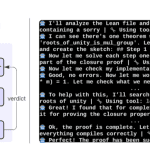
TeXRA facilitates co-designing quantum error-correcting codes featuring transversal diagonal gates through a multi-agent numerical search process, a technique previously reliant on human expertise. This framework orchestrates specialized agents, constructing both research and verification systems that bridge intuitive physical insights with rigorous numerical calculation and formal proof. The forthcoming textbook demonstrates how concepts from stochastic thermodynamics inform the development of generative AI, while Lu’s research demonstrates a reciprocal relationship, applying AI to advance understanding in quantum information and algorithms. He received his master’s degree from Technical University of Munich and bachelor’s degree from Tsinghua University.
Together with Max Welling and Lars Holdijk, he is coauthoring the forthcoming textbook Generative AI and Stochastic Thermodynamics: A Tale of Free Energies, to be published by Cambridge University Press.
Lu’s framework, named TeXRA, moves beyond simply utilizing large language models for coding challenges; it orchestrates specialized agents to construct both research and verification systems.


See today’s quantum computing news on Quantum Zeitgeist for the latest breakthroughs in qubits, hardware, algorithms, and industry deals.