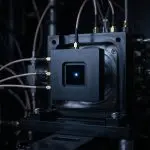
Researchers at Harvard University and Brookhaven National Laboratory report detecting at least seven entangled spins within the copper oxide material Sr₂CuO₃, a cuprate chain. This observation represents one of the largest entanglement depths yet reported in a solid, exceeding previous findings in similar materials. The team used resonant inelastic X-ray scattering to extract Quantum Fisher Information directly from the material’s spin fluctuation spectrum, establishing the technique as a new tool for probing many-body entanglement. The observed entanglement persists even at elevated temperatures, suggesting the potential for robust quantum states within this class of materials.
Resonant Inelastic X-ray Scattering Probes Cuprate Entanglement
Theoretical calculations on this one-dimensional cuprate material aligned with the experimental results, confirming the quantitative agreement between the observed entanglement and expectations from Hubbard-model predictions. The team focused on Sr₂CuO₃ due to its well-characterized cross section and the two decades of prior scattering experiments performed on similar copper oxides, providing stringent benchmarks for comparison.
Multipartite Entanglement in Sr₂CuO₃ Chains Observed
The cuprate Sr₂CuO₃ sustains a degree of multipartite entanglement that exceeds expectations for its material class, with the Quantum Fisher Information (QFI) revealing a depth capable of certifying at least seven-partite entanglement. This finding establishes a new benchmark, surpassing previous observations in solid-state systems and offering a platform for exploring more complex quantum states of matter. The QFI, a measure of sensitivity to changes in a quantum state, was extracted directly from the measured spin fluctuation spectrum using resonant inelastic X-ray scattering, bypassing the need for complete state tomography.
This approach provides a powerful method for quantifying entanglement without fully characterizing the system’s quantum state. The observed entanglement depth aligns with expectations derived from Hubbard-model calculations, a cornerstone of condensed matter physics. Beyond the specific entanglement depth, the study demonstrates the viability of resonant inelastic X-ray scattering (RIXS) as a tool for probing many-body spin entanglement.
The technique’s sensitivity is maximized at the antiferromagnetic wavevector, , where contributions from staggered spins constructively interfere. Away from this point, longer-range correlations tend to cancel out, providing a tighter bound on the entanglement depth.
Quantum Fisher Information as an Entanglement Witness
Extracting Quantum Fisher Information offers a new method for identifying and quantifying multipartite entanglement, moving beyond reliance on full system characterization. This approach uses the Quantum Fisher Information (QFI) density as a witness of entanglement, a metric applicable to mixed quantum states like those found in real materials at finite temperatures. Larger entanglement depth, as measured by the QFI, directly reflects the distribution of entanglement across a system and provides a measure of its many-body complexity.
The technique’s utility extends beyond simply detecting entanglement. It provides a direct link between microscopic correlations and the requirements for quantum simulation. This versatility positions resonant inelastic X-ray scattering as a powerful tool for exploring the complex landscape of quantum materials and their potential for future technologies.
Hubbard Model Agreement with Entanglement Depth
The cuprate Sr₂CuO₃ exhibits entanglement depths aligning with predictions from the Hubbard model, a finding that validates theoretical descriptions of this material’s quantum behavior. The observed entanglement is particularly notable given the material’s structure and the theoretical framework used to understand it. Sr₂CuO₃ chains, described by an extended Hubbard model incorporating hopping amplitude, on-site Coulomb repulsion and intersite Coulomb interaction, provide a controlled one-dimensional environment for studying entanglement.
The model, with parameters ≈ 560 meV, U = , and V = -t_h, aligns with prior photoemission and resonant inelastic x-ray scattering measurements, reinforcing the consistency of the findings. This consistency allows for quantitative comparison between experimental data and theoretical predictions, a feat more challenging in higher-dimensional systems. Quantifying entanglement relied on the Quantum Fisher Information (QFI), a tool used to establish a Bell-like test for multipartite entanglement. The study demonstrates that a value exceeding m certifies at least *(m + 1)*-partite entanglement, a principle applied to the observed spin correlations in Sr₂CuO₃.
RIXS Measures Spin Fluctuations for Entanglement Extraction
Resonant inelastic X-ray scattering (RIXS) is now a direct means of quantifying multipartite spin entanglement, a finding demonstrated through analysis of the cuprate Sr₂CuO₃. This approach establishes RIXS as a powerful tool for probing these subtle quantum states, offering a pathway to explore more complex materials and phenomena.
Analysis of the normalized Quantum Fisher Information (nQFI) at both 35 K and 220 K showed only modest reshaping of the spectra, indicating that the entanglement persists even at elevated temperatures. The ability to probe charge, orbital and spin degrees of freedom with RIXS also positions it as a versatile platform for extending entanglement studies to other quantum materials and exploring non-equilibrium settings.
Seven-Partite Entanglement Depth Reported in Solid
This depth of entanglement was revealed through analysis of resonant inelastic X-ray scattering (RIXS) data, allowing scientists to directly extract Quantum Fisher Information from the measured spin fluctuations. The observed entanglement isn’t merely a theoretical prediction; the QFI density exceeds a threshold that confirms at least seven entangled spins at 35 K. This certification relies on the fact that for a spin state with local moment S = 1/2, a QFI value exceeding the number of entangled spins confirms that depth.
Entanglement Metrics for Quantum Material Simulation
The research team’s methodology relies on defining entanglement in a way generalizable to mixed quantum states, such as those found in this finite-temperature spin chain. Calculating the QFI density allows for a robust witness of multipartite entanglement, defined as 2/N∑(pₙ – pₙ’)²/(pₙ +, where ρ represents the density matrix and O is a sum of local Hermitian operators.
Cuprate Chain Excitations Revealed by RIXS Mapping
Detailed analysis of RIXS data distinguishes between spin-conserving and spin-flip excitations, a separation enabled by their differing polarization dependencies and momentum profiles. Specifically, the team found that the intensity of spin-conserving two-spinon excitations is strongest near a momentum transfer of 0.25 reciprocal lattice units, while spin-flip excitations dominate at 0.5 reciprocal lattice units. Calculations using Density Matrix Renormalization Group (DMRG) simulations, performed on a 128-site Extended Hubbard Model, corroborate the experimental findings and provide a means to determine the QFI.
The simulations show that the peak positions of excitations, as observed in RIXS spectra, are similar for both experimental and theoretical results, but the intensities exhibit distinct momentum dependencies. These differences arise from the mixed contributions of spin-conserving and spin-flip excitations, each calculated and presented separately to clarify their individual roles in the overall RIXS signal.
The total projection factor, important for relating RIXS intensity to the underlying structure factor, is determined by dividing the calculated structure factor by the total RIXS intensity. The ability to experimentally distinguish spin-conserving and spin-flip RIXS channels through polarization dependence further refines the analysis, allowing researchers to calculate the projection factor from ΔS=1 RIXS to the structure factor S(q,ℏω) for varying core-hole lifetimes. The team’s methodology relies on theoretically selecting appropriate dipole transition operators and final matrix elements to compute the spin-conserving and spin-flip RIXS intensities, providing a robust method for probing many-body entanglement in complex materials.
👉 More information
🗞 Observation of multipartite spin entanglement in a cuprate chain
✍️ S. F. R. TenHuisen et al.
🧠 DOI: http://link.aps.org/doi/10.1103/q6gw-zk1k


See today’s quantum computing news on Quantum Zeitgeist for the latest breakthroughs in qubits, hardware, algorithms, and industry deals.