

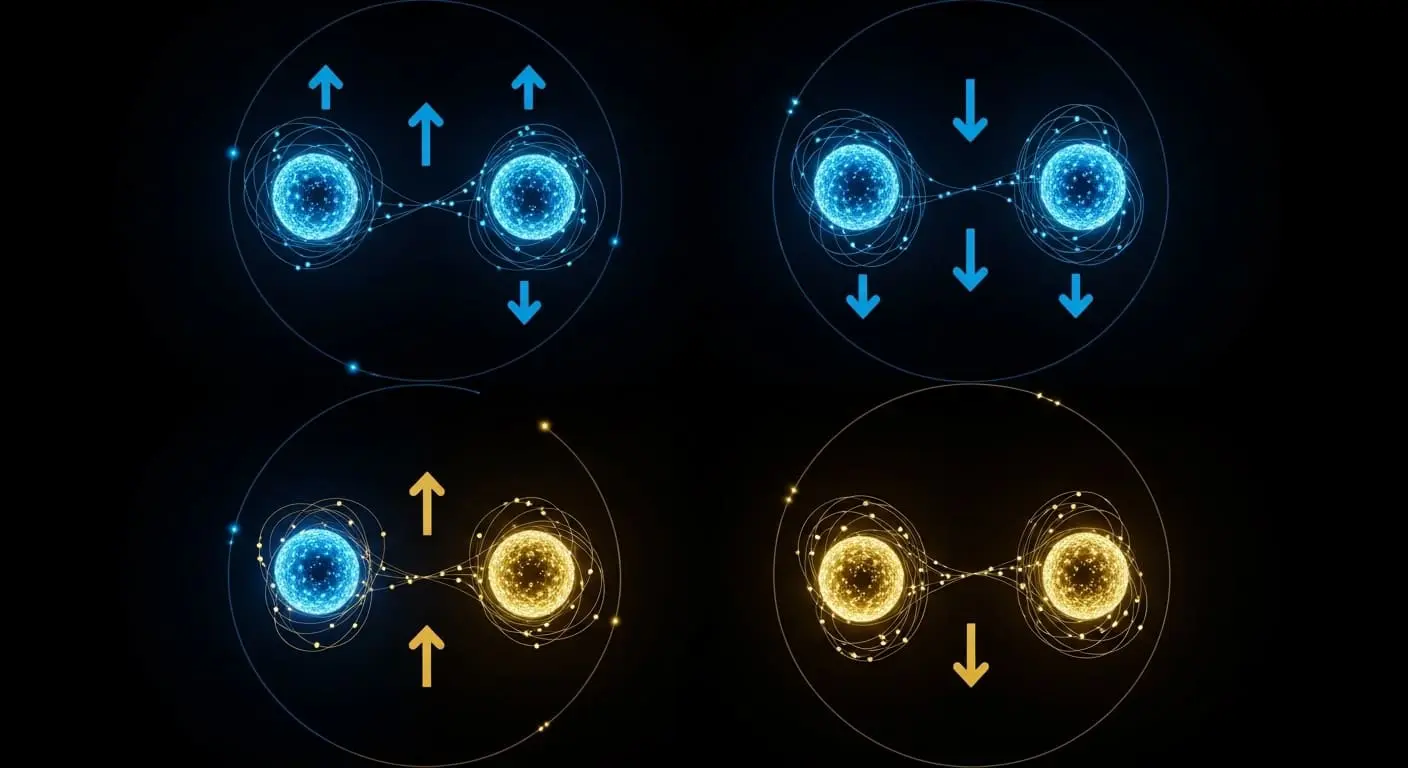
Scientists at Centro de Investigaci on y de Estudios Avanzados del Intituto Polit ecnico Nacional, in collaboration with Universit e Paul Sabatier, have developed a new thermodynamic framework integrating energy conservation with information theory for zero-temperature boson gases in curved spacetime. Led by Jorge Meza-Domínguez, the research utilises the hydrodynamic Madelung representation and the Arnowitt, Deser, Misner (ADM) formalism to establish fundamental relationships between energy balance and the dynamical evolution of boson density. This work offers insights into the persistence of quantum information in curved backgrounds and proposes a potential link between quantum stochasticity and underlying spacetime fluctuations, advancing understanding of relativistic bosonic systems and holding relevance for modelling phenomena such as boson stars and scalar field dark matter.
Curved spacetime decouples energy flow and quantum information in zero-temperature boson gases
A zero-temperature boson gas now benefits from a thermodynamic description within curved spacetime that distinctly separates energy transport and information conservation, a separation previously unattainable in relativistic bosonic systems. Bosons, unlike fermions, can occupy the same quantum state, leading to phenomena like Bose-Einstein condensation and collective behaviour crucial in astrophysical settings. This new dual formulation, achieved through the hydrodynamic Madelung representation and the ADM formalism, clarifies how quantum information is preserved within warped spacetime, offering a novel perspective on the interplay between gravity and quantum mechanics. The hydrodynamic Madelung representation transforms the Klein-Gordon equation into fluid-dynamical equations, allowing for the application of thermodynamic concepts. The ADM formalism, a method for solving Einstein’s field equations, provides a 3+1 split of spacetime, treating time and space differently and facilitating the analysis of energy conservation. This framework introduces a stochastic velocity component, linking quantum potential effects to fluctuations in spacetime itself, potentially revealing a gravitational origin for quantum stochastic behaviour. Traditionally, quantum stochasticity is attributed to inherent uncertainties in quantum measurements, but this research suggests a possible connection to the geometry of spacetime itself.
Analyses conducted within both Minkowski and Schwarzschild spacetimes confirmed the consistency of this framework, accurately modelling quantum systems under varying gravitational conditions. Minkowski spacetime represents flat, non-curved spacetime, serving as a baseline for comparison, while Schwarzschild spacetime describes the geometry around a non-rotating, spherically symmetric mass, such as a black hole or a star. A ‘geodesic velocity’, a four-vector incorporating quantum effects and electromagnetic fields, links the boson’s movement to the geometry of spacetime itself, suggesting gravity may underpin quantum stochastic behaviour. The geodesic velocity represents the path a boson would follow if solely influenced by gravity, but the inclusion of quantum and electromagnetic contributions introduces deviations, potentially explaining observed stochasticity. The derived energy balance equation closely resembles the first law of thermodynamics, extending established principles to relativistic quantum fluids. This equation, expressed in a relativistic context, accounts for changes in internal energy, work done, and heat transfer, but adapted for a quantum fluid described by the boson gas. Integration over a spatial hypersurface yields a global conservation law for energy, confirming that the total energy of the system remains constant over time, even in a curved spacetime.
Increasingly, scientists are focused on understanding how quantum systems behave under the extreme conditions of warped spacetime, vital for modelling environments ranging from the early universe to the interiors of neutron stars. The early universe, shortly after the Big Bang, experienced extreme densities and curvatures, while neutron stars possess immense gravitational fields. While this new thermodynamic description successfully maps energy and information flow in relatively simple gravitational scenarios, such as Minkowski and Schwarzschild spacetimes, applying it to more realistic cosmic environments remains a challenge. These environments often involve complex geometries, rotating black holes, and the presence of multiple interacting fields. Further refinement will be necessary to extend this model to truly complex astrophysical scenarios, potentially requiring numerical simulations and approximations. However, it establishes an important conceptual link between energy and information within gravity’s influence, utilising Fisher entropy as a measure of information. Fisher entropy, a concept from information theory, quantifies the amount of information contained within a probability distribution, providing a measure of the uncertainty associated with a quantum state. The ADM formalism is then used to describe spacetime evolution, allowing for the tracking of energy and information flow over time. This delivers a thorough thermodynamic description of boson gases, particles exhibiting collective quantum behaviour, existing within curved spacetime. The implications of this work extend beyond theoretical cosmology and astrophysics, potentially informing the development of quantum gravity theories and providing new insights into the fundamental nature of spacetime and quantum information.
The research successfully described how energy and information are conserved for boson gases existing in curved spacetime, such as near black holes or in the early universe. This matters because understanding these principles is crucial for modelling extreme astrophysical environments and potentially revealing connections between gravity and quantum mechanics. By utilising the ADM formalism and Fisher entropy, scientists established a framework linking energy transport with the preservation of quantum information. Future work could extend this model to more complex scenarios, perhaps employing numerical simulations to investigate boson behaviour in environments with rotating black holes or multiple interacting fields.
👉 More information
🗞 Energy Balance of a Boson Gas at Zero Temperature in Curved Spacetime
🧠 ArXiv: https://arxiv.org/abs/2603.23931

See today’s quantum computing news on Quantum Zeitgeist for the latest breakthroughs in qubits, hardware, algorithms, and industry deals.



