

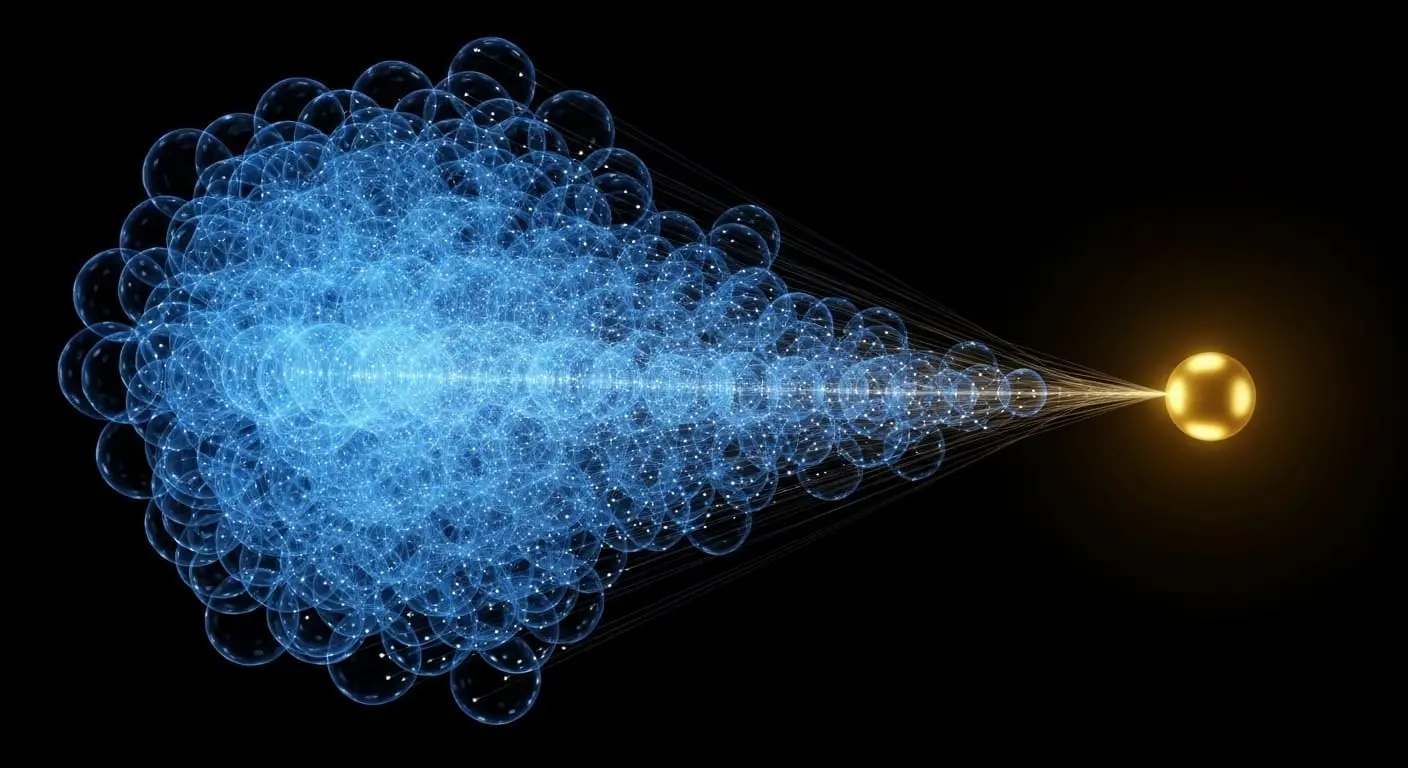
A thorough investigation into the precision limits of atomic sensors reveals a fundamental constraint arising from the discrete nature of atomic ensembles. Chen-Rong Liu and colleagues at College of Metrology Measurement and Instrument show that conventional noise analysis, treating atomic systems as continuous, overlooks an intrinsic “atomic granularity noise”. The study demonstrates this noise fundamentally competes with traditional optical measurement noise, establishing a unified noise-scaling law dependent on the ratio of photon to atom flux. Sharply, the research indicates that increasing optical power, a common technique to improve sensor sensitivity, can unexpectedly worsen performance by pushing the system into an atomic granularity noise-dominated regime, and defines a key threshold beyond which quantum-enhanced metrology offers no further benefit.
Atomic granularity limits quantum metrology sensitivity
A six-fold reduction in sensitivity limitations has been revealed by identifying a critical resource threshold, Rcrit, beyond which quantum-enhanced metrology fails to improve performance. This threshold defines the point at which atomic granularity noise, an intrinsic limitation arising from the discrete nature of atomic ensembles, overwhelms optical measurement noise. Previously, sensors were optimised solely assuming continuous atomic behaviour. A unified noise-scaling law, governed by the photon-to-atom flux ratio, R, demonstrates a crossover between regimes dominated by either optical or atomic noise.
This discovery challenges conventional optimisation techniques, revealing that increasing optical probe power can paradoxically degrade sensor performance. This occurs by driving systems into the atomic granularity noise-dominated regime, a previously unrecognised effect. Detailed analysis showed this noise directly competes with, and ultimately limits, the performance of optical measurements. The team identified a resource threshold, Rcrit, beyond which further increases in optical probe power, a standard optimisation tactic, actually worsen sensor sensitivity. Experiments utilising Rydberg electrometry confirmed sensitivity degrades when systems transition into the AGN-dominated regime, a phenomenon not previously accounted for in sensor design. Furthermore, a unified noise-scaling law governed by the photon-to-atom flux ratio, R, shows a clear crossover point between optical and atomic noise dominance.
Atomic granularity noise limits sensitivity in atomic ensemble measurements
The discrete nature of atomic ensembles causes the conventional continuous-medium approximation used in atomic-ensemble sensing to break down, revealing an intrinsic “atomic granularity noise” (AGN) that competes with optical measurement noise. This research establishes a unified noise-scaling law governed by the photon-to-atom flux ratio, a dimensionless quantity representing the balance between light and atomic density. A crossover point exists where increasing optical power, typically used to improve sensitivity, paradoxically degrades performance by driving the system into an AGN-dominated regime.
The work focuses on identifying and characterising atomic granularity noise as a fundamental limitation. Further investigation into the specific types of atomic ensembles where this effect is most pronounced is also needed. The study builds upon existing noise analysis in atomic-ensemble sensing, traditionally relying on the continuous-medium approximation, by introducing a discrete-atom statistical framework for a more accurate model. Specifically, the research identifies a critical resource threshold, denoted as Rcrit, beyond which quantum-enhanced metrology, techniques using non-classical light to improve precision, fails to yield further sensitivity gains.
This occurs because AGN becomes the dominant source of noise, effectively masking any benefits from advanced light sources. The limitation stems from the finite and stochastic number of atoms within the sensing volume, a factor previously overlooked in conventional models. Moreover, the paper details how the continuous-medium hypothesis, successful in many macroscopic systems, fails when applied to atomic-ensemble sensing due to the inherent discreteness of matter at this scale. This mirrors similar breakdowns observed in fields like fluid dynamics and nanoscale electromagnetism. The derived scaling law provides a framework for understanding how noise scales with the photon-to-atom flux ratio, offering a pathway to optimise sensor performance within the bounds imposed by AGN.
Atomic granularity noise limits sensitivity in atomic ensemble sensors
Scientists at China Jiliang University have identified a fundamental limitation in atomic-ensemble sensing arising from the discrete nature of atomic ensembles, termed “atomic granularity noise” (AGN). This intrinsic noise source competes with, and ultimately limits, the performance of sensors previously thought to be constrained only by optical measurement noise, typically photon shot noise. The research demonstrates that conventional analyses, treating atomic systems as continuous dielectrics, are inaccurate when dealing with a finite number of atoms. By developing a discrete-atom statistical framework, the team derived a unified noise-scaling law dependent on the photon-to-atom flux ratio, denoted as R. This law predicts a transition between regimes where sensitivity is limited by optical measurement noise and those dominated by atomic granularity noise.
Increasing optical probe power, a standard technique to reduce optical measurement noise, can paradoxically diminish sensor sensitivity by pushing the system into the AGN-dominated region. Future research should focus on exploring strategies to mitigate AGN and extend the limits of sensitivity in atomic-ensemble-based metrology, building on the established scaling law. The study draws parallels to limitations observed in other fields, including fluid dynamics and nanoscale electromagnetism, where continuous-medium approximations also break down at smaller scales or with discrete systems.
Atomic sensors, poised to revolutionise precision measurement, operate on principles previously modelled using a simplification. These devices were treated as continuous materials rather than collections of individual atoms. This research demonstrates that this conventional approach overlooks a fundamental source of error, termed “atomic granularity noise”, arising from the discrete nature of the atomic ensemble itself. Identifying this noise establishes a new understanding of sensor limitations, revealing that simply increasing the power of light used to probe these sensors does not guarantee improved performance.
The research revealed that atomic sensors are subject to an intrinsic noise source, termed atomic granularity noise, due to their discrete atomic structure. This finding challenges previous analyses which treated these systems as continuous materials and suggests a fundamental limit to sensor sensitivity. The team demonstrated that increasing optical probe power, commonly used to improve performance, can actually degrade sensitivity by driving the system into an atomic granularity noise-dominated regime. Authors suggest future work will focus on mitigating this noise and extending the limits of precision measurement using this established scaling law.
👉 More information
🗞 Granularity Noise Limit in Atomic-Ensemble-Based Metrology
🧠 ArXiv: https://arxiv.org/abs/2604.05420



See today’s quantum computing news on Quantum Zeitgeist for the latest breakthroughs in qubits, hardware, algorithms, and industry deals.



