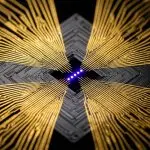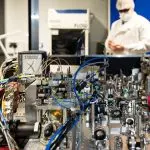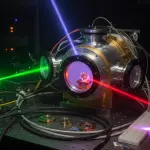
Aegiq’s Artemis photonic quantum computer, deployed at the UK’s National Quantum Computing Centre, is the first to integrate NVIDIA Ising AI models directly into its calibration workflow. This implementation has yielded a threefold reduction in weekly engineering time, allowing Aegiq’s specialists to focus on development and enabling calibration by those without specialist expertise, the company says.
The NVIDIA Ising model automatically balances brightness, purity and indistinguishability, key performance metrics that previously demanded expert attention. “With this first deployment, we have shown the power of AI enhanced calibration to streamline workflows and deliver the high performance that Aegiq’s quantum computers target.”
NVIDIA Ising AI Streamlines Artemis Quantum Computer Calibration
Aegiq’s Artemis photonic quantum computer now uses artificial intelligence to refine its single photon source performance, automatically assessing brightness, purity and indistinguishability. This automated approach represents a shift from manual calibration, which previously demanded significant engineering time and limited system uptime. The NVIDIA Ising Calibration Vision-Language Model (VLM) operates locally on an NVIDIA DGX Spark, enabling the low-latency inference necessary for real-time control of the quantum computer.
Aegiq hosts the VLM and employs an agent-based architecture, with dedicated agents orchestrating experiments and enforcing parameter constraints on the hardware, according to the company. The integration of AI-driven calibration is designed to increase stability and uptime for customers, while also preparing the system for future fault-tolerant quantum computers Aegiq is developing. Beyond calibration, Aegiq is also exploring NVIDIA Ising decoding for quantum error correction, using the AI’s capabilities within their QGATE architecture.
Aegiq’s Agent-Based Calibration Uses Natural Language Prompts
The VLM’s existing training across multiple quantum computing modalities allowed for immediate application to Aegiq’s specific calibration tasks without requiring further specialized training. Users interact with the system through natural language prompts, providing intuitive instructions to the agents.
These prompts direct the agents to perform specific tasks, such as “Check the performance of the single photon source,” or “Find the values of the laser power, wavelength and source bias which achieve the best balance of performance metrics.” The agent then autonomously develops a calibration plan, iteratively executing steps, analysing results and adapting its approach to optimise performance.
The system also accepts prompts like “Perform a targeted sweep around the current hardware settings to find potential improvements to the source performance,” demonstrating a flexibility beyond simple parameter setting. When deployed on the Artemis system at the NQCC, the AI-driven calibration successfully achieved target performance metrics for the first-generation quantum computer. The company is also applying NVIDIA Ising decoding to quantum error correction, further integrating the technology into its QGATE architecture and preparing for scaling up calibration to future fault-tolerant quantum computers.
This dual application of NVIDIA Ising highlights a broader strategy to improve scalable photonic quantum computing, the company says. The company’s approach involves redesigning calibration routines and workflows around the AI-enhanced paradigm, with the goal of achieving new performance metrics and scaling up calibration processes.