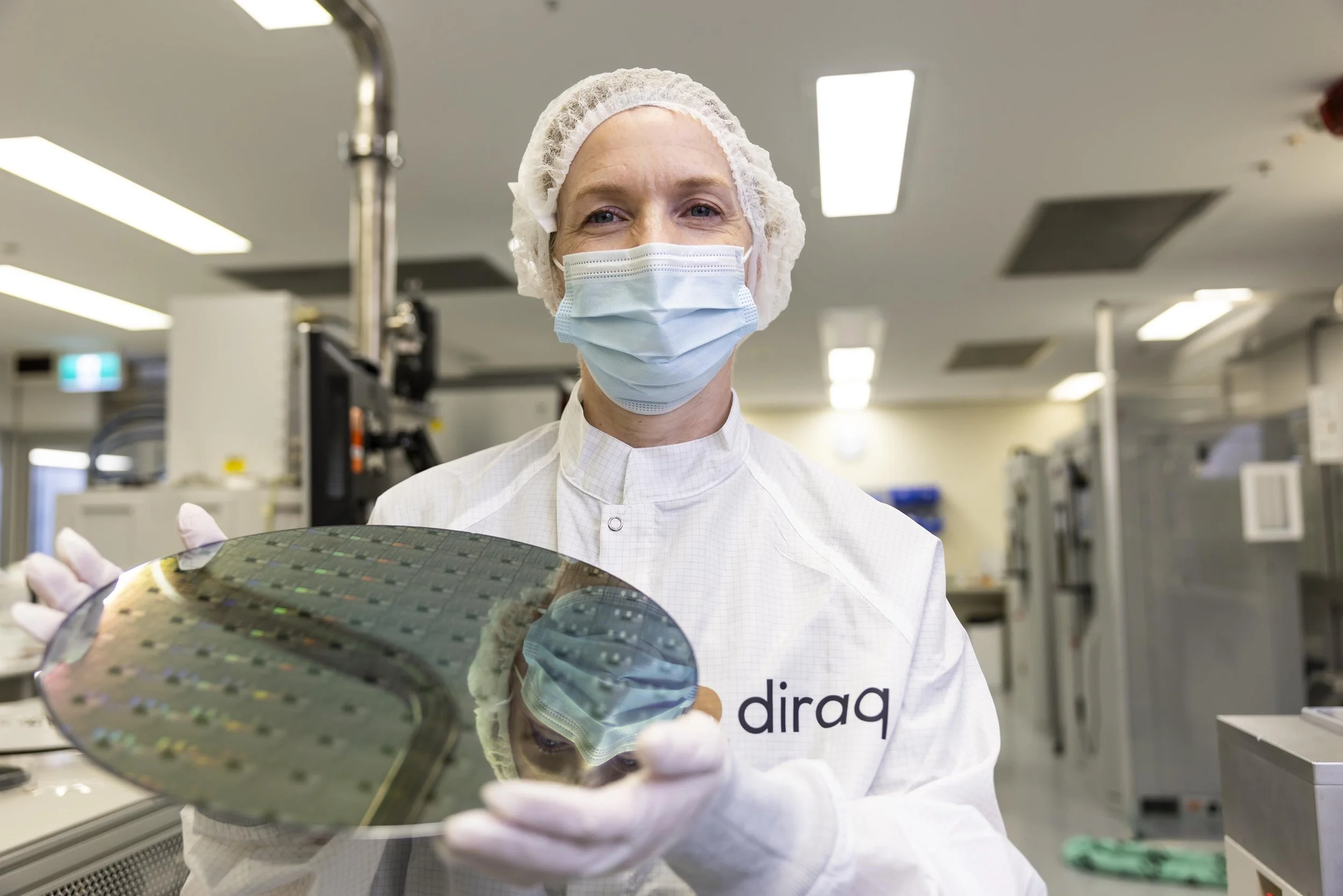
The U.S. Department of Commerce will provide Diraq with $38 million in research and development funding to advance silicon-based quantum computing. This award, stemming from the CHIPS and Science Act, will accelerate the development of U.S. infrastructure for manufacturing and testing quantum processor chips using Diraq’s silicon spin qubit technology.
“Quantum computing will be a core technology of the next decade, and we need to be ready to deploy it at a truly commercial scale to see the maximum benefit,” said Andrew Dzurak, Founder and CEO of Diraq. The funding supports Diraq’s strategy of combining Australian scientific expertise with expanded research, development, and manufacturing capabilities in the United States.
CHIPS Act Funding Accelerates Silicon Quantum Chip Production
Diraq aims to achieve a system with 150,000 physical qubits by 2029, a target now bolstered by a $38 million research and development award from the U.S. Department of Commerce. The company intends to follow this with a system exceeding 2 million physical qubits by 2031, enabling over 10,000 logical qubits for complex calculations, Diraq says. The award recognizes Diraq’s unique approach to qubit fabrication, using silicon spin technology compatible with existing semiconductor manufacturing processes.
Unlike some quantum modalities requiring expansive infrastructure, reaching the size of a football field, Diraq’s compact quantum computers currently fit within the footprint of four standard server racks. This scalability is important because the company anticipates the need for multiple quantum computers, each with millions of qubits, to address diverse industry challenges in fields like pharmaceuticals, agriculture and energy. The company’s technology is designed to integrate with existing classical computing infrastructure, such as GPUs and CPUs, recognizing that different computing architectures excel at different aspects of complex problem-solving.
Diraq’s recent expansion across the United States, with new operations established in Palo Alto, Chicago, Los Angeles and Albuquerque, highlights its commitment to building a trans-Pacific footprint. This strategic positioning allows the company to use both Australian scientific expertise and U.S, according to Diraq. semiconductor manufacturing capabilities.
“This funding from the U.S. This deployment, coupled with its selection for Stage C of DARPA’s Quantum Benchmarking Initiative, demonstrates momentum toward achieving utility-scale operation by 2033. The DARPA initiative represents the most rigorous evaluation program for quantum computing approaches, further validating Diraq’s technology. With a team of over 130 members globally, Diraq is actively creating a path toward powerful and economical quantum computing at scale, aiming to deliver breakthroughs across multiple industries.
Quantum computing will be a core technology of the next decade, and we need to be ready to deploy it at a truly commercial scale to see the maximum benefit.
Andrew Dzurak, Founder and CEO of Diraq

See today’s quantum computing news on Quantum Zeitgeist for the latest breakthroughs in qubits, hardware, algorithms, and industry deals.