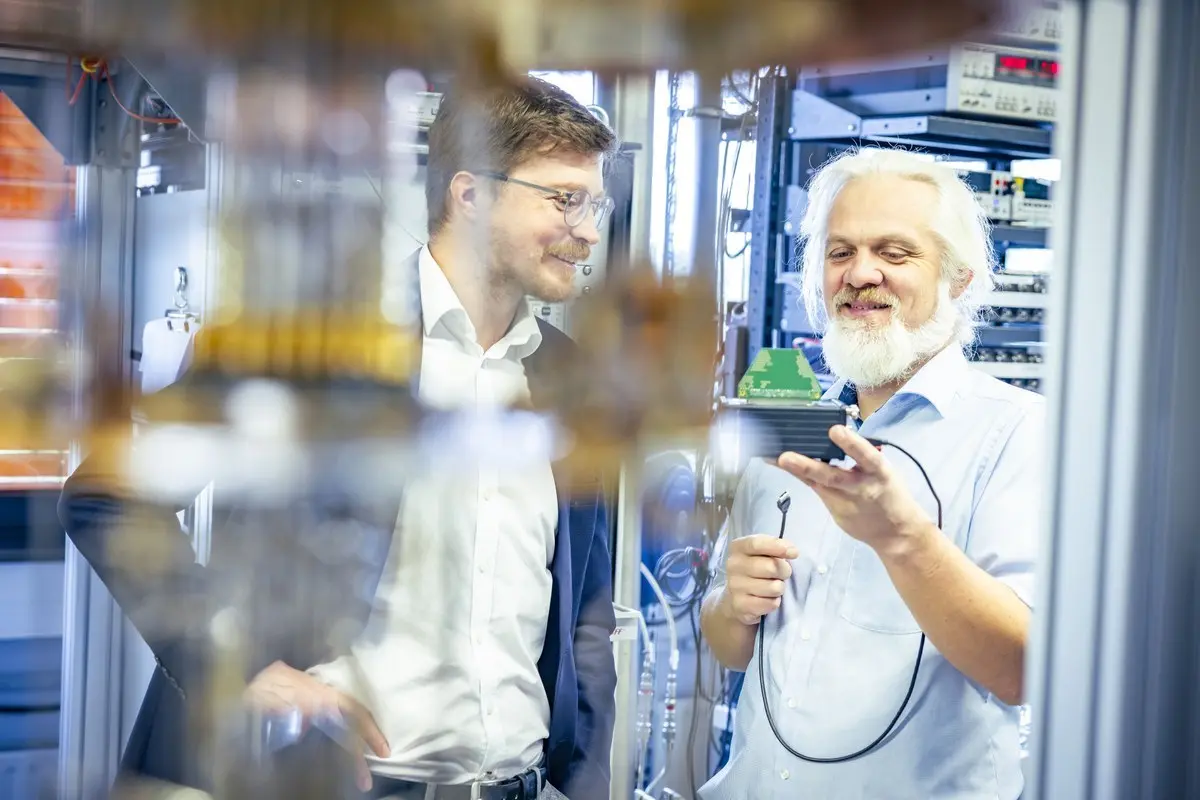
Forschungszentrum Jülich and its spin-off, ARQUE Systems, will scale quantum chip technology with a 35 million euro investment. As part of the € 35 million Q-STAR.NRW project, their approach will now be tested with up to 200 qubits, helping to stimulate value creation in the Rhenish mining area. ARQUE Systems’ technology aims to eventually pack more than ten million qubits onto a chip the size of a thumbnail.
ARQUE Systems’ Semiconductor Approach Enables Scalable Qubit Integration
ARQUE Systems’ technology uses existing semiconductor manufacturing processes, a departure from many quantum computing efforts reliant on novel materials and fabrication techniques. The company, a spin-off from Forschungszentrum Jülich and RWTH Aachen University, recently demonstrated the feasibility of its approach by integrating a five-qubit quantum computer into the Jülich UNified Infrastructure for Quantum Computing (JUNIQ), ARQUE Systems says. This initial demonstration cleared the way for the Q-STAR.

NRW project, a €35 million initiative designed to scale the technology to a 200-qubit system and stimulate economic growth in the Rhenish mining area. The core innovation lies in the combination of established semiconductor miniaturization with a patented method for transporting quantum information. Qubits are constructed from the spin of individual electrons within silicon and silicon-germanium structures, offering rapid switching speeds and compatibility with existing semiconductor industry standards.
This compatibility allows for the potential integration of very large numbers of qubits onto a single chip, a significant advantage over approaches requiring entirely new manufacturing infrastructure. Dr. Markus Beckers, CEO of ARQUE Systems GmbH, explains that Q-STAR. NRW is “about much more than building a single quantum computer,” emphasizing a broader goal of establishing scalable, semiconductor-based quantum computing within North Rhine-Westphalia. Beyond hardware development, the Q-STAR.
NRW project encompasses software, hybrid quantum algorithms, and user support services. According to Forschungszentrum Jülich, integrating this technology into JUNIQ will extend its impact beyond the research facility, positioning North Rhine-Westphalia as a leading technology hub. The project’s success will depend on translating these scientific findings into technological innovations, a process that Forschungszentrum Jülich is uniquely positioned to facilitate through its research infrastructure and industry partnerships.
Q-STAR.NRW Project Funds 200-Qubit Quantum Computer Development
The Q-STAR.NRW project will extend the impact of Jülich’s JUNIQ infrastructure by scaling quantum chip technology to a 200-qubit system. This expansion focuses on establishing a complete quantum computing ecosystem within North Rhine-Westphalia, encompassing hardware development, software creation and user support services for both research and industrial applications. The project’s funding structure allocates 90 percent from federal sources under the Coal Regions Investment Act, with the remaining 10 percent provided by the State of North Rhine-Westphalia, demonstrating a strong commitment to regional economic development. The project will run until the end of 2029.
Mobile Qubits & Shuttling Technology Simplify Control Architecture
Allowing for the controlled transport of electrons and their quantum information across a chip, a patented shuttling process developed by ARQUE Systems is driving a shift in the architecture of quantum control. This innovation bypasses the need for permanent, adjacent qubit arrangements traditionally required for coupling, a significant simplification in quantum chip design. Instead of individual signal lines for each qubit, electrons are moved to designated locations for interaction and quantum operations, reducing complexity and clearing the way for larger qubit counts.
This mobility addresses a core challenge in scaling quantum computers, as it diminishes the demand for extensive wiring and individual qubit control. The shuttling process enables a simplified control architecture, reducing the number of control lines needed to operate the system, a critical factor in building more complex and powerful quantum processors.
Forschungszentrum Jülich believes this combination of shuttling technology, semiconductor expertise, quantum computing, and supercomputing creates an exceptional opportunity to develop a truly scalable technology platform, according to ARQUE Systems. ARQUE Systems, founded in 2022 by Dr. Markus Beckers and Prof. Bluhm, previously conducted research at Stanford and Harvard universities, amongst others.
JUNIQ Integration Connects Quantum Computing with HPC Infrastructure
This integration is central to the Q-STAR. NRW project, which will allow scientists and industry users to develop and test applications under real-world conditions. The JSC’s existing infrastructure provides the necessary environment for these users to translate their work into practical industrial applications, extending the impact of quantum computing beyond the laboratory, the company says. The core of this integration relies on ARQUE Systems’ patented technology, which uses existing semiconductor manufacturing processes to build quantum chips.
The team intends to demonstrate that this technology can be integrated into a world-leading computing infrastructure. This comprehensive approach aims to address the challenges of translating quantum computing potential into tangible results.
Researchers are also developing services for user training, ensuring that the infrastructure is accessible and usable by a wider range of scientists and engineers. The project’s success hinges on the ability to connect quantum processors with classical high-performance computers, allowing for the execution of hybrid algorithms that leverage the strengths of both computing paradigms. This connection, facilitated by JUNIQ, will enable researchers to tackle complex problems that are beyond the reach of either type of computer alone.



See today’s quantum computing news on Quantum Zeitgeist for the latest breakthroughs in qubits, hardware, algorithms, and industry deals.