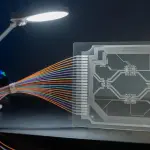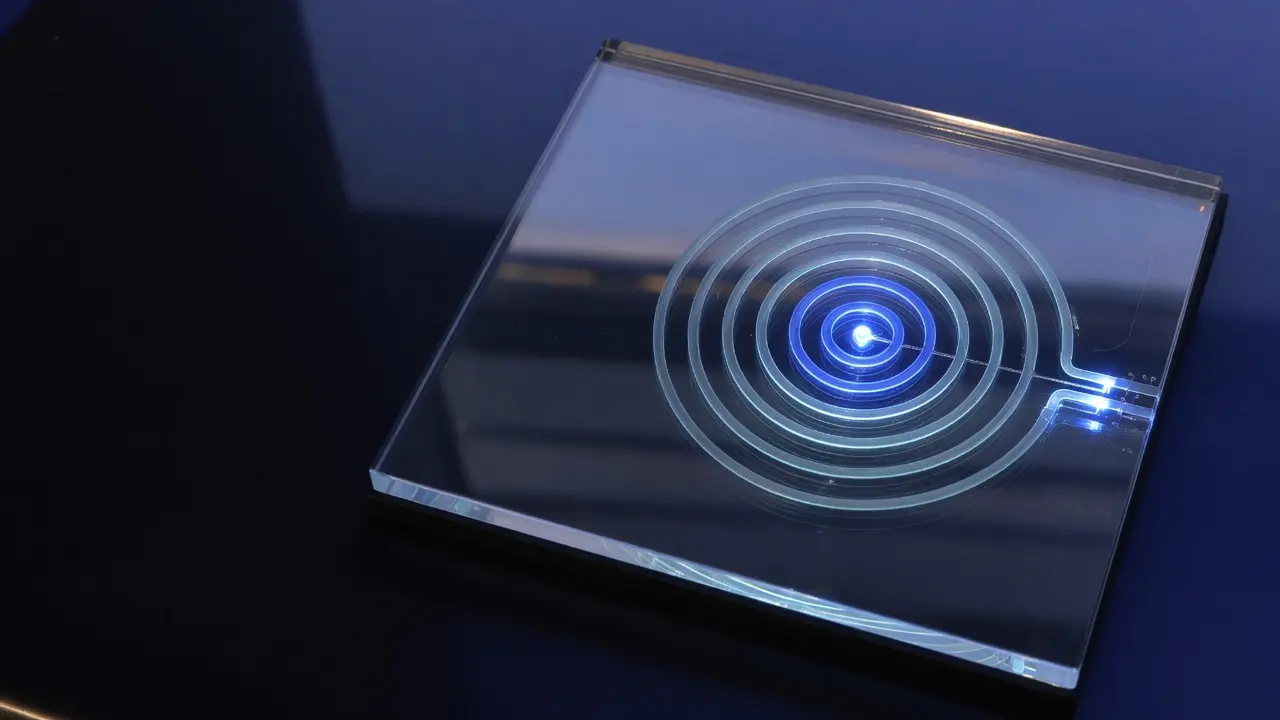
A new architecture for a photonic quantum computer developed by researchers at Sapienza Università di Roma and Gran Sasso Science Institute relies on a loop-based structure, significantly reducing the number of physical components needed for its construction. This modular design aims to address a key challenge in building practical universal quantum computers, offering increased flexibility and scalability compared to other approaches.
The work proves the architecture is universal, deterministic and compatible with standard quantum circuits, and demonstrates its function through numerical simulation. Researchers used machine learning techniques to design building blocks from linear and nonlinear optical components.
Looping Architecture Reduces Component Count for Photonic Quantum Chips
The Modular and Looping Quantum Photonic Processing Unit (ML-QPPU) distinguishes itself through a design that minimizes physical component count, a critical factor in scaling photonic quantum computers. The team’s work demonstrates a pathway toward building more compact and potentially more practical quantum systems by streamlining the hardware requirements. A key feature of the ML-QPPU is its modularity, providing both flexibility and scalability for future development.
This design choice allows for easier integration of new components and adaptation to evolving quantum algorithms. The architecture’s compatibility with the standard quantum circuital model ensures that existing quantum software can be readily implemented, easing the transition from theoretical designs to physical realization. Researchers highlight the system’s ability to perform reprogrammable operations and adaptive measurements, further broadening its potential applications. Recent advances in photon-photon nonlinearities have informed the development of this architecture, though challenges remain in precise optical delay management.
The looping structure, while beneficial for component reduction, introduces a heightened sensitivity to mismatches in optical path length, demanding careful calibration and potentially tunable delays. The authors note the need for continued refinement of nonlinear optical components and control systems. The ML-QPPU uses these components to facilitate photon-photon interactions, a fundamental requirement for quantum computation. The design allows for encoding quantum information in multiple degrees of freedom, including time-bin, dual-rail, polarization, orbital angular momentum and frequency, offering versatility in how quantum bits, or qubits, are represented and manipulated.
This flexibility is a significant benefit, as different encoding schemes may be better suited for specific quantum algorithms or hardware constraints. The team’s simulations demonstrate the functionality of the architecture.
Photonic Quantum Computing: Progress Towards Universal Computation
This approach contrasts with architectures relying on extensive, linear arrangements of optical elements, potentially offering a pathway to more scalable quantum processors. The design’s core innovation lies in its ability to reduce the number of components needed to implement complex quantum circuits, a critical factor in transitioning from theoretical designs to practical devices. While other approaches attempt to mimic these nonlinearities using only linear optics, such as the KLM protocol, this method introduces resource overhead.
This new design instead directly implements nonlinear interactions, potentially streamlining the process and reducing the overall complexity of the system. This compatibility is a significant advantage, as it avoids the need to rewrite algorithms or develop entirely new programming languages. “Among the different platforms for the implementation of universal quantum computing, photonic systems present some peculiarities,” the authors write, highlighting the potential of this platform.
Sycamore and IBM Eagle: Quantum Advantage with Superconducting Processors
Recent demonstrations of quantum advantage using superconducting processors like Sycamore Eagle systems highlight increasing capabilities in the field, but photonic approaches offer distinct architectural possibilities. The 127-qubit Eagle processor recently measured expectation values exceeding the capacity of classical computation, while also implementing adaptive, mid-circuit measurements on up to 100 qubits. Such quantum advantage has also been tackled with photonic platforms. In particular, two optical quantum devices have reached significant size levels, the Jiuzhang and the Borealis systems.
This design enables full connectivity between all modes without requiring swap operations, a common necessity in some superconducting architectures, potentially streamlining quantum calculations. The arrangement ensures photon synchronization throughout multiple layers with a propagation time calculated as Nτ + (N-1)ε, where N represents the number of layers and *ε* is a time constant. This synchronization is critical for maintaining quantum coherence during complex computations.
Jiuzhang and Borealis: Gaussian Boson Sampling for Early Quantum Advantage
Demonstrating early quantum advantage through Gaussian Boson Sampling, the architectures behind the Jiuzhang and Borealis systems represent a distinct approach from designs prioritizing universal quantum computation. These photonic devices, achieving significant scale, are inherently limited in the types of calculations they can perform, serving as a stepping stone rather than a complete solution. The focus on reaching a quantum advantage regime with dedicated, non-universal hardware has driven innovation in photonic platforms, but the ultimate goal remains a large-scale, universal quantum computer.
A key challenge in building such a computer lies in implementing photon-photon interactions, a fundamental requirement for two-qubit gates and universal computation. While some architectures rely solely on linear optical components, restricting computational models, others explore probabilistic gate implementation with linear optics. Recent developments emphasize modularity, scalability and fault tolerance as core elements for achieving practical quantum advantage, with studies focused on integrating multiple optical elements onto single chips.
This integration allows for mass production of these optical architectures, addressing a critical engineering hurdle. Researchers are now exploring designs that move beyond simply scaling existing architectures, with a new emphasis on reducing the physical component count. The proposed architecture relies on a loop-based structure, a departure from architectures requiring extensive linear arrangements of optical elements.
Encoding Quantum Information in Photonic Systems
A key feature of this architecture is its loop-based structure, which contrasts with linear arrangements of optical elements often seen in other designs. This innovative structure allows for the implementation of necessary photon-photon interactions, essential for two-qubit gates, with a reduced number of nonlinear components. The design’s modularity further enhances flexibility and scalability, enabling a high degree of adaptability in constructing and expanding the quantum processor.
The development of this architecture addresses a fundamental challenge in photonic quantum computing: implementing the interactions between photons required for universal computation. The architecture’s theoretical capability to function as a universal quantum computer, while maintaining a reduced component count, positions it as a promising pathway toward building more practical and scalable photonic quantum processors.
KLM Protocol and Cluster States: Approaches to Linear Optical Quantum Computing
Beyond component count, loss mitigation remains a critical challenge for photonic quantum computing, as any photon lost during processing introduces errors. The architecture’s modularity offers a potential avenue for addressing this issue, allowing for targeted error correction and component redundancy. Alternative approaches to achieving deterministic quantum computing, such as measurement-based quantum computation, rely on creating highly entangled cluster states, shifting the difficulty from implementing nonlinear gates to preparing these complex resources.
The Sycamore quantum processor originally reached a size to solve the random circuit sampling problem, and more recently they showed that the 105 qubit Willow processor reached an error rate lower than the threshold needed to implement quantum error correction via specific surface codes. The development of optical architectures using nonlinearities to achieve photon-photon interactions represents a growing area of interest, potentially offering a route to more efficient and compact quantum processors.
Nonlinear Optical Components Enable Deterministic Quantum Gates
This approach allowed for the creation of specific components tailored to the architecture’s requirements, demonstrating a novel application of machine learning beyond data analysis and into the realm of physical component design. This contrasts with other photonic quantum computer architectures, potentially streamlining construction and reducing the complexity of scaling up the system. The architecture’s modularity allows for flexibility and scalability, addressing a significant challenge in building practical quantum computers.
The obtained results highlight both the benefits and drawbacks of this proposed architecture, providing a roadmap for future physical implementation efforts. Deterministic quantum gates are enabled through the use of nonlinear optical components, facilitating photon-photon interactions without relying on probabilistic or measurement-based gates. “Using optical nonlinearities allows for the creation of deterministic universal optical quantum computers that do not rely on probabilistic gates or on measurement based gates,” the authors write, emphasizing a departure from architectures that depend on chance outcomes.
While realizing these nonlinearities presents challenges, recent advancements in the field suggest increasing feasibility. This architecture represents one approach among several currently being explored, each with its own set of strengths and weaknesses as scientists address the hurdles of optical quantum computation.
Modular Design and Scalability for Future Quantum Architectures
A reduction in physical component count distinguishes this photonic quantum computer architecture; the design’s loop-based structure minimizes the number of elements needed for experimental realization, a departure from other approaches. This architecture, developed by researchers, allows for flexibility in scaling and adapting to technological advances, a critical feature for practical quantum computation. The team’s work demonstrates a path toward building a quantum processor with fewer physical parts without sacrificing universality or deterministic operation.
The architecture encodes qubits using single-photon states in a dual-rail system, where logical states |0⟩ and |1⟩ correspond to a single photon’s presence in distinct spatial modes. This requires single-photon sources capable of generating indistinguishable states. This approach allows for connection with the quantum circuital model, potentially using existing optimizations and algorithms developed for that framework. The modular design facilitates the introduction of improvements as technology evolves, offering a long-term advantage over static architectures.
The team illustrated how component numbers and losses scale with computation size, providing insight into the architecture’s limitations and potential. The overall time length of a CNOT layer within the architecture is defined as Nτ + (N-1)ε, where N represents a variable parameter and τ and ε are time-related constants. This precise calculation highlights the attention to timing and synchronization important for reliable quantum gate operation.
The ability to connect quantum optical computation with the established quantum circuital model is a key benefit, allowing the photonic platform to benefit from decades of algorithmic development. “Furthermore, we have illustrated how the losses and the number of components scale with the size of the computation,” the researchers write, emphasizing the scalability analysis performed. The modularity also allows for high flexibility, given that future improvements to the design can be readily introduced following technological advances.
👉 More information
🗞 Modular and Looping Quantum Photonic Processing Unit for Quantum Computing
✍️ Denis Stanev, Nicolò Spagnolo and Fabio Sciarrino (Dipartimento di Fisica, Sapienza Università di Roma, Piazzale Aldo Moro 5, I-00185 Roma, Italy)
🧠 ArXiv: https://arxiv.org/abs/2611.12126v1


See today’s quantum computing news on Quantum Zeitgeist for the latest breakthroughs in qubits, hardware, algorithms, and industry deals.